How to Choose the Right Gear Motor for Packaging Machines
Practical selection guide for choosing a right-angle AC gear motor for packaging machines — covering speed, torque, frame size, duty cycle and voltage.
আরও পড়ুন
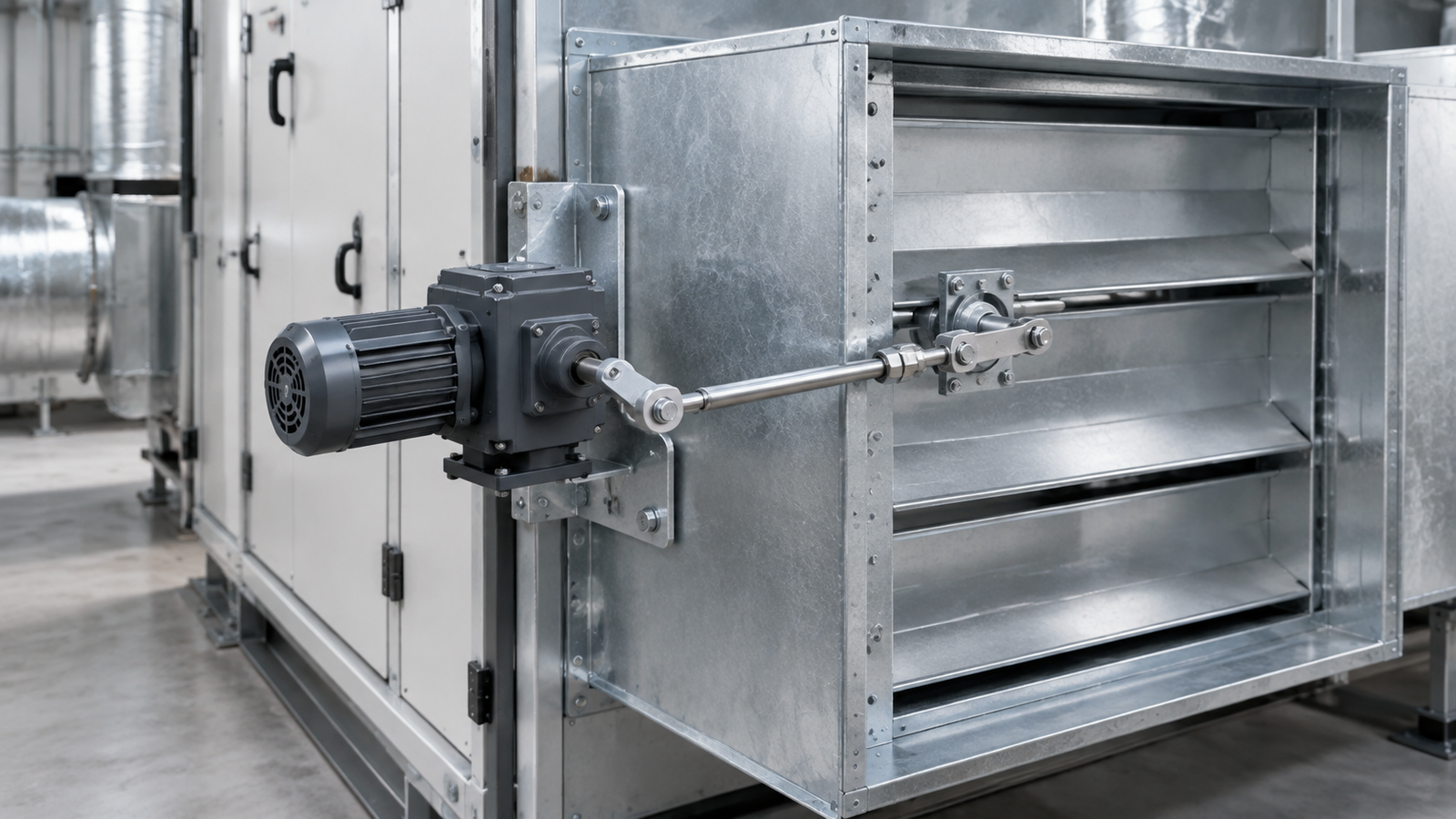
Most drives inside HVAC equipment have one of two jobs: turn a damper blade through 90 degrees and hold it against duct static pressure, or rotate a small fan slowly and continuously. Both are torque problems rather than speed problems, and both are usually solved with a compact gear motor for HVAC duty in a right-angle frame instead of a general-purpose motor plus a separate reducer. This guide covers the sizing logic for air handling units, VAV boxes, unit heaters and cooling tower fan drives.
Quick answer: start with required output torque in N·m — blade area multiplied by duct static pressure, adjusted for linkage geometry and a safety margin — then pick the gear ratio that produces the travel time you need. A 25 W right-angle AC gear motor covers roughly 0.45–7.84 N·m of allowable load at 5–500 r/min, enough for zone dampers, small VAV boxes and light fan drives. Above that, move to the 40–140 W and 120–300 W right-angle frames.
HVAC is a broad label, and the drive requirements inside it differ enormously. It helps to separate duties by how the load behaves rather than by equipment name.
All of these need low output speed and moderate torque from a small package — the operating window of a right-angle AC gear reducer motor, where the gearbox turns the output shaft 90 degrees from the motor axis so the motor sits parallel to the driven shaft.
Damper sizing is the most common HVAC drive calculation and the one where oversizing and undersizing happen most often. Three numbers decide the outcome.
Required torque is driven by the pressure differential across the blade and the area over which it acts, plus friction in the blade bearings and linkage. A large blade in a high-static-pressure main duct needs far more torque than a small terminal-unit blade in a low-pressure branch, and the linkage often works at a mechanical disadvantage because the actuator arm and blade arm differ in length. Calculate blade torque from area and pressure, multiply by the linkage ratio, then add roughly 25–50% for bearing friction, seal drag and dust accumulation. The result is the torque the gearbox must deliver at the speed the blade actually moves, not the motor’s rated torque.
Dampers are specified by travel time rather than r/min, because a 90-degree stroke takes the same time however you describe it. Commercial damper actuators are commonly specified at 60–150 seconds for full stroke, which for a quarter-turn output is roughly 3–10 r/min at the gearbox shaft. A 4-pole AC induction motor runs at about 1250–1550 r/min at 50/60 Hz, so a damper drive needs a reduction in the region of 100:1 to 300:1. A gear motor removes the coupling, bracket and alignment step that a separate reducer would add to the assembly.
Once the blade reaches position, the drive must resist the pressure pushing it back. High-ratio reductions add meaningful back-driving resistance, but that is a resistance rather than a guarantee. Where the sequence requires the damper to close on power loss, specify a spring-return mechanism or fail-safe linkage instead of relying on the gearbox.
Fan duty behaves differently from damper duty: a damper sees a static load and long idle periods, a fan sees continuous rotation and a starting surge. Three points change the selection.
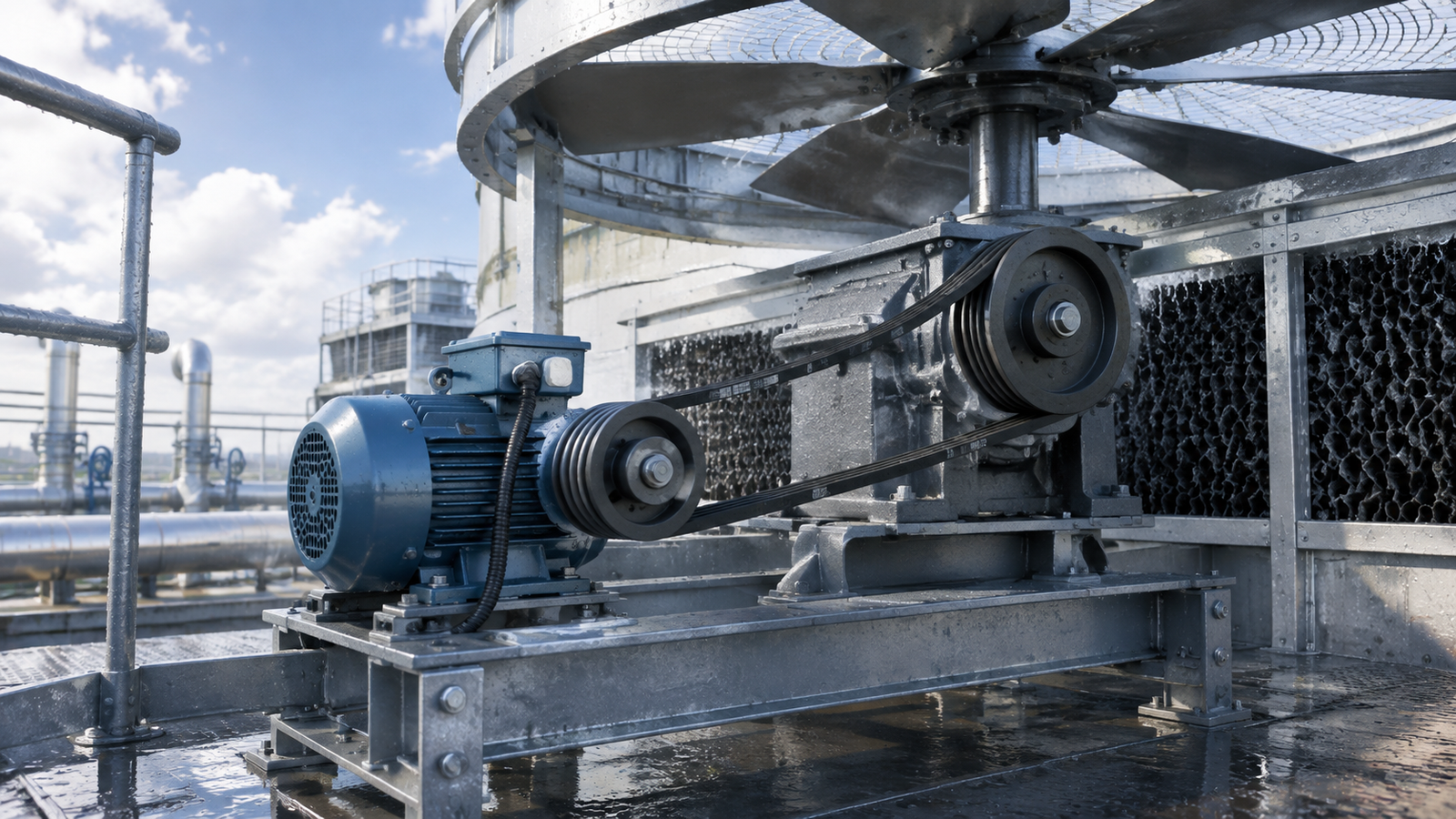
On a fan coil or unit heater, a 25 W right-angle frame is usually enough. On a cooling tower or large exhaust fan the torque moves into the range where a 40–140 W or 120–300 W right-angle frame is the realistic starting point, with the motor mounted outside the wet air stream and belt reduction into the fan shaft.
Treat the figures below as scoping ranges to start the conversation, not final selections. The allowable load table for the specific frame confirms the choice.
| HVAC duty | Typical output torque | Typical output speed | Starting frame |
|---|---|---|---|
| Zone or VAV box damper | 1–3 N·m | 3–10 r/min | 25 W right-angle |
| Main duct / AHU damper | 5–15 N·m | 3–8 r/min | 40–140 W right-angle |
| Fan coil or unit heater fan | 1–4 N·m | 20–100 r/min | 25 W right-angle |
| Cooling tower / exhaust fan (belt drive) | 10–20 N·m | 10–40 r/min | 120–300 W right-angle |
| Hydronic valve actuator (quarter-turn) | 3–10 N·m | 3–10 r/min | 25–140 W right-angle |
Two parameters deserve a second look. Output speed is not free: every step of reduction that lowers speed also raises available torque, so the two are chosen together. And the allowable load published for a gear motor applies at a specific output speed — a frame that carries 7.84 N·m at 5 r/min carries much less at 500 r/min. Reading the gear motor size chart at the wrong speed is the most common cause of a drive that works on the bench and stalls on the duct.
For the compact end of HVAC work, the 4GN 25 W right-angle gear reducer motor is a useful reference point because its published limits map cleanly onto real damper and light fan duties.
The 110 V single-phase option matters in retrofit work, where a rooftop unit or terminal box is fed from a legacy supply and pulling a new three-phase circuit is not practical.
When the load moves beyond what that frame can carry, the same right-angle family scales up. The 5GU 40–140 W right-angle motor covers larger AHU dampers and heavier fan drives with a 90 mm frame and ratios extending to 500:1. For cooling tower and large exhaust fan duties, the 6GU 120–300 W right-angle motor is the next step up. Staying inside the family keeps the mounting style and geometry consistent across a product line that spans several equipment sizes.
Mounting hardware. A gear motor driving a damper through a linkage produces a reaction torque that has to go somewhere. A torque arm, a correctly sized flange and a flexible coupling protect the gearbox output bearing from loads it was never designed to carry; the gear motor accessories guide covers how these parts are matched to a frame size.
Duty cycle. Damper positioning is intermittent, and a reversible 30-minute rated motor handles it comfortably. Fan rotation is continuous, and the same motor will run hot and fail early. Match the duty rating to the duty, and step up a frame where the two disagree.
Ambient and ingress. A standard industrial gear motor suits a dry plant room but is not a washdown or weatherproof unit, so it should not be mounted where it takes direct spray or sustained condensation. On cooling towers that means belt reduction into the fan shaft with the motor outside the air stream. For a first-time calculation, the practical gear motor selection guide walks through the same torque, speed and ratio sequence with worked examples.
| Mistake | What happens | What to do instead |
|---|---|---|
| Sizing on motor rated torque instead of allowable load | The gearbox is overloaded and gear teeth wear or strip | Read the allowable load table at your actual output speed |
| Ignoring linkage and bearing friction | The blade stalls part-way through its stroke | Add a 25–50% margin over calculated blade torque |
| Using a 30-minute rated motor on a continuously running fan | The motor overheats and service life drops sharply | Step up a frame or specify a continuous-duty unit |
| Choosing output speed before torque | The drive package has to be reworked after the first test | Fix torque and ratio first, then confirm travel time |
| Assuming the gearbox holds position on power loss | The damper drifts out of position when the supply drops | Use a spring-return or fail-safe mechanism where required |
| Mounting a standard motor in a wet tower area | Moisture ingress, corrosion and premature failure | Move the motor out of the air stream and use belt reduction |
HVAC gear motor selection comes down to four numbers: required output torque, required output speed, duty cycle and ambient. Get torque from blade area, static pressure and linkage geometry with a margin on top; get speed from the travel time the control sequence needs; then check that the allowable load at that speed sits inside the chosen frame. Most zone dampers, small VAV boxes and light fan drives are covered by a 25 W right-angle frame; larger duct dampers and cooling tower fans move into the 40–140 W and 120–300 W frames.
If you would rather not work through the ratio and allowable-load tables yourself, send over the damper size, duct static pressure, target travel time and supply voltage, and the team at Tenchuan can match a right-angle gear motor to the duty and confirm the frame against the published load data.
It depends on blade area, duct static pressure and linkage geometry rather than on equipment name. Small zone and VAV dampers typically need 1–3 N·m and suit a 25 W right-angle frame. Main duct and AHU dampers commonly need 5–15 N·m, which moves the selection into the 40–140 W range.
Usually not. A 25 W right-angle frame reaches about 7.84 N·m of maximum allowable output load at its slowest ratios — enough for small and medium dampers, but short of what a large blade in a high-static-pressure duct needs.
Work backwards from travel time. A 90-degree stroke in 60–150 seconds corresponds to roughly 3–10 r/min at the gearbox output, which means a reduction ratio near 100:1 to 300:1 for a 50/60 Hz motor.
High-ratio gear trains resist back-driving, which helps a damper stay put, but that resistance is not a certified holding function. Where fail-safe operation is required, use a spring-return mechanism or fail-safe linkage.
A standard industrial gear motor is intended for dry indoor conditions and is not a washdown or weatherproof product. In tower service, mount it outside the wet air stream with belt reduction into the fan shaft, and confirm the ingress protection level the installation needs.
Not the same unit you would use for damper positioning. Reversible 30-minute rated models are built for intermittent duty. For continuous rotation, step up a frame size or select a continuous duty rating.