AC Gear Motor Overheating: 6 Causes and How to Fix Them
A hot gear motor is a symptom. Six causes that explain almost every overheating complaint, the temperature numbers that define too hot, and a ten-minute diagnostic.
আরও পড়ুন
If you are sourcing a ছোট এসি গিয়ার রিডাক্সার মোটর for a Malaysian machine build, the enquiry almost always comes down to four things: can the unit survive 240 V, what does it actually cost landed, how long until it reaches Port Klang, and who answers the phone in year three. Price lists are easy to find. A straight answer on the other three is not.
This guide is written for the OEM buyer, machine builder and maintenance engineer in Malaysia who is comparing a local distributor against a direct import from a Chinese gear motor supplier. It covers the voltage mismatch that quietly shortens motor life, the real cost structure behind a quotation, lead time by stage, the documents your forwarder will ask for, and the sizing points that matter at 50 Hz.
Four variables decide whether a gear motor is a good buy, and only one of them is the unit price:
This is the single most common technical gap in quotations sent to Malaysia. A motor nameplate reading “220 V / 380 V” was designed around a distribution system that Malaysia does not use. Malaysia’s low-voltage supply is 240 V phase-to-neutral and 415 V phase-to-phase at 50 Hz.
What happens in practice:
| Supply | Motor rated | Actual applied voltage | Effect |
|---|---|---|---|
| 240 V single-phase | 220 V | +9% | Core saturates slightly, magnetising current rises, winding runs hotter than the design point |
| 415 V three-phase | 380 V | +9% | Same effect, plus higher starting current and more stress on insulation |
| 240 V single-phase | 230/240 V | Within tolerance | Design point — correct choice |
An AC induction motor tolerates roughly ±10% voltage variation at rated frequency, so a 220 V motor on 240 V will run. It will also run a few degrees hotter, and the temperature rise is what shortens insulation life. If your duty is intermittent and the ambient is a comfortable 30 °C, you may never notice. If the motor sits inside an enclosure on a factory floor in Johor at 40 °C ambient and runs eight hours a day, the margin you just gave away is the margin you needed.
Two honest options. First, specify a 230/240 V winding — most Chinese gear motor factories including ours can wind to 240 V, it is a winding change rather than a new design. Second, if you accept the 220 V unit, derate the continuous load a little and keep the ambient under control. What you should not do is assume the nameplate does not matter.
Frequency is the other half of the question. At 50 Hz a motor rated 1500 r/min at 60 Hz turns at roughly 1250 r/min. Output torque rises proportionally, so power stays about the same, but your machine’s output speed will be 17% lower than the datasheet you sized from. If the machine was designed in a 60 Hz country, recheck the speeds on the গিয়ার মোটর আকারের চার্ট before you commit to a ratio.
Buyers often assume price scales with watts. It does not, not in the 15–300 W band that dominates Malaysian machine building. Price is driven by the frame, the gearbox stage count, and the options. A useful way to read a quotation is to break it into the five cost blocks below.
| Cost block | What moves it up | Where buyers overpay |
|---|---|---|
| Motor (frame + winding) | Frame size, copper mass, single vs three-phase, 240 V custom winding | Buying a bigger frame than the torque needs |
| Gearbox | Number of stages, ratio, gear material and heat treatment, output shaft and bearing size | Buying a high ratio when a smaller motor at a lower ratio would do |
| Electrical accessories | Capacitor and cover, terminal box vs lead wires, thermal protector, brake | Paying for a brake the machine does not need |
| Mechanical options | Right-angle output, hollow shaft, flange, custom shaft, IP upgrade | Specifying a flange before checking the foot pattern will not fit |
| Logistics and documentation | Carton volume, pallet count, Form E, testing reports | Small orders shipped in oversized cartons |
Gear ratio is the most misunderstood line item. Ratio does not add cost in a straight line — the third stage does. A 3:1 single-stage unit and a 100:1 three-stage unit at the same power are different products with different internal parts, and the price gap reflects the extra stage, not the number on the label. This is also why “just give me more reduction” is a bad way to ask for more torque: past a certain ratio the gearbox allowable load is already the ceiling, and more reduction buys nothing. The gear ratio calculation guide walks through that limit.
We do not publish a fixed price list, because a 25 W single-phase unit with a 50:1 ratio and a 300 W three-phase unit with a custom shaft are not comparable line items. What we will do is quote the configuration you specify and show you what changes if you drop an option, so you can see where the money is.
“Lead time” in a quotation usually means the wrong thing. Ask for it stage by stage.
| Stage | Typical duration | What you control |
|---|---|---|
| Technical confirmation (ratio, shaft, supply) | 1–3 working days | How complete your first enquiry is |
| Production — stock specification | 5–10 working days | Choosing a catalogue ratio instead of a custom one |
| Production — non-standard ratio, shaft or winding | 15–25 working days | Whether you can accept the nearest catalogue ratio |
| Testing and packing | 1–3 working days | Whether you need a test report per unit or per batch |
| Sea freight, South China to Port Klang | 7–12 days port to port | Which sailing you are booked on |
| Malaysian clearance and delivery | 3–7 working days | Having Form E and a complete document set ready before arrival |
Total from enquiry to your door for a stock specification is commonly three to five weeks. The two stages buyers most often lose time on are the first and the last: an incomplete enquiry that needs three rounds of clarification, and a document set that is incomplete when the vessel arrives.
Our published position on order quantities, sample units and the response we commit to is set out in the MOQ, lead time and sample policy. If you are placing a first order to validate a design, read that before you assume a 500-piece minimum.
A gear motor is a low-voltage industrial component, not a consumer appliance, and that difference decides which approvals apply. Be careful with advice that treats every electrical import as identical.
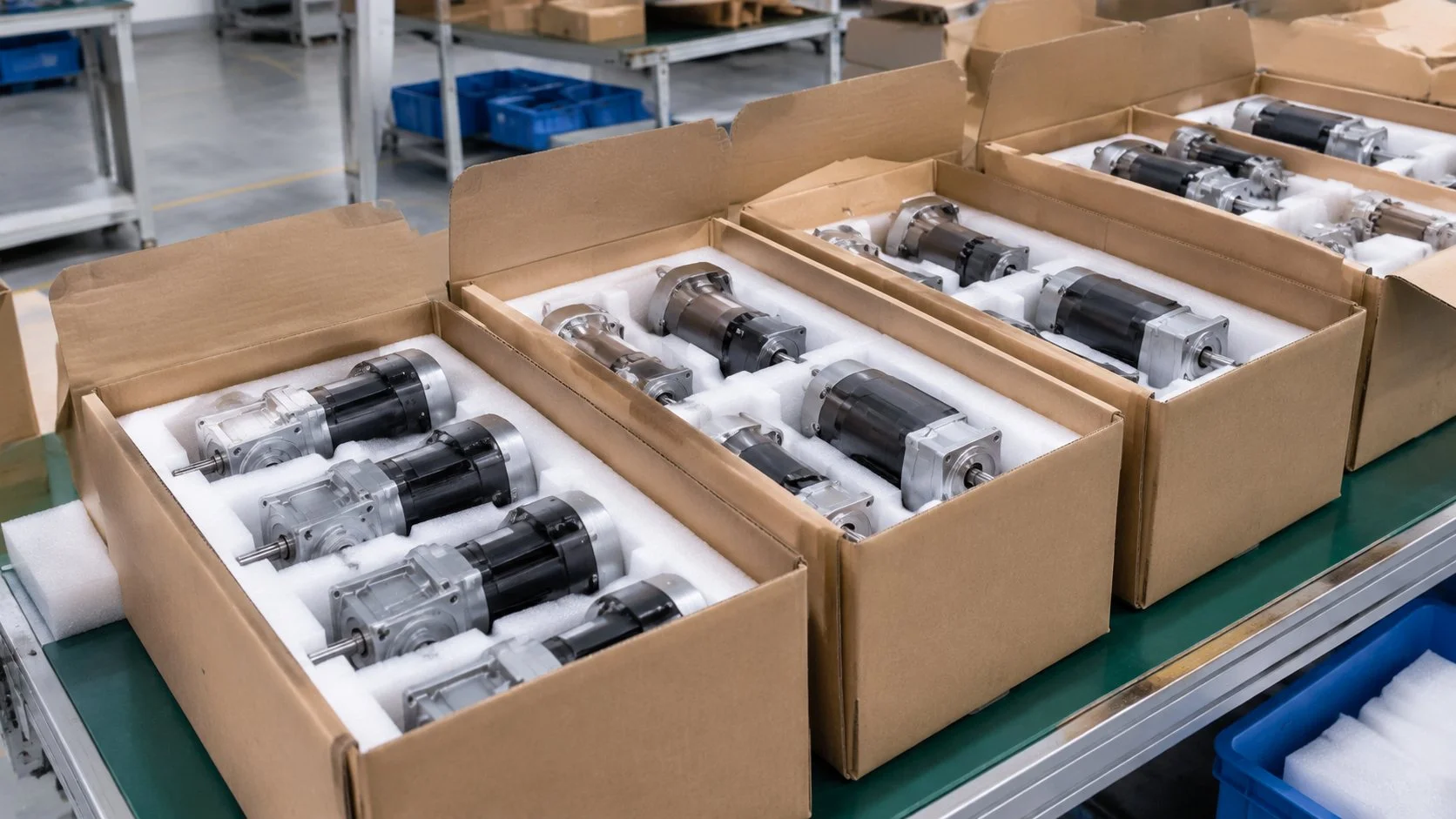
This is not a pitch for direct import. There are real cases where a Malaysian stockist is the better commercial decision.
| Situation | Better route | Why |
|---|---|---|
| Breakdown on a single production machine, need it this week | Local stockist | You are buying availability, not parts |
| Prototype build, one or two units, design still moving | Local stockist | Iteration speed beats unit price |
| Repeat OEM build, 50 units per quarter, specification frozen | Direct import | Removes distributor margin on a known, stable item |
| Non-standard ratio, shaft or 240 V winding | Direct import | Local stock is catalogue specification only |
| Application needs engineering support on sizing | Either — check the capability | Many stockists resell without application engineering |
The break-even point usually falls somewhere between 20 and 50 units per order, once you account for freight, clearance and the working capital tied up in a larger shipment. Below that, freight and handling dominate. Above it, the unit price difference compounds.
Three patterns come up repeatedly in enquiries from Malaysian machine builders.
Packaging and filling lines. The dominant frame is 60–120 W. A 90 W AC gear reducer motor at a 25:1 to 50:1 ratio covers most conveyor and sealing-station drives. Buyers frequently specify 300 W “for safety” and then find the gearbox is oversized for the mounting space.
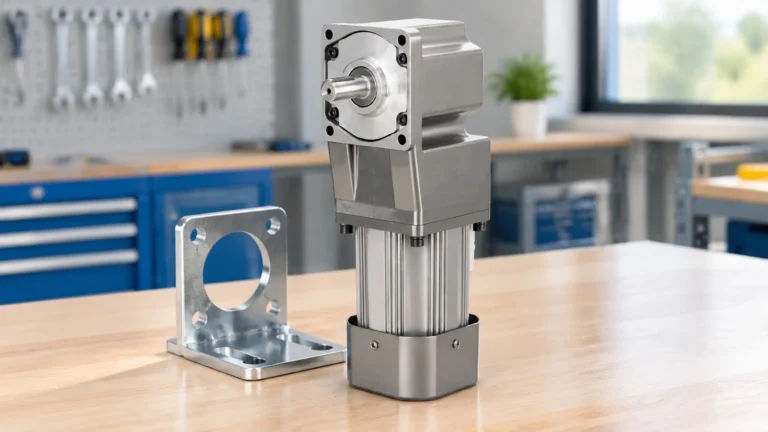
Right-angle mounting in confined frames. Where the motor cannot sit inline with the driven shaft, a right-angle unit removes the belt or chain. A 120–300 W right-angle gear reducer motor with a 90-degree output is the usual answer, and it is worth checking the frame height before assuming the parallel-shaft unit will fit.
Higher-torque conveying and small mixers. Going up to 300 W in the 100 mm frame is a different class of gearbox: allowable output load rises to a much higher ceiling than the 25 W frame, and the shaft grows to match. Do not size this by comparing wattages alone; compare the allowable load at your target output speed.
One more point that matters in Malaysia’s climate: ambient temperature and humidity. A standard totally enclosed fan-cooled motor is rated at 40 °C ambient. An enclosure that traps air, or a mounting position against a hot machine frame, can push the effective ambient well past that. If the drive lives in a sealed cabinet, treat the cabinet temperature as the ambient, not the room temperature.
| Mistake | Consequence | Fix |
|---|---|---|
| Ordering a 220/380 V motor for a 240/415 V supply without discussion | Runs hot, shorter insulation life | Specify 240 V / 415 V winding at enquiry stage |
| Sizing from 60 Hz datasheet speeds | Machine runs 17% slow | Recalculate at 50 Hz before fixing the ratio |
| Choosing ratio by “how slow do I want it” | Wrong torque at the output, or an oversized gearbox | Start from required output torque, then derive speed |
| Leaving the enquiry without output shaft details | Two extra weeks of clarification | Send shaft diameter, length, keyway and any drawing |
| Budgeting duty only, ignoring sales tax and forwarding | Landed cost surprise at clearance | Ask the forwarder for a full landed-cost estimate |
| Assuming a local stockist stocks your ratio | Same lead time as import, higher price | Ask for stock confirmation in writing |
Most slow quotations are slow because the enquiry was incomplete, not because the factory was busy. The AC gear motor quotation guide sets out the eight fields that change the price and the three that force a re-quote. For Malaysia specifically, add these two lines to whatever you send:
Send those with the load description, output speed, duty cycle, mounting orientation and shaft requirement, and a quotation should come back with a specification you can actually build around rather than a price you have to re-check.
Yes, it will run — a 9% over-voltage is inside the usual ±10% tolerance band. It will run warmer than at its design point. For continuous duty at high ambient, specify a 240 V winding instead.
Three to five weeks door to door for a catalogue specification: 5–10 working days production, 7–12 days sea freight to Port Klang, and 3–7 working days clearance and delivery. Custom ratios add roughly two weeks.
It depends on the rating and on how the product is placed on the market. Malaysia regulates a defined list of electrical equipment, and a motor supplied as a component of machinery is treated differently from a standalone electrical product. Confirm the requirement for your specific rating and HS line with your forwarder or a Malaysian conformity consultant rather than relying on a general answer.
For most electric motor tariff lines under HS 8501, yes. Under the ASEAN–China FTA the preferential rate is typically zero. Confirm the exact eight-digit classification, but this is normally the largest single saving available on a Malaysian import.
It depends on the model and on whether it is a catalogue specification. Sample quantities are available for design validation on selected models. The current position is set out in our MOQ and sample policy rather than in a fixed number here.
Yes. Winding to 415 V is a specification change, not a redesign, and it should be stated at enquiry stage so it is priced into the quotation rather than discovered after the order.
If you are comparing suppliers for a Malaysian build, send the application details — output torque, output speed, duty, mounting and destination port — and we will come back with a configuration and a landed-cost basis you can put next to your local quote.