রিডাক্টরে আপনার বিশ্বস্ত অংশীদার

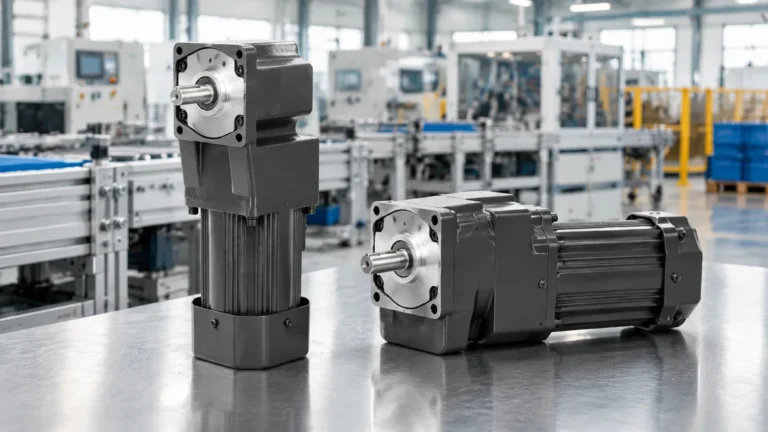
Choosing a gear motor for medical equipment is a different exercise from choosing one for a conveyor or an agitator. The unit sits next to a patient, inside a Class II medical device, or on a hospital trolley that gets wiped down with disinfectant every shift. That changes three things at once: the noise budget drops below 45 dB(A) for bedside use, the electrical safety case must reach IEC 60601-1, and the gearbox backlash has to be tight enough for the actuator to position a load the first time, every time. This guide walks through those requirements, then shows how to map them onto a real ছোট এসি গিয়ার রিডাক্সার মোটর series without overpaying for features the device does not need.

If you are still new to how a gear motor is sized in general, start with our practical explanation of how a gear reducer motor works and the gear motor selection workflow before diving into the medical-specific filters below.

What Counts as a Medical Application

For gear motor selection purposes, a medical application is any device that falls under IEC 60601-1 or is used in a clinical environment. The list is wider than most engineers expect:

  • Patient handling: hospital beds, ICU beds, birthing beds, patient lifts, stretchers, wheelchairs (powered).
  • Drug delivery and fluid handling: infusion pumps, syringe pumps, dialysis machines, blood warmers, enteral feeding pumps.
  • Respiratory and anaesthesia: ventilators, CPAP/BiPAP units, oxygen concentrators, nebulisers, anaesthesia workstations.
  • Surgical and imaging: surgical tables, surgical lights, drills and saws, endoscopy pump units, X-ray collimators, patient-positioning tables.
  • Lab and diagnostics: centrifuges, agitators, mixers, autosamplers, pipette robots, point-of-care analysers.
  • Rehabilitation and daily living: powered prosthetics, stair lifts, electric recliners, CPAP cleaners.

Each category stresses a different combination of noise, precision, and safety. A hospital bed needs self-locking to keep the patient from sliding down if power fails; a syringe pump needs micro-step resolution more than raw torque; a ventilator needs EMI cleanliness so it does not disturb its own sensors. Knowing which axis your device sits on keeps the spec list short.

Three Non-Negotiable Specs: Noise, Precision, Safety

Industrial gear motor datasheets list 20+ parameters. For medical devices, three of them quietly decide whether the unit passes review:

Noise — typically 40 to 50 dB(A) at 1 m

Bedside and wearable devices need the gearbox to be quieter than the room. Most hospital rooms sit around 35 to 40 dB(A) at night, so the drive itself should contribute less than 10 dB(A) above the background. Practically that means:

Comparison of gear motor noise levels measured in dB(A) for bedside medical devices such as infusion pumps and hospital beds

  • Helical gears at < 1500 r/min motor input, not worm gears (worm sets add 5 to 10 dB(A) at the same load).
  • Metal or high-grade polymer gears running in a lubricant bath, not dry-bushed bronze.
  • Resilient mounting (rubber grommets between the motor and the equipment chassis).
  • Balanced rotor and run-tested bearings — out-of-box vibration is a major source of perceived noise in gearboxes that look fine on the bench.

If your device is patient-worn (insulin pump, prosthetic, CPAP), look for total drive noise below 35 dB(A). That usually forces a small-frame, low-voltage DC motor with a precision-ground planetary reducer rather than an AC induction unit.

Precision — backlash, repeatability, holding torque

Medical positioning tasks are usually low speed and short travel: a few hundred millimetres of lead screw travel, or a few degrees of valve rotation. The gear motor must move the load to the commanded position without overshoot, and it must hold that position without back-driving. That breaks down into:

  • Backlash: under 1° (preferably under 0.5°) for valves and dosing, under 3° for hospital bed actuators.
  • Repeatability: better than ±2% of commanded position across the full stroke.
  • Holding torque: when the motor is de-energised, the gearbox must not let the load drift. A worm gear achieves this naturally; a helical gear pair needs a holding brake or a back-stop.
  • Speed control: stepper or BLDC drives give the micro-stepping that dosing pumps need; AC induction units with a VFD are fine for pumps and fans that do not need positional accuracy.

For low-voltage DC medical gear motors, the holding-torque requirement is often met with a small electromagnetic parking brake that engages when the drive is de-energised. A 25 W or 40 W brake adds less than 30 mm to the gearbox length and removes a whole class of field-failure modes.

Safety — electrical isolation, leakage current, self-locking

The drive lives inside a device that touches patients. Two layers of safety apply:

  • Electrical safety (IEC 60601-1): reinforced insulation between the mains side and the patient side, earth leakage current below 0.1 mA normal condition (BF-type applied parts) or 0.01 mA (CF-type, direct cardiac contact). Practically that means the gear motor’s external surfaces must be reliably earthed and the motor insulation class should be B or F.
  • Mechanical safety: self-locking so the load stays put on power loss (critical for hospital beds, patient lifts, surgical tables), and limit-switch integration on linear actuators so the controller can detect end-of-stroke.

For devices that may see washdown (dialysis machines, surgical tables, mobile carts), also check the IP rating. An IP54 motor and gearbox is the practical floor; IP65 or IP66 is needed for anything that gets sprayed or immersed during cleaning.

Step-by-Step: How to Choose a Gear Motor for Medical Equipment

  1. Lock down the device class. IEC 60601-1 type BF or CF, IP rating, expected duty cycle, and target service life. These decide the spec floor before you look at suppliers.
  2. Compute the load torque. For a linear actuator: T = (F × lead) / (2π × η) × service factor. For a rotating load: T = (P × 9550) / n × service factor. Include a service factor of at least 1.5 for medical use, more if the device starts under full load (bed actuators).
  3. Set the noise ceiling. Pick the dB(A) target from the use case table below, then write it into the spec. Suppress worm gears early if the target is below 45 dB(A).
  4. Decide on motor type. AC induction for mains-powered fixed equipment (pumps, fans, beds); BLDC or stepper for battery or low-voltage devices (portable pumps, prosthetics, surgical tools).
  5. Pick the gearbox. Match the output speed window first (e.g. 20 to 200 r/min for an actuator), then the torque envelope, then backlash. For most medical uses a single-stage helical অথবা একটি planetary reducer hits the noise/torque/cost balance.
  6. Add the safety options. Holding brake, encoder, IP-rated cable gland, earthing lug, Class B/F insulation, thermal protector. Each is small on its own and expensive to retrofit.
  7. Verify with the supplier. Ask for an EMC test summary (EN 55011 / IEC 61000-4-2/4), an IP test report, and an insulation class certificate. A reputable medical-grade gear motor supplier will hand these over without prompting.

Common Medical Applications and Their Drive Specs

ApplicationTypical MotorTypical GearboxNoise TargetSafety Notes
Hospital bed actuator24 V DC, 25–60 WWorm or helical, ratio 30:1 to 60:1< 50 dB(A)Self-locking required; limit switches on stroke
Patient lift24 V DC or 12 V DC, 100–200 WWorm, ratio 40:1 to 80:1< 55 dB(A)Self-locking on power loss; mechanical backup
Infusion / syringe pumpStepper, 5–24 VPlanetary or lead screw, very low backlash< 40 dB(A)Encoder for closed-loop; CF-grade isolation
Ventilator blowerAC induction or BLDC, 50–150 WDirect-drive or single-stage helical< 45 dB(A)EMI suppression; thermal cut-out
Lab centrifugeBLDC, 100–400 WDirect-drive preferred< 60 dB(A)Imbalance detection; safety lid interlock
Surgical drill / sawBrushless DC, 100–300 WPlanetary, ratio 5:1 to 30:1< 65 dB(A)Autoclavable or sealed; earthed housing
Powered wheelchair24–48 V DC, 200–600 W (×2)Planetary, ratio 30:1 to 50:1< 55 dB(A)Electromagnetic parking brake; IP54 minimum
Lab stirrer / mixerAC induction, 25–90 WHelical, ratio 5:1 to 30:1< 50 dB(A)Earthed chassis; spill-resistant IP rating

Where the spec says “small AC gear reducer motor” with output around 25 to 40 W, the 25 W small AC gear reducer motor and the 15 W small AC gear reducer motor series cover most of the bed-actuator and stirrer envelopes at a price point that scales into OEM volumes. See also the 40 W small AC gear reducer motor variant when you need extra headroom on starting torque.

Common Mistakes When Specifying a Medical Gear Motor

The same five errors come back across most projects we review. Catch them before you freeze the BOM and you save both tooling and certification cost.

  • Spec’ing an industrial-grade motor into a Class II device. Industrial gear motors are not earthed the way medical devices expect, and their leakage current usually sits above the 0.1 mA BF limit. Ask for a medical-grade variant or plan for an isolation transformer.
  • Ignoring duty cycle. A motor rated for S1 continuous duty at 25 W is fine for a stirrer; a bed actuator needs short-time duty S2 with a thermal margin, not the same continuous-duty motor.
  • Forgetting the holding case. A helical-only drive will back-drive when the motor stops. Either pick a worm gear for natural self-locking, or add a parking brake and wire it into the controller’s safe-state logic.
  • Over-spec’ing backlash on a non-positioning load. A pump or a fan does not need sub-1° backlash. Specifying planetary precision for a centrifugal pump wastes money and adds gearbox mass you do not need.
  • Skipping the EMC conversation. Some low-cost gear motors use unshielded brushed DC motors that radiate heavily. In a ventilator or a patient monitor that creates real noise on the ECG. Ask for an EMC summary, not a hand-wave.

For more on the trade-offs that come up when you size a small AC drive in general, our small AC gear reducer motor selection guide covers the basic physics, and the types of gear motors overview is a useful refresher on which gear topology fits which duty.

How to Validate a Medical Gear Motor Before Volume Release

Once a sample is on the bench, run a four-step validation pass before signing off the supplier:

  1. Functional: run the unit through the full duty cycle at 25 °C, then again at 5 °C and 40 °C, and confirm torque, speed, and noise stay inside spec.
  2. Electrical safety: hi-pot, earth bond, and leakage current tests against IEC 60601-1 limits for the device class.
  3. EMC: pre-compliance scan against EN 55011 Class B and IEC 61000-4-2/4/6. Fixing EMC at certification is ten times the cost of fixing it on the bench.
  4. Reliability: accelerated life test at elevated temperature and full load (e.g. 1000 h at 1.3× rated load). Look for lubricant migration, bearing wear, and any change in backlash.

Keep a validation report for each supplier, dated and version-controlled, so the next project can re-use the data instead of re-running the full test plan.

প্রায়শই জিজ্ঞাসিত প্রশ্নাবলী

What noise level is acceptable for a bedside medical gear motor?

For equipment that runs while the patient is trying to sleep — hospital beds, infusion pumps, CPAP units — keep total drive noise below 45 dB(A) at 1 m. Anything louder will be perceived as “the machine is running” by the patient, even when the room is otherwise quiet.

Do medical gear motors need to be IEC 60601-1 certified?

The whole device needs IEC 60601-1 certification; individual components like the gear motor do not get a separate 60601-1 mark. What the supplier must provide is supporting documentation — insulation class, leakage current, hi-pot data, EMC test summary — that the device maker can roll into the 60601-1 submission.

Worm gear or planetary gear for medical equipment?

Worm gear for any drive that needs natural self-locking on power loss (beds, lifts, surgical tables). Planetary for any drive that needs high precision and low backlash in a small footprint (dosing pumps, surgical tools, prosthetics). Helical gear for the in-between — pumps and fans where noise matters but exact stopping position does not.

Can I use a standard industrial gear motor in a medical device?

Sometimes, but only after an isolation barrier such as a medical-grade power supply, a Class II enclosure, or a battery. Direct mains connection of an industrial gear motor into a patient-contact device is rarely acceptable because the earth leakage current and the EMI signature are out of spec. Use a medical-grade gear motor or a clearly documented isolation plan.

What IP rating do I need?

IP54 (dust-protected, splash-proof) is the practical minimum for any equipment wiped down daily. IP65 (jet-proof) is the right target for dialysis machines, surgical tables, and any device that sees liquid splash during normal cleaning. IP66 or IP67 is needed only for equipment that gets hosed down or immersed.

How do I match an existing medical device to a replacement gear motor?

Pull the original motor’s nameplate: voltage, wattage, rated speed, rated torque, shaft diameter, and frame size. Use those five numbers as the hard constraint, then re-check the noise, backlash, and IP requirements against the new device design. Cross-reference the original frame against our gear motor size chart to find a drop-in replacement.

How long should a medical-grade gear motor last?

Target 20,000 hours of rated-load operation for non-critical hospital equipment (beds, pumps, lab stirrers), and 30,000 to 40,000 hours for diagnostic and life-support equipment where field service is expensive. Both figures assume the unit is mounted within its thermal envelope and on a damped chassis.

What accessories matter for medical gear motor installs?

Three: a holding brake for any load that must stay put on power loss, an encoder for any closed-loop position control, and a properly rated cable gland (IP matched) for any device that gets cleaned or wiped. For a refresher on the broader accessory set, see our gear motor accessories guide.

If you want help mapping a specific medical device to a small-frame gear motor, send us the device class, the load torque, the noise target, and the IP requirement. Our engineering team can usually return a shortlist of small AC gear reducer motors within one working day.

পূর্ববর্তী পোস্ট

Gear Motor Size Chart: Frame Sizes, Dimensions & Torque Specifications

পরবর্তী পোস্ট

How to Select a Gear Motor for Door Openers: Torque, Speed & Self-Locking Requirements

সম্পর্কিত পোস্টসমূহ

+86-18665197728 ফোন manager@cntenchuan.com ই-মেইল হোয়াটসঅ্যাপে চ্যাট করুন হোয়াটসঅ্যাপ