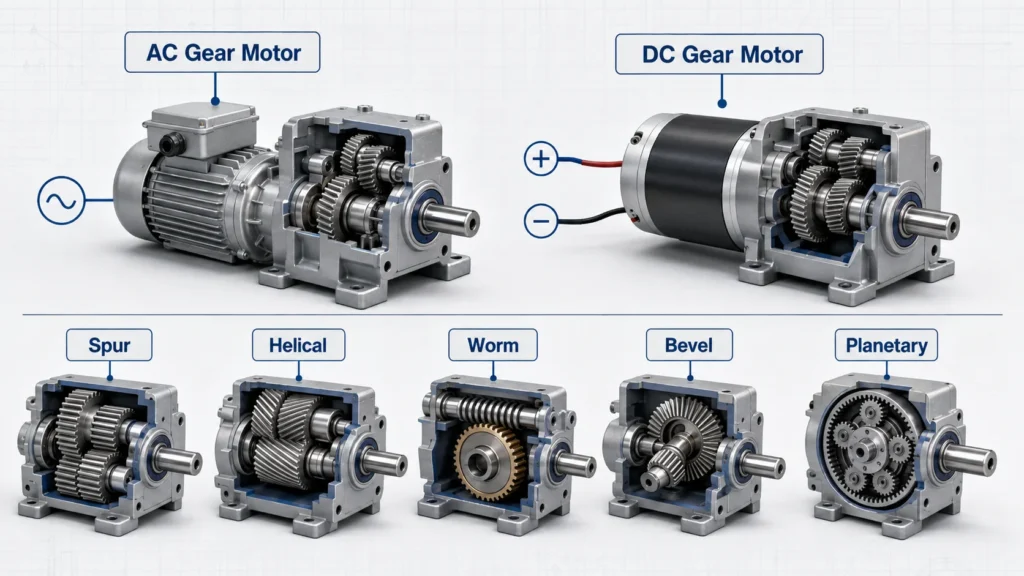
The main types of gear motor can be classified in two ways: by the electric motor that supplies the power and by the gears that transmit it. AC and DC describe the power and control characteristics; spur, helical, worm, bevel, and planetary describe the gearbox. Understanding both layers helps you compare speed control, torque density, noise, efficiency, shaft direction, size, and cost without confusing unlike products.
Types of Gear Motor Quick Comparison
Jenis
Main difference
Typical advantage
Common consideration
AC gear motor
Runs from alternating current
Reliable for fixed-speed industrial duty
Variable speed may require an inverter and motor compatibility check
DC gear motor
Runs from direct current
Convenient speed and direction control
Brushed models require brush maintenance; brushless types need electronic control
Spur
Straight teeth on parallel shafts
Simple and economical
Can be noisier at higher speed
Heliks
Angled teeth engage gradually
Smoother, quieter power transfer
Creates axial force that bearings must support
Cacing
Screw-like worm drives a wheel at 90 degrees
High ratio in a compact right-angle form
Sliding contact can reduce efficiency and produce heat
Bevel atau hypoid
Transfers motion between intersecting or offset axes
Efficient right-angle layout
Precision manufacturing and alignment affect performance
Planetari
Planet gears rotate around a central sun gear
High torque density in a coaxial package
Usually more complex and costly
No single design is best for every machine. Power source, required output speed and torque, available space, operating hours, positioning accuracy, environment, and budget determine the right combination.
AC Gear Motor vs DC Gear Motor
AC Gear Motor
A geared motor AC unit combines an alternating-current motor—often an induction or reversible motor—with a reducer. AC versions are widely used in conveyors, packaging machines, food-processing equipment, and other installations connected to mains power. They are valued for robust construction and dependable continuous operation.
A gear motor 220V is a common search, but voltage alone is not enough to specify a product. Buyers must also confirm whether the supply is single-phase or three-phase, whether the frequency is 50 or 60 Hz, and whether the motor must reverse or work with a speed controller. The actual nameplate voltage and frequency must match the installation.
DC Gear Motor
A DC gear motor is useful where the machine has a battery or DC supply, or where simple variable-speed and direction control are priorities. Brushed DC units are often economical and easy to drive. Brushless DC versions can offer longer service life and more sophisticated control, but they require compatible electronics.
A gear motor 12V is common in mobile robots, small vehicles, actuators, hobby equipment, and portable machinery. Never select it by voltage and no-load rpm alone. Check rated torque, stall or peak current, continuous current, gearbox load limit, duty cycle, and the capacity of the battery, wiring, fuse, connector, and controller.
Which Power Type Should You Choose?
Choose AC when mains power, industrial durability, and steady operation are the main priorities.
Choose brushed DC for straightforward low-voltage control and cost-sensitive intermittent applications.
Choose brushless DC when electronic speed control, efficiency, and reduced brush maintenance justify the added controller complexity.
For compact industrial AC options, the small gear motor range shows how power, frame size, voltage, and reduction choices can be organized within one product family.
Spur Gear Motors: Simple and Economical
Spur gears have straight teeth and normally connect parallel shafts. Their straightforward construction makes them a practical choice for light automation, vending equipment, small conveyors, and mechanisms where moderate noise is acceptable. They can be efficient, easy to manufacture, and cost-effective.
The tradeoff is abrupt tooth engagement. At higher speed, this can create more noise and vibration than a comparable helical design. A spur reducer is therefore a good baseline choice when price and simplicity matter more than very quiet operation.
Helical Gear Motors: Smooth and Quiet
Helical gear teeth are angled, so contact builds progressively and several teeth can share the load. This promotes smoother transmission and lower noise, making helical geared drives suitable for production lines and continuous-duty conveyors.
The angled contact generates axial thrust, which the bearings and housing must manage. Manufacturing is also more involved than for basic spur gears. Select helical gearing when smooth running, load capacity, and sound level are more important than the lowest initial price.
Worm Gear Motors: Compact Right-Angle Reduction
A worm gearbox uses a screw-like worm to drive a gear wheel, usually turning the output through 90 degrees. It can achieve a substantial reduction in one stage and fit conveniently into machines where an inline shaft would be awkward.
Because the teeth experience significant sliding contact, worm drives may lose more energy as heat than other designs. Some configurations resist back-driving, but self-locking must never be assumed from the word “worm.” Lead angle, friction, lubrication, wear, vibration, and load all influence whether the output can drive the input. Use a brake when holding a load is safety-critical.
Bevel and Hypoid Gear Motors: Efficient Direction Changes
Bevel gears transmit power between intersecting shafts, while hypoid designs use offset shafts. Both can provide a compact right-angle arrangement. They are often selected for conveyors and packaging systems that need efficient power transfer around a machine corner.
Compared with worm gearing, bevel or hypoid units may offer better efficiency, depending on the exact design. Their geometry and bearing loads require precise manufacturing and correct lubrication, so published ratings and mounting instructions matter.
Planetary Gear Motors: High Torque Density
A planetary stage places planet gears around a central sun gear inside a ring gear. Multiple gear contacts share the load, producing high torque capacity in a compact coaxial layout. Low-backlash versions are used in robotics, servo axes, and positioning equipment.
The advantages come with greater component count, manufacturing complexity, and often a higher gear motor price. Planetary gearing is most valuable when compact size, torque density, stiffness, or precise motion outweighs the need for the cheapest solution.
Metal Gear Motor vs Plastic Gear Motor
A metal gear motor usually handles higher loads, temperatures, and shock than a similar plastic-geared product. Metal gears can also provide better dimensional stability, but they may increase weight, noise, and price. Plastic gears can be quiet, lightweight, corrosion-resistant, and economical for suitable loads.
Material labels do not reveal the complete design. Gear geometry, tooth finish, heat treatment, shaft support, lubricant, housing stiffness, and operating temperature can matter as much as whether the gear is metal or polymer. Ask for rated performance and life data under conditions close to the real application.
Gear Motors with Wheels, Connectors, and Other Accessories
Gear Motor with Wheel
A gear motor with wheel is usually a drive assembly for a robot, cart, automated guided vehicle, toy, or mobility platform. In addition to motor torque, check wheel diameter, vehicle mass, gradient, target speed, surface friction, acceleration, and the number of driven wheels. A larger wheel travels farther per revolution but requires more shaft torque for the same tractive force.
Gear Motor with Connector
A gear motor with connector simplifies installation only when the electrical interface is correctly specified. Confirm voltage and current rating, pinout, polarity, locking method, wire gauge, environmental sealing, temperature rating, and mating-part availability. Starting current may be much higher than normal running current, so a connector sized only for steady current can overheat.
What Does “Gear Motor Yamaha” Mean?
Ungkapan gear motor Yamaha is ambiguous. It may refer to a geared actuator, starter-related component, replacement assembly, or another part used on a Yamaha vehicle or machine rather than a general-purpose industrial gearmotor. Identify the Types of Gear Motor equipment model, year, function, original part number, voltage, connector, mounting points, and shaft before purchasing. Do not substitute an industrial drive solely because the names sound similar.
How Power Rating Changes the Choice
Within the same AC family, power can provide a useful first filter. A compact mechanism may start with a Motor pengurang gigi AC kecil 15W, while a light conveyor may suit a Model 40W. Applications requiring more output can be compared against a Model 90W atau sebuah Model 160W.
Wattage does not replace sizing. Two units with the same motor power may produce very different output speed and torque because their ratios and gearbox ratings differ. Verify continuous and peak torque, service factor, duty cycle, radial and axial load, mounting, and thermal limits.
How to Select the Best Types of Gear Motor
Define the power source: voltage, AC or DC, phase, frequency, and controller.
Calculate the load: required output speed, running torque, starting torque, and shock load.
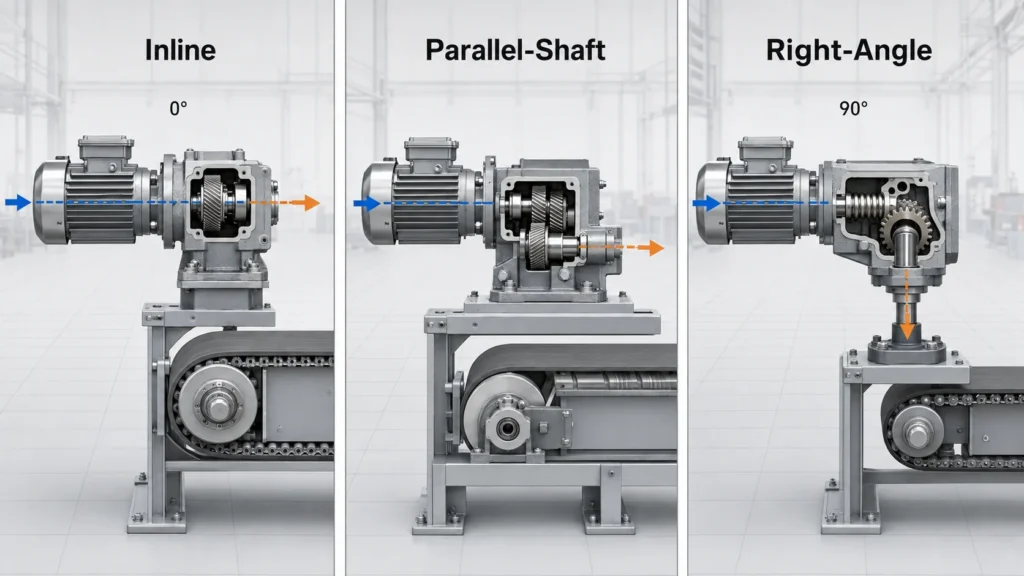
Choose the shaft arrangement: inline, parallel-shaft, or right-angle.
Check mechanical limits: output shaft dimensions, radial and axial loads, mounting, and available space.
Check the environment: temperature, dust, moisture, washdown, corrosion, and enclosure requirements.
Validate the duty: operating hours, starts per hour, reversing, braking, and thermal performance.
Test a representative sample: measure speed, current, temperature, sound, and load behavior in the actual machine.
When comparing suppliers, review the full Produk range and learn about manufacturing capabilities on Tentang Tenchuan. A useful quotation should match the same technical specification across every candidate.
The important differences between geared drives are not captured by one label. First match the AC or DC power and control system, then choose the gear architecture and shaft layout that satisfy torque, speed, space, efficiency, noise, and accuracy requirements. Visit the Halaman Utama Tenchuan for an overview, or Hubungi Tenchuan with your application data for model selection and current pricing.
Pertanyaan yang Sering Diajukan
Which Types of Gear Motor is most efficient?
There is no universal winner. Efficiency varies with gear geometry, number of stages, ratio, load, speed, lubrication, and manufacturing quality. Compare efficiency or input-power data at the intended operating point.
Which Types of Gear Motor is best for high torque in a small space?
Planetary designs are often considered for high torque density, but the correct choice must also meet speed, duty, backlash, bearing-load, thermal, and budget requirements.
Can a 12V gear motor replace a 220V model?
Not directly. They require different power sources and controls, and their size, duty, current, torque, and mounting may differ. Compare complete performance specifications rather than voltage alone.
Are metal gears always better?
No. Metal often suits higher loads and temperatures, while engineered polymers can reduce noise, weight, and cost. The right material depends on the operating conditions and design targets.
Why do two motors with the same wattage have different prices?
Gear type, ratio, materials, precision, bearings, sealing, motor technology, controller, brake, certifications, quantity, and customization can all change the price.
What details should I send to a manufacturer?
Send output rpm, continuous and peak torque, power supply, duty cycle, mounting, shaft loads, available space, environment, control requirements, quantity, and any required drawing or certification.
Untuk memilih motor roda gigi dengan tepat, mulailah dari beban yang digerakkan: tentukan kecepatan keluaran yang dibutuhkan, torsi kontinu dan puncak, siklus kerja, sumber daya, cara pemasangan, beban poros, serta lingkungan pengoperasian.
Panduan praktis mengenai pengoperasian motor roda gigi, jenis-jenisnya, aplikasi, penentuan ukuran, harga, pengadaan dari produsen asli (OEM), dan pemilihan pemasok.