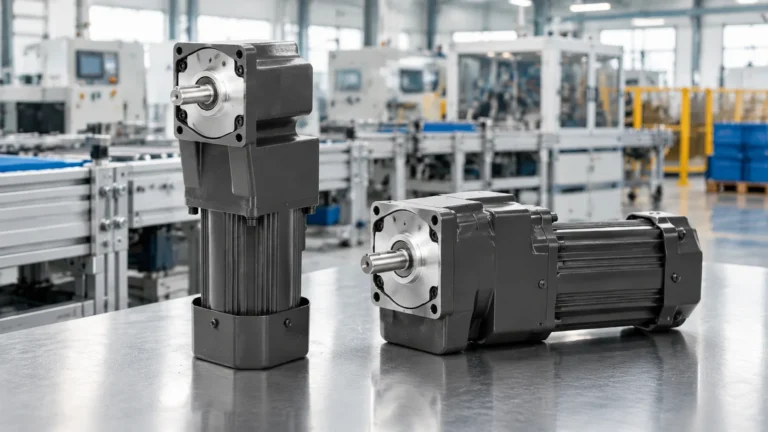
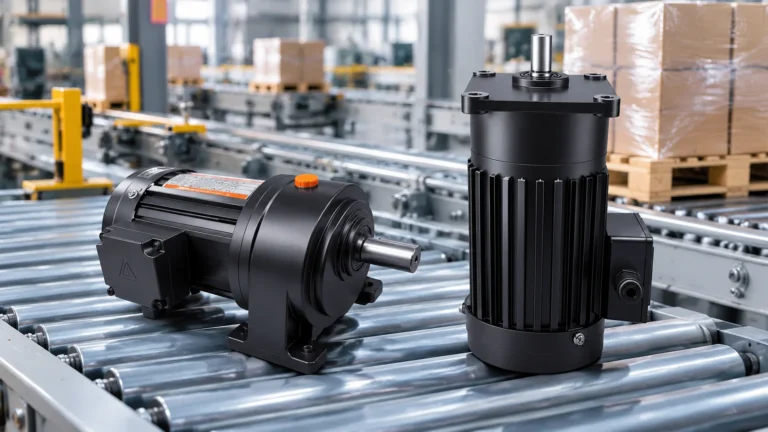
Parallel-Shaft vs Right-Angle Gear Motor: Which Fits Your Machine
Right-angle vs inline gear motor compared with real allowable load tables: efficiency, torque, the self-locking myth and how to decide in five steps.
Baca Selengkapnya
A 25W gear motor is the point where a drive stops being a toy and starts doing real work — but it is also the first power class where buyers get the numbers wrong. The motor alone produces around 154–220 mN·m. The gearbox in front of it can multiply that to 7.84 N·m at the output shaft, or deliver almost nothing if you pick the wrong ratio. This guide walks through the full 25W AC gear motor range on an 80 mm 4RK frame, using the published motor data and the allowable load table so you can size a unit from your own load figures rather than guesswork.
Two sets of numbers matter, and catalogs often blur them. Motor-side figures describe the bare motor at the rated speed. Gearbox-side figures describe what arrives at the output shaft after the reduction ratio is applied. If you mix the two up, you will either oversize the drive or stall it on the first shift.
The 4RK series is a reversible AC induction motor with a matched die-cast gearbox. The table below shows the 25W variants as published for this frame, including the 30W models that share the same footprint when you need a small torque reserve.
| Model | Tugas | Power | Tegangan | Frekuensi | Saat ini | Torsi awal | Rated torque | Rated speed | Capacitor |
|---|---|---|---|---|---|---|---|---|---|
| 4RK25GN-C | Dapat dibalik, 30 menit | 25 W | 1 fasa 220 V | 50 Hz | 0.24 A | 231 mN·m | 185 mN·m | 1250 r/min | 2/450 μF/VAC |
| 4RK25A-C | Continuous | 25 W | 1 fasa 220 V | 60 Hz | 0.26 A | 192 mN·m | 154 mN·m | 1.550 putaran per menit | 2/450 μF/VAC |
| 4RK25GN-A | Dapat dibalik, 30 menit | 25 W | 1 fasa 110 V | 50 Hz | 0,50 A | 231 mN·m | 185 mN·m | 1250 r/min | 8/250 μF/VAC |
| 4RK25A-A | Continuous | 25 W | 1 fasa 110 V | 60 Hz | 0.56 A | 192 mN·m | 154 mN·m | 1.550 putaran per menit | 8/250 μF/VAC |
| 4RK25GN-S | Dapat dibalik, 30 menit | 25 W | 3 fasa 220 V | 50 Hz | 0.24 A | 231 mN·m | 185 mN·m | 1250 r/min | — |
| 4RK25A-S | Continuous | 25 W | 3 fasa 220 V | 60 Hz | 0.225 A | 192 mN·m | 154 mN·m | 1.550 putaran per menit | — |
Note that starting torque is only about 25% above rated torque in this frame. That is normal for a capacitor-run AC motor, and it matters: a load that needs 2.5 times rated torque to break away will sit and hum instead of turning. If your machine starts against a full load, plan for that gap rather than assuming “25W is 25W”.
The fastest way to size a 25W gear motor is to work backwards from the speed your machine needs. Once you have the output speed, the ratio is fixed, and the ratio gives you the torque ceiling. There is no separate guesswork.
| Rasio roda gigi | Output speed (50 Hz) | Max allowable load |
|---|---|---|
| 3:1 | 500 r/min | 0.45 N·m (4.5 kg·cm) |
| 5:1 | 300 r/min | 0.79 N·m (7.9 kg·cm) |
| 10:1 | 150 r/min | 1.55 N·m (15.7 kg·cm) |
| 15:1 | 100 r/min | 2.25 N·m (23 kg·cm) |
| 20:1 | 75 r/min | 3.10 N·m (31.5 kg·cm) |
| 30:1 | 50 r/min | 4.12 N·m (42 kg·cm) |
| 50:1 | 30 r/min | 6.18 N·m (62 kg·cm) |
| 75:1 | 20 r/min | 7.84 N·m (80 kg·cm) |
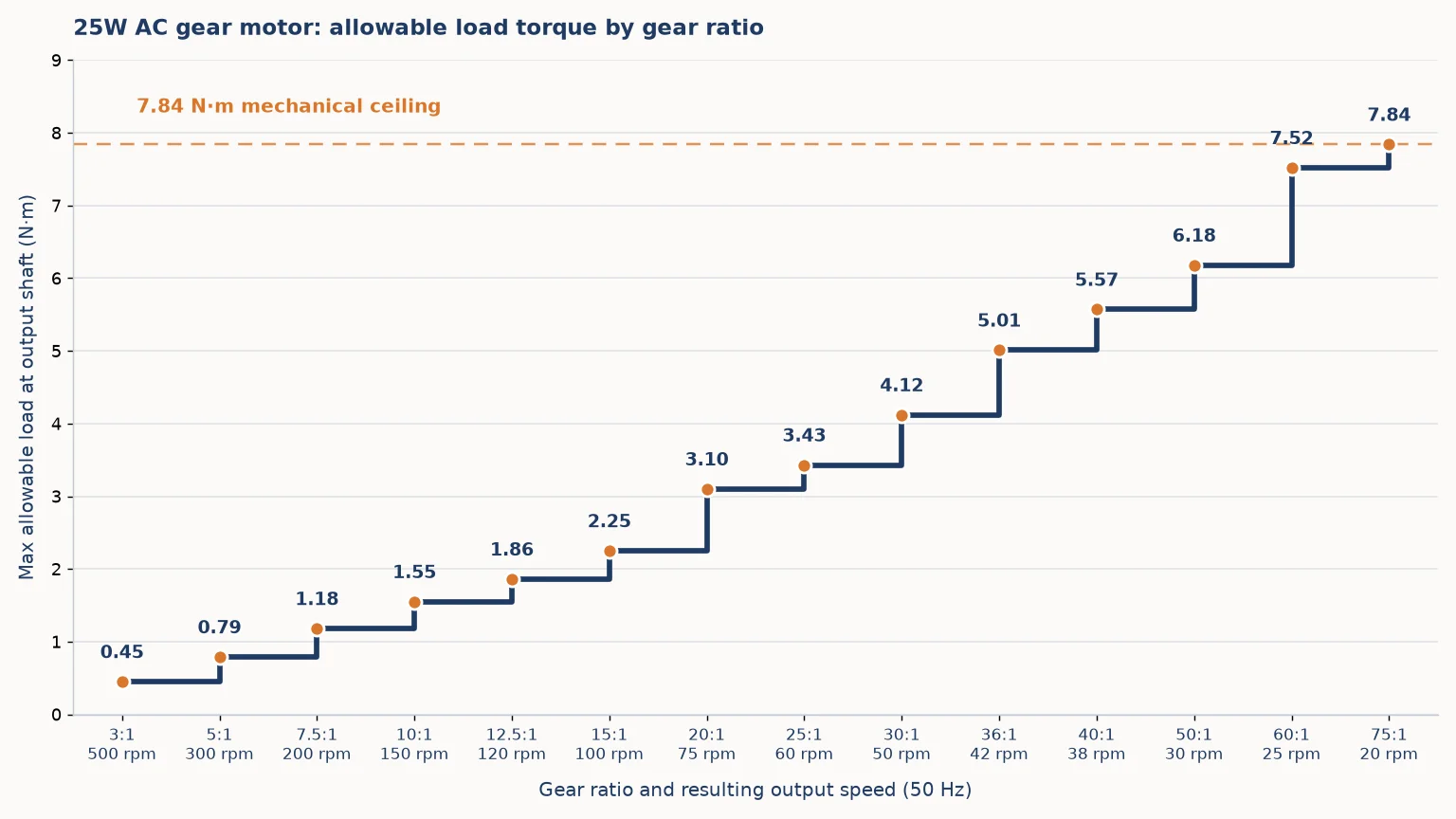
Suppose a small belt conveyor needs a roller speed of 60 rpm and your load calculation gives 2.8 N·m at the roller shaft. At 50 Hz, 1500 ÷ 60 = 25, so you need a 25:1 ratio. Reading the table at 25:1 gives 3.43 N·m — a 22% margin over the 2.8 N·m requirement, which is a comfortable place to land for a lightly varying load.
Two adjustments are usually needed after this. If the conveyor is fed in bursts rather than continuously, the peak torque may exceed the average figure you calculated, so verify the peak against 3.43 N·m, not the average. And if the ratio calculation itself is unfamiliar, the method is explained step by step in how to calculate gear ratio of a gear reduction motor.
The 25W allowable load table ends at 7.84 N·m on the 75:1 ratio. Ratios up to 300:1 exist on the same gearbox, but they no longer add torque: the gearing is already at the mechanical limit of this frame, so slowing down further simply repeats the same ceiling. Anything above roughly 8 N·m at the output shaft is not a 25W job.
There are three honest ways out:
The 25W unit sits at a genuine decision point. Below it, the 15W gear motor on a 70 mm frame handles light, intermittent loads where space is the binding constraint. Above it, 90 mm frames take over from 40W upward and carry noticeably higher torque at the same speed.
Choose 25W when the load lands between roughly 1 and 5 N·m, the speed requirement is between 30 and 200 r/min, and the mounting envelope only fits an 80 mm body. Step down to 15W when the duty is short and the load stays under about 1 N·m — you will save cost and depth. Step up to 40W when the load is above 5–6 N·m at your target speed, or when the machine starts against full load and the 25% starting margin is not enough.
When the machine geometry forces a 90-degree output, a parallel-shaft unit will not fit regardless of power. In that case the 4GN right-angle 25W gear motor delivers the same 80 mm class in a bevel configuration. Full body dimensions across all frames are collected in the Tabel Ukuran Motor Roda Gigi if you need to check clearances before ordering.
Three electrical variants exist in the 25W frame, and the choice usually follows the site rather than the motor. Single-phase 220V covers most Southeast Asian and Middle Eastern single-phase supplies. Single-phase 110V suits North American and some Latin American sites. Three-phase 220V is the better choice where a three-phase distribution is already available, because it removes the run capacitor and gives a slightly lower current draw for the same output.
Frequency is the part buyers miss. The same gearbox at 50 Hz gives 1250 r/min motor speed; at 60 Hz it gives 1550 r/min — about 24% faster, and therefore 24% less torque at the same load. A machine designed around a 50 Hz datasheet will run fast and weak on a 60 Hz supply unless the ratio is recalculated. Always confirm the site frequency before locking a ratio.
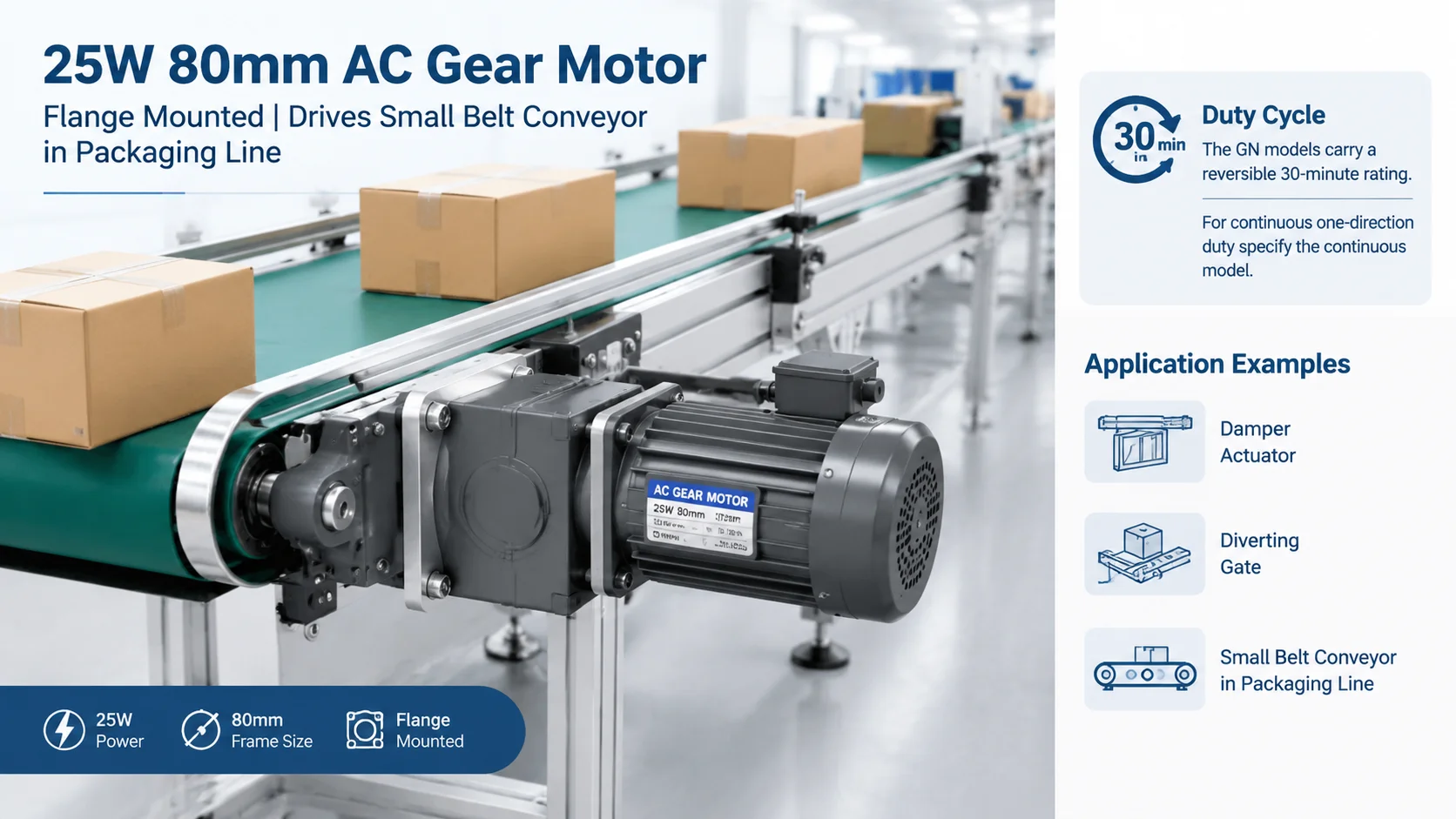
The GN models carry a reversible 30-minute rating. That rating is not a warm-up suggestion — it defines how long the motor can run before the winding temperature reaches its insulation class limit under rated load. Run a reversible model continuously in one direction and it will run hotter than a continuous-duty unit of the same power, simply because the thermal design assumes rest periods.
For continuous one-direction duty, specify the continuous model. For a reversing application — a damper actuator, a diverting gate, a reciprocating pusher — the reversible model is the correct choice, provided the cycle gives the motor time to cool between moves. If your cycle is 40 seconds on and 5 seconds off, all day, that is continuous duty and the model code should reflect it.
Suppliers can quote accurately only when the load is described, not just the power. Include: required output speed in r/min, load torque or the mass and radius you are driving, duty cycle including starts per hour and reversing, supply voltage, phase and frequency, mounting orientation and available space, and any shaft or flange modification needed. With those six items a ratio and model can be confirmed in one exchange instead of three.
Yang 4RK 25W AC gear motor page carries the full specification and allowable load tables for the 80 mm frame, including the 30W variants, so you can check the numbers against your own duty before contacting us.
Around 7.84 N·m (80 kg·cm) at the output shaft on the highest listed ratio (75:1). The bare motor produces only 154–220 mN·m; the rest comes from the gearbox.
The motor runs at 1250 r/min at 50 Hz and 1550 r/min at 60 Hz. Output shaft speed ranges from 500 r/min at 3:1 down to 5 r/min at 300:1, with 2–15% slip depending on load.
The reversible GN models are rated for 30 minutes. For continuous one-direction operation, specify the continuous model of the same frame.
Yes, with the matching speed controller and a motor sized for it. Reduction in speed also reduces cooling, so continuous low-speed operation needs a torque check, not just a dial setting.
Usually yes for belts up to about 1 m with light product and 30–100 r/min roller speed, provided the calculated load torque stays under 3–4 N·m. Heavier or inclined belts should move to a 40W or 90W frame.
The GN model is reversible with a 30-minute rating; the A model is the continuous-duty version. Both use the same 80 mm frame and 25W rating.
Size a 25W gear motor from output speed and load torque, not from power alone. Confirm the ratio from your required r/min, read the allowable load for that ratio, check the 7.84 N·m ceiling, then match voltage, phase and frequency to the actual site supply. Get those four right and the drive will sit inside its thermal limits for years; skip one and no amount of margin elsewhere will compensate.