AC Gear Motor Overheating: 6 Causes and How to Fix Them
A hot gear motor is a symptom. Six causes that explain almost every overheating complaint, the temperature numbers that define too hot, and a ten-minute diagnostic.
Baca Selengkapnya
“Oriental motor replacement” is one of the most searched phrases in the small AC gear motor market, and most of the pages answering it are catalogues that let you filter by part number. That is not the hard part. The hard part is that two motors with the same frame number, the same wattage and the same ratio can still fail to interchange, because the thing that actually decides it is the shaft, the gearhead type, the duty rating and the capacitor.
This guide is a working cross-reference for the right-angle and parallel-shaft AC gear reducer motor ranges that mirror the Oriental Motor World K naming convention: the 4RK, 5RK and 6RK families. It covers how the part numbers decode, what the equivalent frame is, the four dimensions that decide whether a replacement bolts up, where the electrical match differs, and the traps that turn a two-hour swap into a two-week redesign.
If all five match, the swap is mechanical and takes an afternoon. If any one does not, you are changing the machine, not the motor.
The value of the World K convention is that the part number tells you most of what you need before you open a datasheet. It is worth learning the structure, because it is also the structure our own catalogue follows.
| Position | Example | What it tells you |
|---|---|---|
| Leading digit | 5RK40GN | Frame group. 2 = 60 mm, 3 = 70 mm, 4 = 80 mm, 5 = 90 mm. 6 (100 mm) is a larger frame that the K series does not reach but our range does. |
| Motor type letters | 5RK40GN | RK = reversible motor, rated for 30-minute duty. IK = induction motor, rated for continuous duty. This is the single most misunderstood pair of letters in the whole convention. |
| Wattage | 5RK40GN | Output power in watts. Note that the wattage is not the frame: a 5RK40, a 5RK60 and a 5RK90 are all the same 90 mm frame. |
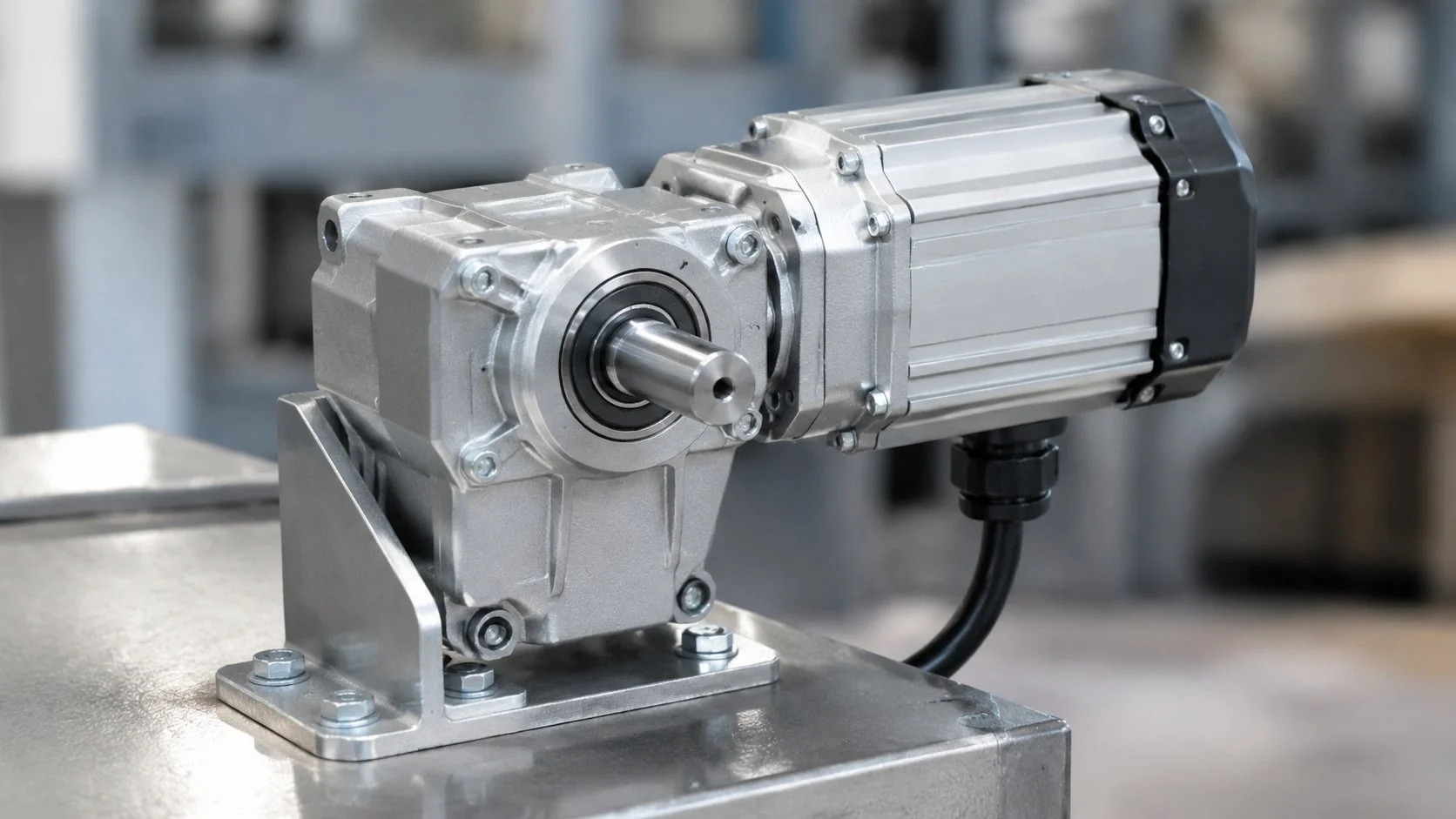
| Gearhead code | 5RK40GN | Gearhead and shaft style. GN is the parallel-shaft family, GU and GE are the right-angle output family. The gearhead is a separate part on these motors, which is why the same motor can be sold with different output arrangements. |
| Supply letter | 5RK40GN-CW2 | Supply variant. C = 220 V single-phase, A = 110 V single-phase, and S or U = the three-phase version depending on series. A trailing F on the 100 mm frame models denotes the fan-cooled build. |
| Terminal option | 5RK40GN-CW2TE | Connection style — terminal box versus lead wires. Getting this wrong is a rework, not an inconvenience. |
One warning about this table: naming conventions are conventions, not standards. They vary between manufacturers and have changed over product generations. Use the structure to orient yourself quickly, then confirm every letter against the supplier’s own model list before you order. A cross-reference table that claims universal equivalence is a red flag.
This is the useful part. Our range covers 15 W to 300 W across four frames, with right-angle variants at three of them.
| Frame | Power band | Our series | Typical output torque range | Ratio range | Max allowable output load |
|---|---|---|---|---|---|
| 70 mm | 15–20 W | 3RK | 95–150 mN·m | 3:1 – 250:1 | 4.9 N·m (50 kg·cm) |
| 80 mm | 25–30 W | 4RK / 4GN right-angle | 154–220 mN·m | 3:1 – 300:1 | 7.84 N·m (80 kg·cm) |
| 90 mm | 40–140 W | 5RK / 5GU right-angle | 246–670 mN·m | 3:1 – 500:1 | 19.6 N·m (200 kg·cm) |
| 100 mm | 120–300 W | 6RK / 6GU right-angle | 740–1,840 mN·m | 3:1 – 500:1 | Up to 43 N·m (440 kg·cm) |
Two honest notes on that table. First, the 100 mm frame is where our range extends beyond the K series — if you are replacing a 90 W unit, the 120 W 6RK is a frame change, not a drop-in upgrade, so check the mounting space before specifying it for headroom. Second, the maximum allowable output load is a ceiling, not a target. On the 90 mm frame the allowable load reaches 19.6 N·m at high ratios and stays there; adding more reduction past that point does not give you more torque, it just gives you a slower shaft. The panduan perhitungan rasio roda gigi works through that ceiling explicitly.
Buyers spend most of their comparison time on torque and almost none on the four numbers that determine whether the replacement can be bolted on. Get these from the original drawing before anything else.
| Dimension | Why it decides the swap | Di mana bisa menemukannya |
|---|---|---|
| Mounting face and foot hole pitch | The bolting pattern. A 4 mm difference means re-drilling a bracket on the machine. | Original datasheet drawing, or measure the existing bracket |
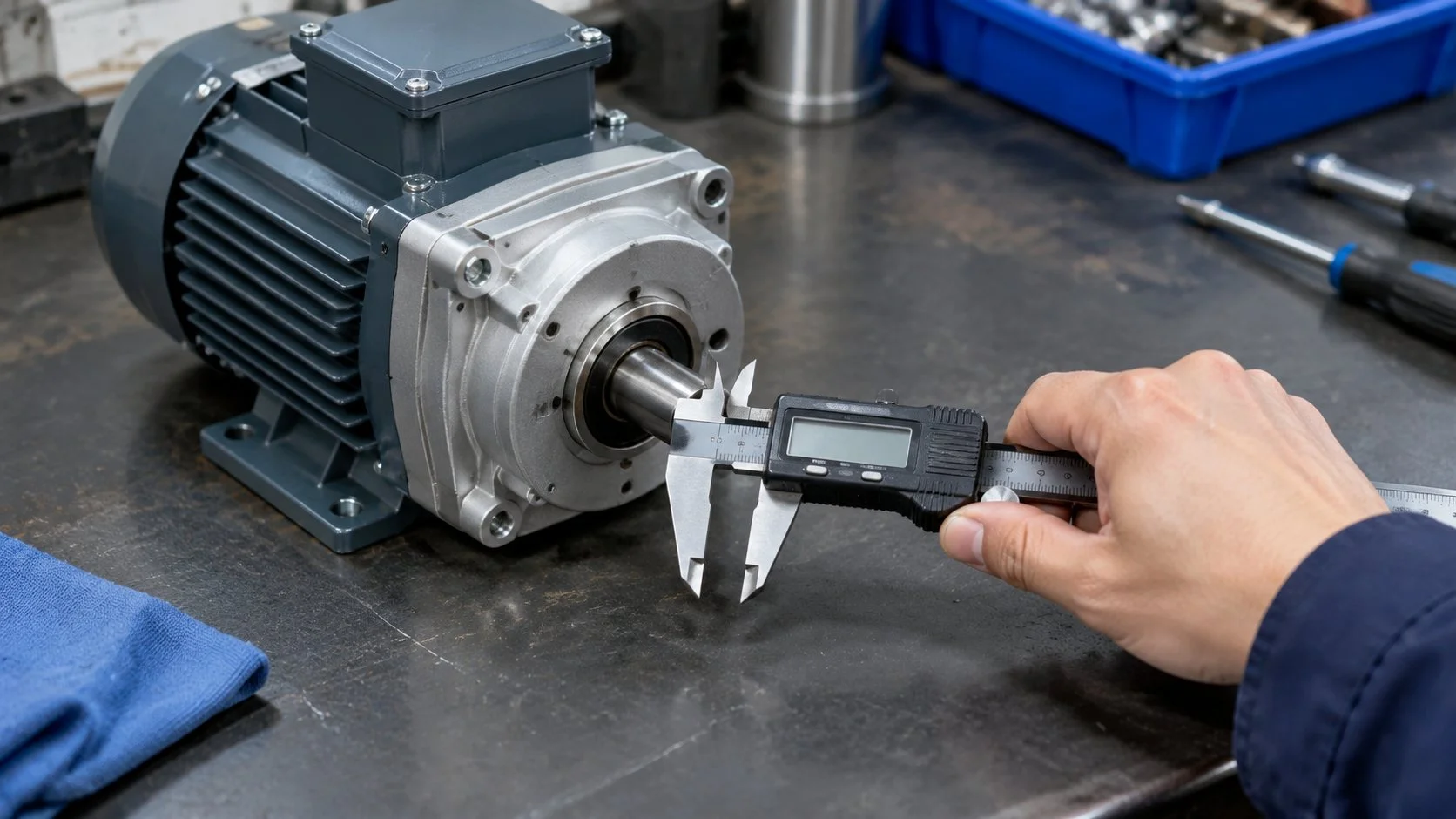
| Output shaft diameter and length | The pulley, sprocket or coupling is already bored to a size. A 1 mm change means a new hub. | Measure the shaft, not the bore |
| Keyway width and depth | An unkeyed shaft on a keyed application will slip under load | Measure, and confirm whether a key is supplied |
| Overall envelope, including the terminal box | A motor that fits the bracket can still foul the frame or a guard | Measure the installed space, not just the motor |
For the 90 mm frame the published reference points for a 40 W right-angle unit are a 12 mm output shaft and an overhung load limit of 250 N at 10 mm from the shaft end, rising to 350 N at 20 mm. For the 90 W right-angle hollow-shaft version the shaft is 17 mm and the permissible overhung load is 560 N at 10 mm, 500 N at 20 mm. Those figures come from the Oriental catalogue and are worth reproducing in your comparison, because they are the numbers that decide whether your existing pulley position is still acceptable. Our 40–140 W right-angle gear reducer motor covers the same 90 mm frame envelope.
This is where most cross-reference tables quietly stop being useful, because the mechanical data matches and the electrical detail does not.
The capacitor. A single-phase World K motor needs a run capacitor, and the correct value depends on the voltage and the frame. A 220 V unit takes a different capacitor from a 110 V unit, and getting it wrong produces a motor that starts poorly, draws high current and runs hot. If a replacement is quoted without a capacitor specification, that is an incomplete quotation.
Reversible versus induction. The RK models are 30-minute rated. The IK models are continuous. A buyer replacing an IK motor with an RK motor because the frame and wattage match has just halved the continuous duty capability of the machine. This is not a small detail, and it is the first thing to check when a replacement runs hot. The reversible vs continuous duty guide explains what the 30-minute rating physically limits.
Thermal protection. The World K reversible motors commonly include a built-in thermal protector, automatic-reset type, opening around 130 °C and closing around 85 °C. If the original had one and the replacement does not, the machine has lost its last line of defence against a stalled load. Ask explicitly.
Insulation class and temperature rise. Class B insulation with a permissible temperature rise of 80 K by the resistance method is the reference point for this class of motor. If your application runs at high ambient, that 80 K rise is the number that matters, not the insulation class alone.
Terminal box versus lead wires. A TE suffix means a terminal box. Replacing a terminal-box motor with a lead-wire motor changes the wiring, the gland arrangement and often the enclosure rating. Easy to fix at order stage, painful after installation.
The most common cross-referencing error is matching on ratio. Two motors at 50:1 are not equivalent unless they also deliver the same torque at the resulting output speed, and torque at the output depends on gearbox efficiency, which depends on the number of stages.
Work in this order:
If step 5 fails, more ratio will not fix it. You need the next frame up. The torque calculation guide covers the conversion chain in detail, and the size chart gives the frame dimensions you need for the fit check.
| Trap | Apa yang terjadi | How to avoid it |
|---|---|---|
| Matching wattage and ignoring frame | The replacement does not bolt to the existing bracket | Confirm the frame group from the leading digit first |
| Replacing an IK (continuous) motor with an RK (30-minute) unit | Motor overheats under continuous duty | Check the type letters, not just the wattage |
| Matching ratio but not output torque | Machine stalls or the gearbox is overloaded | Compare allowable load at the target output speed |
| Ignoring shaft diameter and keyway | New pulley, new coupling, new alignment work | Measure the existing shaft before ordering |
| Quotation without a capacitor specification | Poor starting, high current, hot winding | Require the capacitor value and voltage in the quotation |
| Assuming right-angle and parallel-shaft units share a footprint | The 90-degree output fouls the machine frame | Check the envelope, including the output position |
On the last one: a right-angle gearbox does not turn the same motor 90 degrees within the same envelope. It changes where the shaft exits and how much space the assembly occupies. The parallel-shaft vs right-angle comparison covers the geometry trade-off, and our 120–300 W right-angle unit is the 100 mm frame option where an inline layout will not fit.
A credible cross-reference has to say where it does not apply. There are situations where substituting is the wrong decision, and a supplier who will not say so is not giving you engineering advice.
Send these and a competent supplier can quote in one pass:
Missing item 3 is the single most common reason a replacement quote has to be revised. Photos cost nothing and remove an entire round of clarification. For the 80 mm frame specifically, the 25 W selection guide covers the ratios and allowable loads in that frame, and the 4GN right-angle unit is the 25 W option most often used where a compact 90-degree output is needed.
Largely, yes. The 4RK designation is the reversible 25 W motor in the 80 mm frame, and 4GN denotes the right-angle gearhead family on that frame. The motor is one part and the gearhead is another, so confirm both the motor code and the gearhead code when comparing.
Only if the mounting space allows it. The 90 W unit sits on the 90 mm frame and the 120 W unit sits on the 100 mm frame, so this is a frame change rather than a like-for-like upgrade. Check the bracket and envelope before specifying for headroom.
RK is a reversible motor rated for 30-minute duty. IK is an induction motor rated for continuous duty. They share frames and wattages, which is exactly why substituting one for the other is a common and expensive mistake.
Yes. A single-phase motor’s capacitor value is matched to its voltage and winding. A mismatched capacitor causes poor starting, high current draw and excess heating. Require the capacitor specification in the quotation.
That is the right question to ask, and it needs the pulley position. Overhung load limits are quoted at a distance from the shaft end — 250 N at 10 mm and 350 N at 20 mm for a typical 40 W right-angle unit on the 90 mm frame. Send the distance from the shaft end to the load centre and the limit can be confirmed for the specific model.
A catalogue ratio in stock specification is typically 5–10 working days of production. A non-standard ratio, shaft or winding is 15–25 working days. See the MOQ and lead time policy for the current position.
If you have an existing nameplate and a photograph of the mounting, send them with the application details and we will come back with the closest equivalent, the dimensions that differ, and an honest note on anything that will not interchange.