Lab and diagnostic equipment builders ask us the same thing in almost every enquiry: “Can you supply a gear motor for medical equipment?” The honest answer is that it depends entirely on which medical equipment, and the distinction matters more than most suppliers admit. A patient-contact or life-support device belongs to a completely different supply chain — certified assemblies, validated traceability, IEC 60601-1 documentation. But a large share of what gets called “medical equipment” is benchtop laboratory and diagnostic hardware: sample handlers, tube carousels, reagent mixers, slide scanners, pipetting axes, centrifuge lids, analyser drawers and lab conveyor sections.
Those machines use low-noise AC gear motors in exactly the power range this factory builds. This guide draws the line clearly, then explains how to specify a drive on the near side of it.
First, the boundary: what we can and cannot supply
Being explicit about this saves both parties a wasted month of sampling.
| Requirement | Standard compact AC gear motor | Certified medical drive |
|---|
| Benchtop lab / diagnostic hardware, non-patient-contact | Yes | Over-specified |
| Sample handling, carousel, drawer, lid, mixer, conveyor | Yes | Over-specified |
| IEC 60601-1 electrical safety case | No — component only, no medical file | Required |
| Patient-contact or life-support function | Không | Required |
| Noise below 45 dB(A) at 1 m | Not guaranteed — achievable to ~50–55 dB(A) with correct mounting and ratio | Designed to the budget |
| Repeatable positioning without external feedback | No — needs sensors or mechanical stops | Servo / stepper |
| Sterilisation or disinfectant-wipe resistance | Depends on housing finish — specify, do not assume | Validated |
If the device needs a 60601-1 file, a certified medical drive supplier is the correct route. If the device is a lab instrument where the motor sits behind an enclosure and drives a tube carousel, a compact AC gear motor is both cheaper and easier to service — and a replacement unit can be on site in days rather than a requalification cycle.
Why noise, not torque, usually decides the specification
In a benchtop analyser, torque is rarely the constraint. A tube carousel weighs a few kilograms and turns at 5–30 r/min. Almost any 15 W or 25 W unit will move it. What fails acceptance is sound.
Three separate sources contribute, and buyers usually attack only the first:
- Airborne motor noise — fan, bearing and electromagnetic hum. Roughly fixed by the motor design. A 4RK 25 W unit is quieter than a 90 W unit at the same speed, so do not oversize.
- Gear mesh noise — rises with input speed and with load, and is worst on the first stage. A two-stage 100:1 box running at 1450 r/min input produces more mesh noise than a three-stage 100:1 arrangement, even though both give the same output speed.
- Structural amplification — the enclosure, baseplate and mounting bracket act as a sounding board. This is the dominant factor in practice and almost always the cheapest to fix.
Practical sequence that works on benchtop instruments, in order of cost-effectiveness:
- Mount on a compliant pad, not metal-to-metal. A 3–5 mm nitrile or EPDM pad between gearbox foot and frame typically drops measured noise 4–7 dB(A).
- Choose the highest ratio that meets your speed, so input speed per stage stays low. On our 25 W 4RK, 100:1 gives 15 r/min output — already slow enough that the gearbox is barely audible over ambient.
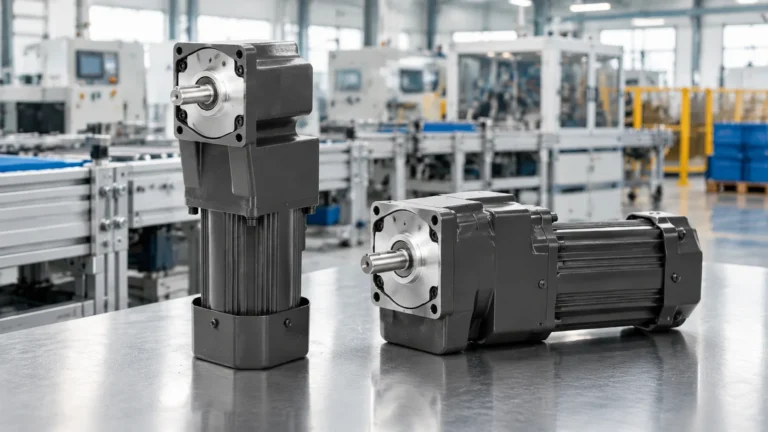
- Use a right-angle unit where the layout allows. The 4GN right-angle 25 W puts the motor axis across the machine rather than into the enclosure wall, which changes what gets excited.
- Do not oversize the frame. Selecting a 90 W unit for a load a 25 W handles adds mass, fan noise and cost for no benefit.
Sizing for a lab instrument: the four numbers
1. Tốc độ đầu ra
Sample carousels run 2–20 r/min. Pipetting Z-axes and drawer slides run 20–80 r/min through a belt or lead screw. Slide scanners are faster, 100–300 r/min, usually with a belt reduction.
2. Torque at the driven element
For a rotary carousel, torque is dominated by bearing friction and any offset centre of gravity, not by the sample weight:
T = μ · W · rbearing + W · e
where μ is bearing friction coefficient (0.002–0.01 for a quality sealed bearing), W the total carried weight, rbearing the bearing radius and e any eccentricity. For a 3 kg carousel on a 40 mm bearing, that is often under 0.3 N·m — a small fraction of what a 25 W unit offers at 50:1.
3. Allowable load at the selected ratio
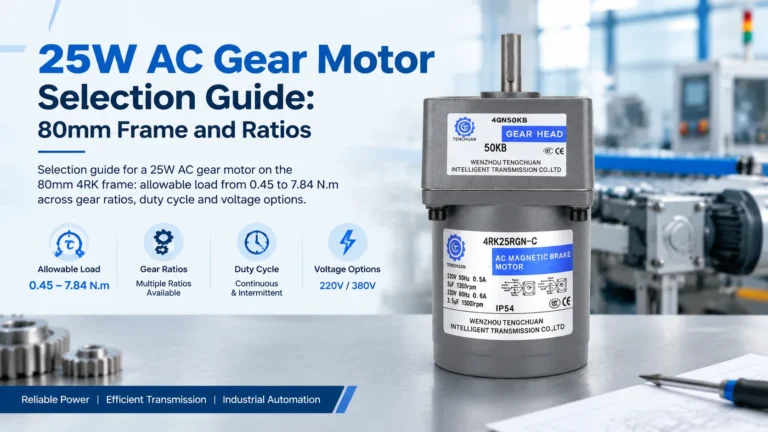
Do not read torque off the motor nameplate; read the gearbox allowable load at your ratio. On the 25 W 4RK: 0.45 N·m at 3:1, 1.55 N·m at 10:1, 4.12 N·m at 30:1, 7.84 N·m at 100:1 and above. Lab instruments typically sit between 10:1 and 100:1.
4. Duty and thermal rating
Our small AC series carries a reversible 30-minute rating. An analyser that indexes all day long is liên tục duty and should be sized for the continuous load, not the reversible figure. A lid or drawer that opens a few times per shift is comfortably inside the 30-minute reversible envelope. Getting this backwards is the most common cause of a hot gearbox in the field.
Disinfectant wipe-down: what to specify
Most benchtop instruments are wiped with 70% IPA or a quaternary ammonium wipe at shift end. That is a chemical exposure problem, not a water-ingress one, and it damages different things:
- Labels and nameplates lift first. Specify a laser-etched or plate-mounted rating rather than a paper label.
- Paint and coatings on cast housings can soften. Avoid solvent-sensitive coatings near the wipe path.
- Shaft seals harden with repeated IPA contact. Keep the seal out of the direct wipe line, or accept a shorter seal service interval.
Nobody should promise “disinfectant-proof” without a defined chemical and contact time. Ask the equipment builder for the actual wipe agent and frequency, then match the housing finish to it. That single question resolves most lab-drive warranty disputes before they start.
Positioning: what an AC gear motor does and does not do
An AC gear motor runs to a speed; it does not run to a position. There is no encoder, no holding torque at standstill, and no repeatable stopping point. In a lab instrument this is usually fine, because the mechanism provides the reference:
- Mechanical stops plus a home sensor — the carousel indexes against a detent, and a single optical sensor confirms home once per revolution.
- Geneva or intermittent mechanism — the gearbox runs continuously and the mechanism produces discrete steps. This is the classic answer for tube handling and it removes positioning from the drive entirely.
- Brake or friction hold — if a Z-axis must not drop on power loss, a brake is required. A spur or right-angle bevel gear train is not self-locking at the ratios used here.
If the instrument genuinely needs multi-position servo control with sub-degree repeatability, that is a servo application and no amount of gear ratio will substitute for it.
Selection checklist
- Confirm the device is non-patient-contact and needs no 60601-1 file.
- Set the noise budget and measure it on the actual enclosure, not on a datasheet.
- Size torque from bearing friction and eccentricity, then add a 1.5–2.0 service factor for jam recovery.
- Read allowable load at the chosen ratio, and confirm you are not past the gearbox ceiling.
- Classify the duty as continuous or intermittent — do not use the reversible 30-minute rating for continuous indexing.
- Specify housing finish against the actual wipe agent.
- Decide how the mechanism finds position: stops, detent, sensor or Geneva.
Câu hỏi thường gặp
Can you provide a gear motor with IEC 60601-1 certification?
No. We supply the drive as a component. The medical device manufacturer holds the 60601-1 file and performs the risk assessment. For devices where the motor is inside an enclosure and not patient-contact, a component-level drive is normal practice.
What noise level can I expect from a 25 W AC gear motor?
Typically 50–55 dB(A) at 1 m for a bare unit at moderate load. With a compliant mounting pad, a high ratio to keep mesh speed low, and an acoustically dead enclosure, benchtop instruments routinely measure below that at the operator position.
Can I get a low-voltage or DC version?
Our production range is single-phase 110V/220V and three-phase 220V/380V AC. We do not build DC or brushless drives. If the instrument must run from a DC bus, a DC gear motor supplier is the right source.
How do I hold a vertical axis without a brake?
You generally cannot, safely. A spur or bevel right-angle gear train is not self-locking, so the load will creep or drop. Use a brake motor, a counterbalance, or a mechanical ratchet. Do not rely on gear friction.