250W Gear Motor: Specifications, Torque Table and Applications
Ngày đăng: Tác giả: Lisa
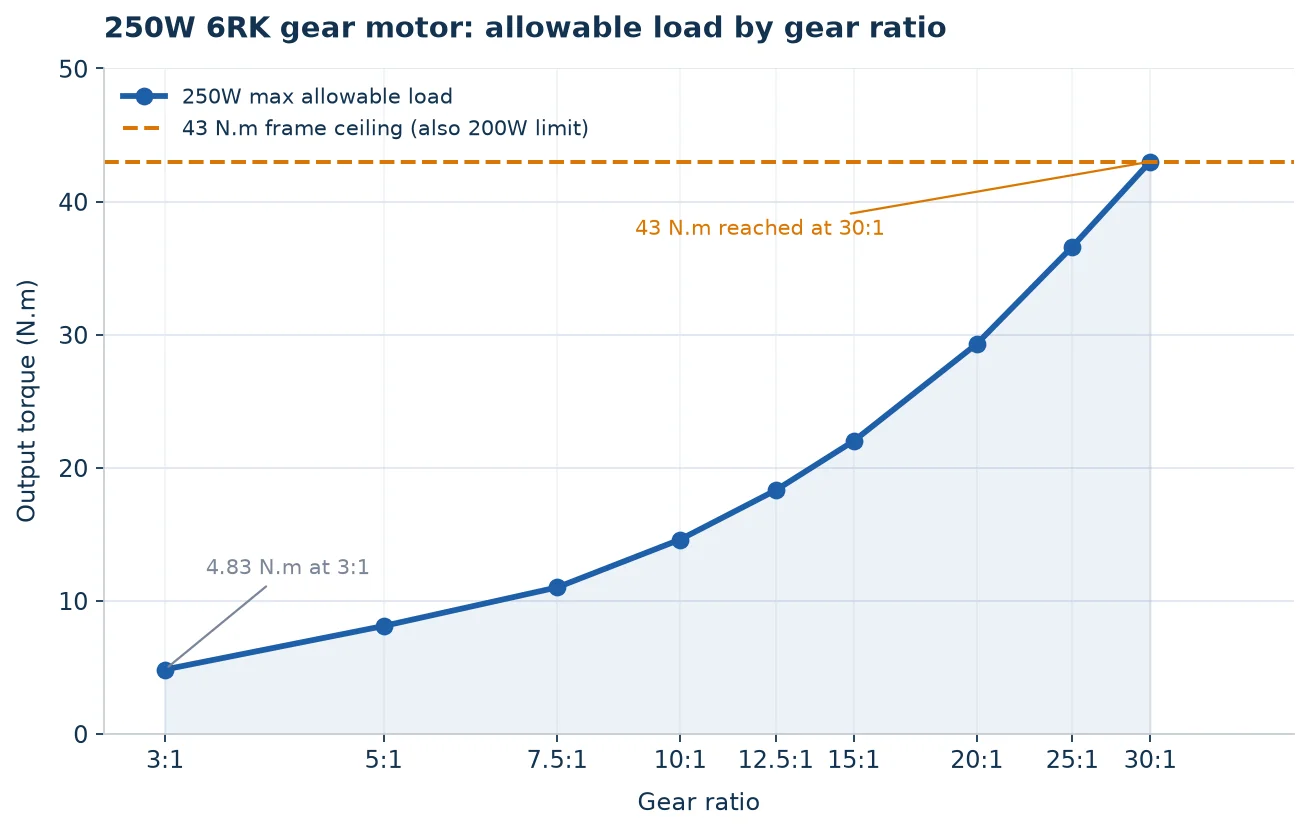
A 250W gear motor is the top of the small AC family, and it is where the arithmetic stops being forgiving. The bare motor produces 1840 mN·m at 1350 r/min on a 100 mm 6RK frame, but the same gearbox will deliver anything between 4.83 N·m at 3:1 and a hard 43 N·m ceiling from 30:1 upward. Two buyers with the same 250W requirement and different ratios are looking at drives that differ by a factor of nine in output torque and have completely different mounting consequences.
This guide walks through the published 6RK 250W data — motor table, allowable load table and the limits behind them — so you can confirm a 250W unit against your own duty, and know when 250W is genuinely the right class instead of a convenient guess.
What the 250W frame actually is
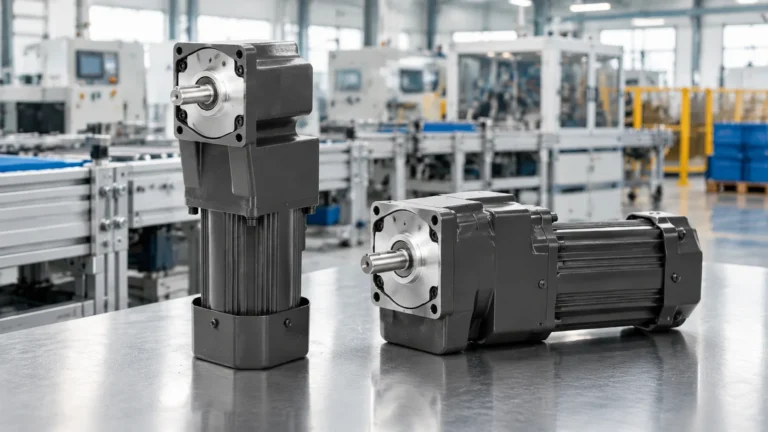
The 6RK series covers 120W to 250W on a single 100 mm frame. Within that family the 250W unit has the heaviest winding and the highest rated torque, but it shares the gearbox, the mounting pattern and the shaft options with the 120W model. That matters for two reasons: a machine designed around a 120W unit can often be upgraded to 250W without changing the frame, and the allowable load ceiling of 43 N·m applies to the gearbox as much as to the motor.
Motor-side specification for the 250W variants
Model
Nhiệm vụ
Điện áp
Tần số
Hiện tại
Mô-men xoắn khởi động
Rated torque
Rated speed
Capacitor
6RK250GU-CF
Có thể đảo ngược trong 30 phút
1 pha, 220 V
50 Hz
1.60 A
2020 mN·m
1837 mN·m
1.350 vòng/phút
12/450 μF/VAC
6RK250A-CF
Continuous
1 pha, 220 V
60 Hz
1.55 A
1700 mN·m
1540 mN·m
1.550 vòng/phút
12/450 μF/VAC
6RK250GU-AF
Có thể đảo ngược trong 30 phút
1 pha, 110 V
50 Hz
3.30 A
2020 mN·m
1837 mN·m
1.350 vòng/phút
48/250 μF/VAC
6RK250A-AF
Continuous
1 pha, 110 V
60 Hz
3.20 A
1700 mN·m
1540 mN·m
1.550 vòng/phút
48/250 μF/VAC
6RK250GU-UF
Có thể đảo ngược trong 30 phút
3-phase 380 V
50 Hz
1.30 A
2022 mN·m
1840 mN·m
1.350 vòng/phút
—
6RK250A-UF
Continuous
3-phase 380 V
60 Hz
1.20 A
1760 mN·m
1600 mN·m
1.550 vòng/phút
—
Three points in that table are worth flagging for anyone comparing quotes. Starting torque is only about 1.1 times rated torque at 1-phase 220 V — the lowest starting margin in the whole small range, which is why a 250W drive sized close to its limit will refuse to break away a jammed load. The 110 V versions pull more than twice the current of the 220 V versions, which drives cable and protection sizing. And the 60 Hz rows give up about 15% of rated torque while running faster, so a ratio selected on 50 Hz data lands short on a 60 Hz supply.
Allowable load: where 250W torque actually stops
Tỷ lệ
Output speed at 50 Hz
Tải trọng tối đa cho phép
3:1
500 r/min
4.83 N·m (49.3 kg·cm)
5:1
300 r/min
8.10 N·m (82.1 kg·cm)
7.5:1
200 r/min
11.0 N·m (112 kg·cm)
10:1
150 r/min
14.6 N·m (149 kg·cm)
12.5:1
120 r/min
18.3 N·m (186 kg·cm)
15:1
90 r/min
22.0 N·m (224 kg·cm)
20:1
68 r/min
29.3 N·m (298 kg·cm)
25:1
54 r/min
36.6 N·m (375 kg·cm)
30:1
45 r/min
43.0 N·m (440 kg·cm)
36:1 and above
37 r/min and below
43.0 N·m (440 kg·cm)
The 43 N·m figure is a mechanical rating shared across the 200W and 250W models on this frame. It is reached at 30:1 on the 250W unit but only at 50:1 on the 200W unit. Buying 250W and then specifying a 50:1 gearbox to reach a slow speed will not produce more output torque than the 250W at 30:1 — it produces the same 43 N·m and you have paid for motor capacity the gearbox cannot transmit.
Sizing method for a 250W application
Work from the machine backwards. Required output speed fixes the ratio; the ratio fixes the allowable load; the allowable load must exceed your calculated running torque with a margin that covers peaks.
Worked example: an inclined conveyor drive
An inclined belt carrying 40 kg of product at 0.25 m/s needs a drive roller at 45 r/min, and your load calculation — belt pull multiplied by roller radius, plus the incline component — gives 24 N·m continuous, peaking at 31 N·m on each start.
Tỷ lệ: 1350 ÷ 45 = 30, so 30:1. Output speed confirmed at 45 r/min.
Allowable load: the table gives 43 N·m at 30:1, which covers the 31 N·m start peak with a 39% margin.
Starting torque check: the motor starts at 1.1 times rated, giving 2020 mN·m motor-side. At 30:1 that is enough to accelerate the load only if the belt is not started fully loaded against the incline. If it is, add a mechanical brake or start unloaded — the gearbox margin does not compensate for a weak breakaway.
Duty: a conveyor that runs a full shift is continuous duty, so specify the A model. Reversing gates and pushers on the same frame use the GU model.
Electrical: 1-phase 220 V draws 1.6 A; three-phase 380 V draws 1.3 A with no capacitor and better starting behaviour. Where three-phase is available it is the simpler drive.
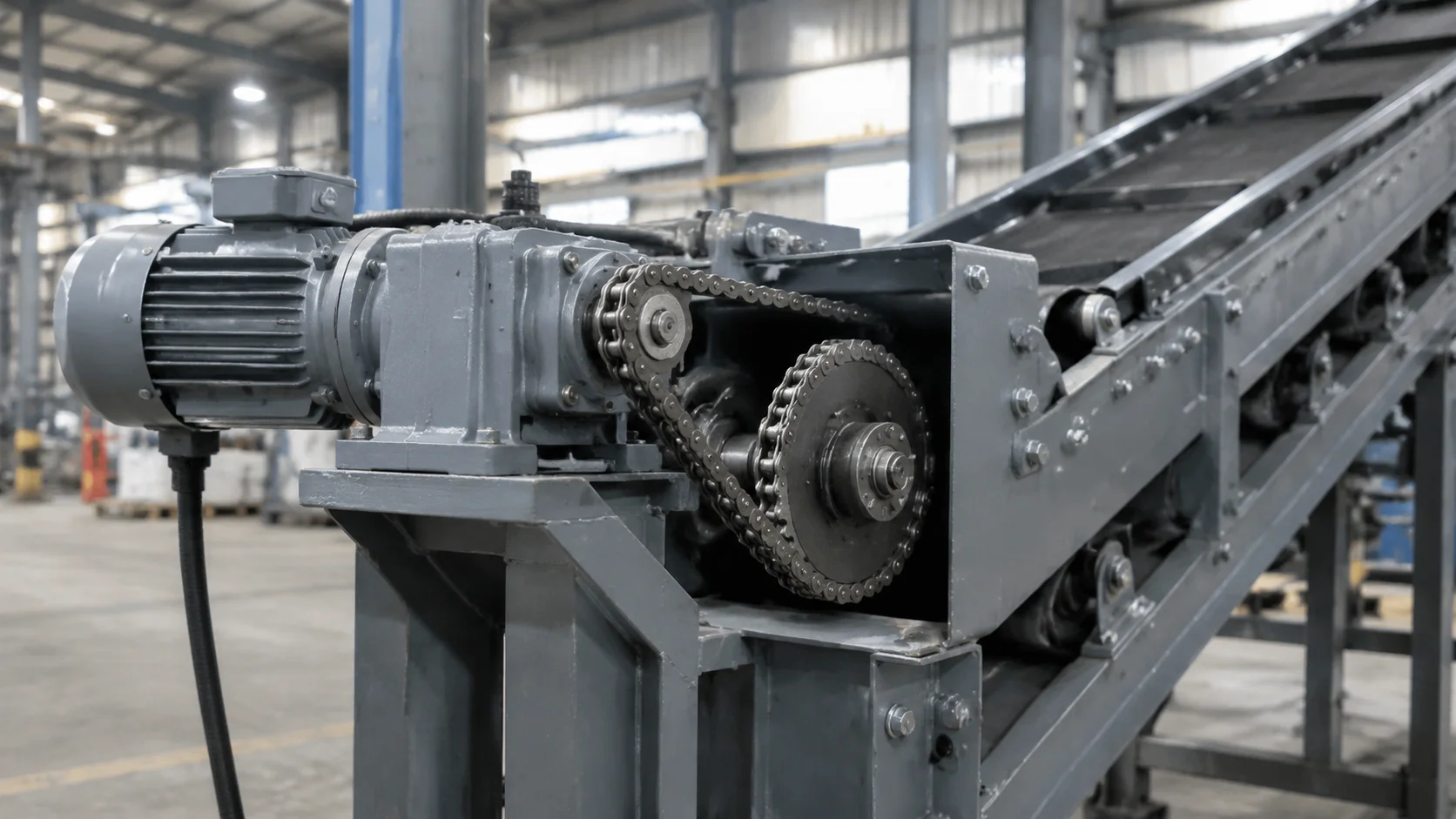
Most 250W enquiries arrive because someone was quoted 200W and wants more margin, or because a 300W unit was proposed and they suspect it is overkill. The comparison is closer than it looks.
200W: same 100 mm frame, same 43 N·m gearbox ceiling, but it needs 50:1 rather than 30:1 to reach it. Below 30:1 the 250W carries noticeably more load — 22 N·m against 17.6 N·m at 15:1. See the 200W AC gear reducer motor.
300W: a different class in practice. The 300W unit is the practical top of the small range and the more sensible answer once your requirement passes 43 N·m or your duty is genuinely continuous under load.
400W and above: the electrical logic changes completely — three-phase only, a larger shaft and a different mounting plate. That step is covered in the medium gear reducer motor phạm vi.
If your load needs 43 N·m at 45 r/min and runs continuously, 250W at 30:1 sits exactly on the ceiling with no margin. That is the point to move to 300W or to 400W rather than to accept the quotation because the number matched.
Duty cycle, reversals and the 30-minute rating
The GU models are rated for 30 minutes of reversible operation. The rating is a thermal limit at rated load with rest periods assumed; it is not a warm-up allowance and it does not reset if you reverse inside the period. A gate that opens in 8 seconds, holds for 40 seconds and closes in 8 seconds has a generous thermal margin. A 250W gearbox running a reciprocating pusher at 20 strokes a minute has almost none, because the motor never cools.
Two practical rules cover most cases. If the drive runs in one direction for more than half its cycle, specify the A model. If it reverses constantly, specify the GU model but check that the off-time between moves is real, and confirm the gearbox is rated for the reversal frequency — reversing shock loads the gear teeth in both directions and is the most common cause of premature gear failure on this class.
Mounting, shaft and load side
The 250W frame is normally flange mounted, with foot mounting available on request. Three mechanical items deserve attention before ordering. Overhung load: a sprocket or pulley placed far out on the output shaft applies a radial force that the bearing, not the gearbox torque rating, has to absorb. Reaction torque: the housing needs a torque arm or a solid flange fixing. And alignment: at 43 N·m a small coupling misalignment produces a large alternating side load, so use a flexible coupling rather than a rigid one wherever possible.
Assuming torque scales with power. At 30:1 the 250W gives 43 N·m, but at 10:1 it gives only 14.6 N·m. Ratio decides, power only sets the ceiling.
Buying 250W for a ratio above 30:1. Past the ceiling the extra motor power is not transmitted; the correct answer is a larger frame.
Sizing on average torque. With a starting margin of only 1.1 times rated, a 250W drive has no reserve for a breakaway peak.
Using 50 Hz torque figures on a 60 Hz site. Rated torque drops to 1540–1600 mN·m and output speed rises 15%.
Treating a reversible unit as continuous. The GU rating assumes cooling pauses that production cycles often remove.
Information needed for an accurate 250W quotation
Send seven items: required output speed in r/min; load torque, or the mass and radius you are driving; duty cycle including starts per hour and reversing; supply voltage, phase and frequency; mounting orientation and available space; shaft and flange requirements; and any environmental condition such as dust, washdown or ambient above 40 °C. Ambient temperature matters at this power level because the allowable load figures assume a normal industrial environment.
Cái 6RK 250W AC gear reducer motor page publishes the complete motor table and the allowable load data for every power in the 120–250W family, so you can compare 200W, 250W and 300W against the same duty before deciding.
Câu hỏi thường gặp
What is the maximum torque of a 250W gear motor?
43 N·m (440 kg·cm) at the output shaft, reached at 30:1 and held at every higher ratio. The motor alone produces 1840 mN·m at 1350 r/min.
What speed does a 250W gear motor run at?
500 r/min at 3:1 down to 4.5 r/min at 300:1 at 50 Hz, with actual speed 2–15% below the synchronous value depending on load.
Can a 250W gear motor run continuously?
The A models are the continuous-duty versions. The GU reversible models are rated 30 minutes and assume cooling pauses between moves.
Is 250W enough for a conveyor?
For belts up to roughly 3 m at 30–60 r/min with moderate product weight, yes, provided load torque stays below about 30 N·m. Heavier or steeply inclined belts should move to 400W, where the shaft and mounting change as well.
Why does the 110V version draw more current than the 220V version?
Same power at half the voltage means roughly double the current. The 250W 110V model draws 3.3 A against 1.6 A at 220V, which affects cable size and protection settings.
What is the difference between 6RK250GU-CF and 6RK250A-CF?
GU is the reversible model rated 30 minutes at 50 Hz; A is the continuous-duty model, with 60 Hz data on the same row. Both are 250W on the 100 mm frame.
Bottom line
The 250W gear motor is a genuinely capable drive, but only inside a 43 N·m envelope that a higher ratio cannot extend. Fix output speed, read the allowable load for that ratio, add margin for the start peak, then decide reversible or continuous from the real cycle. If the answer needs more than 43 N·m at slow speed, move to the 300W or medium frame instead of asking a 250W unit to carry a load its gearbox was never rated for.
So sánh động cơ bánh răng góc vuông và động cơ bánh răng thẳng dựa trên bảng tải trọng cho phép thực tế: hiệu suất, mô-men xoắn, “lầm tưởng về khả năng tự khóa” và cách đưa ra quyết định qua năm bước.
Hướng dẫn lắp đặt động cơ bánh răng 750W (khoảng 1 HP): những điểm khác biệt giữa lắp đặt theo phương thẳng đứng và phương ngang, mức dầu, bảo vệ phớt, tải trọng dọc trục và mô-men xoắn theo tỷ số truyền.
Cách lựa chọn công suất cho động cơ giảm tốc AC 25W trên khung 4RK 80 mm: tốc độ đầu ra, tải cho phép từ 0,45 đến 7,84 N·m, mô-men xoắn tối đa, chu kỳ làm việc và các lựa chọn điện áp.