Động cơ giảm tốc AC 400W: Chuyển từ tải nhẹ sang tải trung bình
Ngày đăng: Tác giả: Lisa
A 400W gear motor is the point where a small drive stops being small. Below it, everything runs on single-phase power, a 12–15 mm output shaft and a frame light enough to lift by hand. At 400W the drive becomes three-phase only, the shaft steps up to 22 mm, the unit weighs around 12 kg, and the starter, the cable and the mounting plate all change with it. Buyers who treat 400W as “a bigger 90W” are the ones who discover the difference after the machine is built.
This guide covers what actually changes at 400W, how to calculate the output torque you will get at each ratio, what the step up from a small frame forces you to re-check, and how to decide between 400W and 750W before you commit to a layout.
What changes when you move from a small frame to 400W
The power figure is the least interesting part of the change. Five other specifications move at the same time, and each of them has consequences for the machine design.
Item
90W small frame
400W medium frame
Consequence
Supply
1-phase 110 V / 220 V, or 3-phase 380 V
3-phase 220 V / 380 V only
No single-phase option; site must have three-phase distribution
Run capacitor
Required on single-phase models
None
One less wear item, no capacitor-induced torque dip
Trục ra
12–15 mm typical
22 mm standard
Different coupling, sprocket and bore; existing parts will not fit
Starting current
Modest, often within a domestic circuit
4–7 times full load current on direct-on-line start
Needs a proper starter, overload relay and cable sizing
Mass
3–5 kg
Around 12–13 kg
Mounting plate, bracket stiffness and handling change
Mounting
Flange or foot, compact pattern
Vertical or horizontal configuration, larger bolt pattern
Layout must be decided before ordering, not after
That table is the real content of a 400W selection. The motor produces 400W and it is either 220 V three-phase or 380 V three-phase; almost every project problem at this power level comes from the five rows underneath that fact.
Calculating what 400W delivers at the output shaft
The product page publishes power, shaft diameter, voltage and mounting, but output torque depends on the ratio you select, so it has to be calculated rather than looked up. The standard relationship is:
Output torque (N·m) = 9550 × P (kW) × η / n (r/min)

where P = 0.4 kW
      η = gearbox efficiency, typically 0.85–0.92 for a 2–3 stage reduction
      n = output speed = motor rated speed ÷ ratio
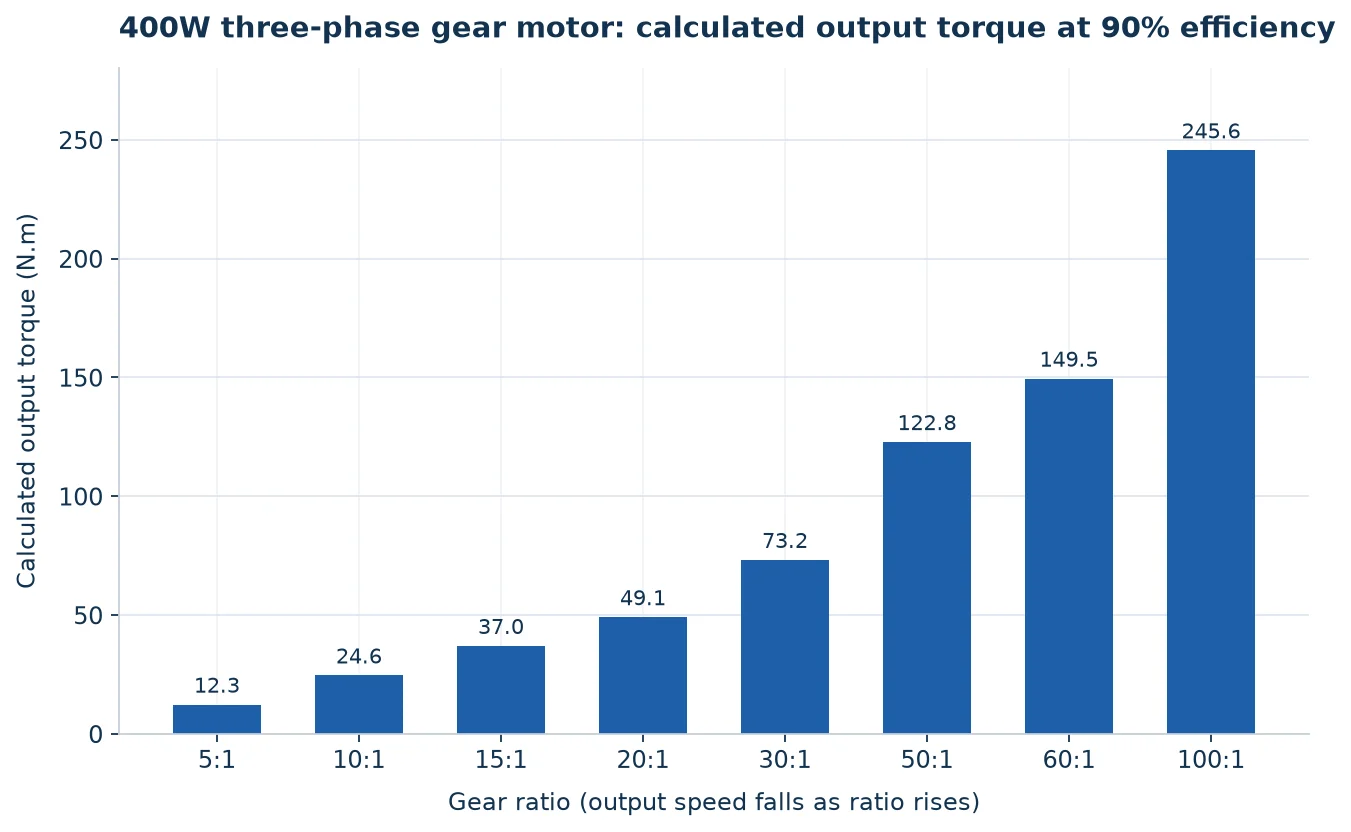
Using a 4-pole motor at about 1400 r/min and an efficiency of 0.90, the calculated figures look like this.
Tỷ lệ
Output speed at 50 Hz
Calculated output torque (η = 0.90)
5:1
280 r/min
12.3 N·m
10:1
140 r/min
24.6 N·m
15:1
93 r/min
37.0 N·m
20:1
70 r/min
49.1 N·m
30:1
47 r/min
73.2 N·m
50:1
28 r/min
122.8 N·m
60:1
23 r/min
149.5 N·m
100:1
14 r/min
245.6 N·m
Two qualifications keep this table honest. First, it is the theoretical capability of a 400W input at 90% efficiency — the gearbox’s own allowable load rating is a separate number and can be the lower of the two at high ratios, so the specific model rating must be confirmed for the ratio you choose. Second, it takes no service factor. A 400W drive selected at exactly its calculated torque has no margin for shock, frequent starts or a jam, and should be multiplied up before the model is fixed.
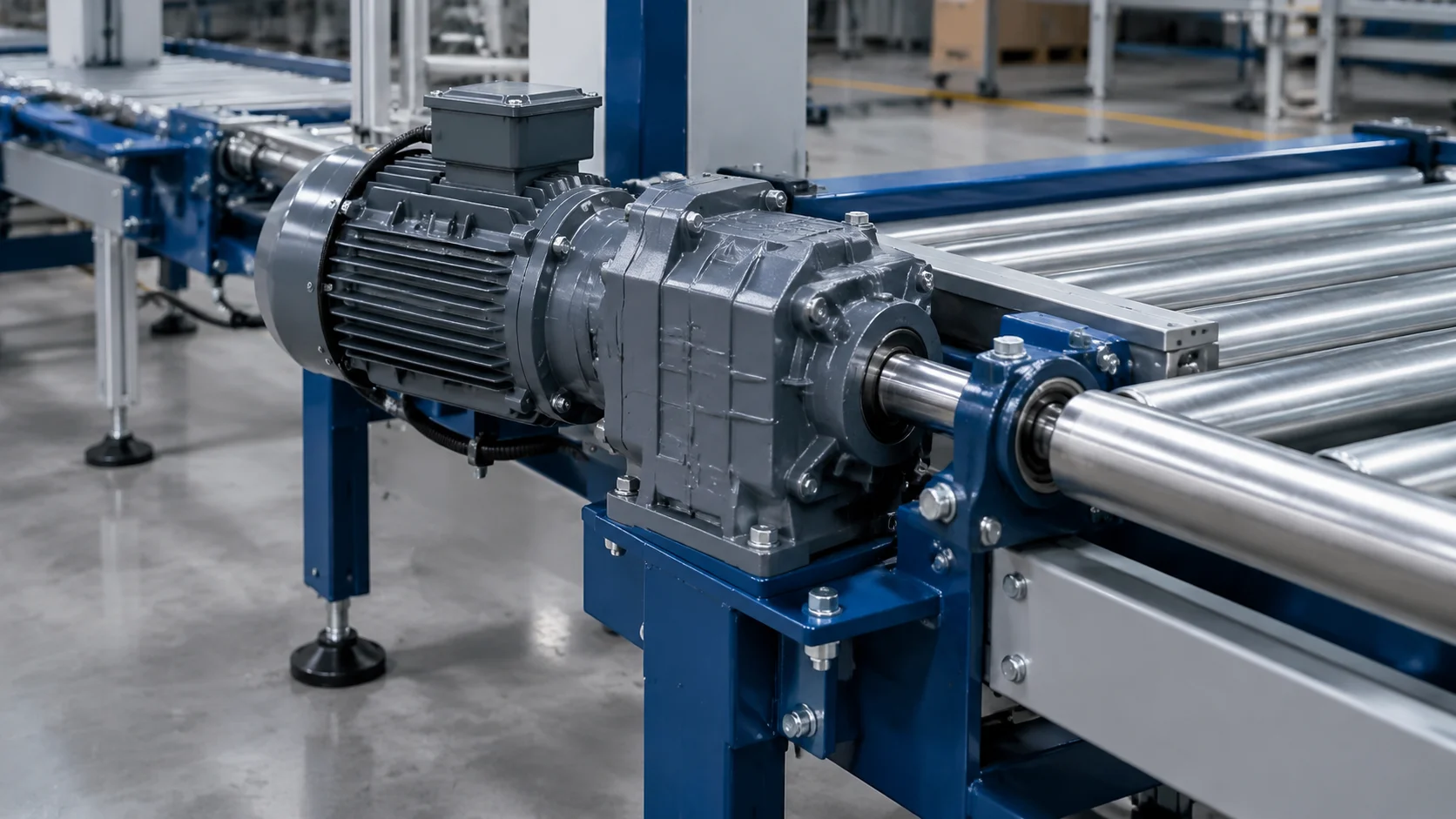
A pallet conveyor with a chain drive needs 12 r/min at the head shaft and the load calculation gives 180 N·m running torque, with starts under load and a reversing cycle for two-way transfer.
Tỷ lệ: 1400 ÷ 12 ≈ 117, so choose 100:1 as the nearest standard ratio. Actual output becomes 14 r/min, 17% above target — usually acceptable on a transfer conveyor, but check that the control sequence tolerates it.
Calculated torque: the table gives 245.6 N·m at 100:1. Against 180 N·m that is a 36% margin.
Hệ số dịch vụ: reversing with starts under load is a moderate-shock duty. Applying 1.5 gives a required 270 N·m, which exceeds the calculated capability at 100:1. The honest options are a 120:1 ratio, a 750W unit at 100:1, or reducing the start load mechanically.
Gearbox check: confirm the specific gearbox’s allowable output torque at 100:1 — on medium frames this is often the binding limit rather than the motor.
Starter: 400W at 380 V draws roughly 1.2 A full load with a start current several times higher. Size the thermal overload to the nameplate current and use a contactor rated for the start current, not for the running current.
What you must re-check when upgrading from a small frame
Retrofits are where 400W causes the most trouble, because the mechanical and electrical infrastructure around the old drive was sized for a fraction of the load. Six items need re-verification.
Mounting plate and bracket stiffness. A 12 kg motor at 73 N·m of reaction torque will flex a bracket that was fine for a 4 kg unit. Check for deflection under load, not just bolt spacing.
Coupling and keyway. The 22 mm shaft needs a matching bore and a key rated for the torque; an old 14 mm coupling cannot be adapted with a bush at this torque level.
Tải trọng nhô ra. A sprocket positioned the same distance from the housing applies roughly three times the radial force it did at 90W. Either move the load closer to the shoulder or add a support bearing.
Starter and protection. Three-phase drives need a contactor, thermal overload and correctly sized cable. A direct-on-line start at this power is normal on a stiff supply but should be checked on a long or weak feeder.
Control logic. Reversing at 400W needs a proper reversing starter with an interlock, and a delay between direction changes so the drive decelerates before it is re-energised.
Gearbox lubrication. Medium frames are commonly oil-filled rather than grease-packed. Confirm the oil grade, the fill level and whether the unit is supplied already filled for the mounting orientation you are using.
Vertical or horizontal: decide at the specification stage
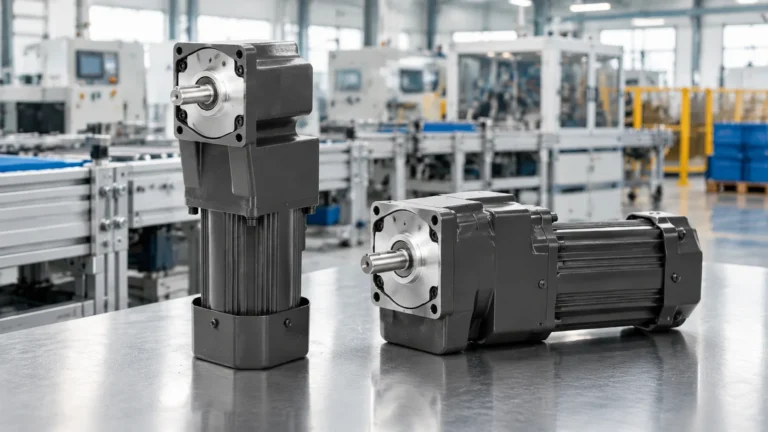
The 400W unit is offered in both vertical and horizontal configurations, and this is not a cosmetic choice. The horizontal version has its output shaft parallel to the mounting surface and suits conventional conveyor and machine base layouts. The vertical version places the motor above or below the gearbox so the output faces down or up, which is the right answer when the driven shaft is vertical — a mixer, an agitator, a vertical screw or a rotary table — and the wrong answer when the machine only has a space problem, because a vertical unit raises the centre of gravity and puts the output seal at the bottom where any leakage is visible.
Choose the configuration from the direction of the driven shaft first, then check that the surrounding structure has room. If the driven shaft is horizontal and the constraint is side clearance, the right answer is usually a different gearbox arrangement rather than a vertical mounting.
Where 400W stops and 750W starts
400W and 750W are the two workhorses of the medium range, and the decision between them is usually about torque margin and shaft size rather than a step in power.
Item
400W
750W (≈1 HP)
Trục ra
22 mm
28 mm
Supply
3-phase 220 V / 380 V
3-phase 220 V / 380 V
Mounting
Vertical or horizontal
Vertical or horizontal
Calculated torque at 30:1
≈ 73 N·m
≈ 138 N·m
Cách sử dụng thông thường
Pallet and chain conveyors, packaging machines, small mixers
Heavy conveyors, agitators, pumps, lifting screws
If your requirement sits within about 60% of the 400W capability at the ratio you need, 400W is the economical answer. If it sits at or above that, the 750W AC gear reducer motor gives double the torque and a larger shaft for the same electrical supply — and the 28 mm shaft is often the real reason to move up, because a 22 mm shaft carrying a heavy overhung sprocket at 400W torque is a bearing life problem waiting to happen.
When 400W is the wrong choice
Three situations call for a different answer rather than a bigger frame.
Only single-phase power is available. There is no 400W single-phase model. Either install a phase converter — and accept the derating and starting limitations that come with it — or stay at 250W, where single-phase 220 V is standard. The 250W frame carries up to 43 N·m.
The load has high inertia and needs controlled acceleration. A 400W induction motor started direct-on-line accelerates hard. If the machine needs a ramp, add a VFD, which also lets you run the drive above or below nominal speed within the motor’s thermal limits.
The duty is precise positioning. An induction gear motor has no encoder and no holding torque at zero speed. If the axis needs repeatable stop positions under load, the correct answer is a brake motor or a servo drive, not a larger AC unit — the failure modes are described in diagnosing a geared motor that will not turn.
Information to send for a 400W quotation
Include: required output speed in r/min; load torque, or the mass and radius being driven; duty cycle with starts per hour and reversing; available supply voltage and whether 220 V or 380 V three-phase; vertical or horizontal configuration and the direction of the driven shaft; shaft, keyway and flange requirements; ambient conditions and any washdown or dust exposure. Add the driven element type — conveyor, mixer, screw, rotary table — because it determines the service factor the sizing needs.
Cái 400W AC gear reducer motor page lists the standard 22 mm shaft, the 3-phase 220 V / 380 V options, both mounting configurations and the dimension drawing, so you can check the mechanical fit before requesting a ratio.
Câu hỏi thường gặp
Is a 400W gear motor single-phase or three-phase?
Three-phase only, available in 220 V or 380 V. There is no single-phase 400W model in this range; the largest single-phase option is 250W.
What is the output torque of a 400W gear motor?
It depends entirely on the ratio. Calculated at 90% efficiency, a 400W input gives about 24.6 N·m at 10:1, 73 N·m at 30:1 and 245 N·m at 100:1. Confirm the gearbox’s own allowable load for the ratio you select, since it may be the lower figure.
What size shaft does a 400W gear motor have?
A standard 22 mm output shaft. The 750W model in the same range uses 28 mm, and the small frames use 12–15 mm.
Can a 400W gear motor be mounted vertically?
Yes, a vertical configuration is available alongside the horizontal one. Choose it when the driven shaft is vertical, and check that the oil level and seal position match the orientation.
How much current does a 400W gear motor draw?
Around 1.2 A full load at 380 V three-phase, and roughly double that at 220 V three-phase. Starting current on a direct-on-line start is typically four to seven times the full load figure, so size the contactor and overload accordingly.
Can I run a 400W gear motor on a VFD?
Yes. A VFD gives controlled acceleration, reversing without a reversing starter, and speed adjustment, but the motor’s cooling falls with speed, so continuous operation well below nominal speed needs a torque and temperature check.
Bottom line
Treat 400W as an engineering change, not a power upgrade. It brings three-phase supply, a 22 mm shaft, a heavier housing and a starter that must be sized for real starting current. Calculate the output torque from your chosen ratio rather than from the power rating, apply a service factor for the actual load, and confirm the gearbox allowable load — then decide vertical or horizontal from the driven shaft direction. Get those four right and 400W is the most cost-effective drive in the medium range; skip one and the machine will be re-engineered around the motor.
So sánh động cơ bánh răng góc vuông và động cơ bánh răng thẳng dựa trên bảng tải trọng cho phép thực tế: hiệu suất, mô-men xoắn, “lầm tưởng về khả năng tự khóa” và cách đưa ra quyết định qua năm bước.
Hướng dẫn lắp đặt động cơ bánh răng 750W (khoảng 1 HP): những điểm khác biệt giữa lắp đặt theo phương thẳng đứng và phương ngang, mức dầu, bảo vệ phớt, tải trọng dọc trục và mô-men xoắn theo tỷ số truyền.
Cách lựa chọn công suất cho động cơ giảm tốc AC 25W trên khung 4RK 80 mm: tốc độ đầu ra, tải cho phép từ 0,45 đến 7,84 N·m, mô-men xoắn tối đa, chu kỳ làm việc và các lựa chọn điện áp.