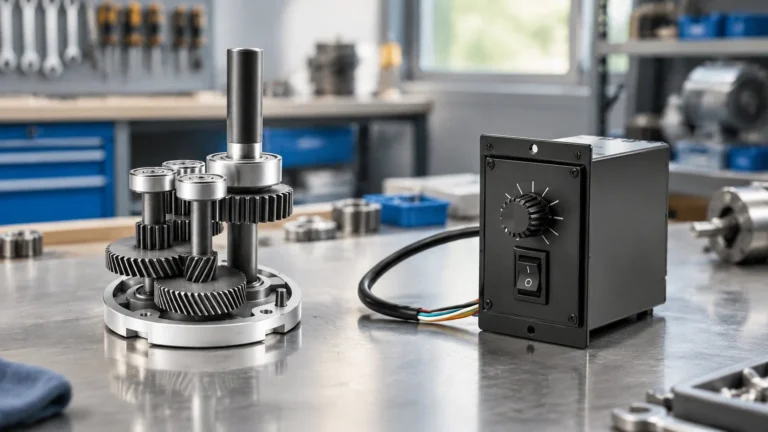
Three-Phase Gear Motor: 220V/380V Wiring and Selection Guide
প্রকাশিত: লেখক: লিসা
A three-phase gear motor is usually bought by someone who already has three-phase power on site — a 380 V distribution board, a contactor in the panel, and a maintenance team that knows what a thermal relay is. That is a different starting point from the buyer choosing between phase types from scratch. The question is not “should I use three-phase?” but “which three-phase unit, at what voltage, wired how, and protected by what?”
This guide covers the electrical side of a three-phase gear motor specification: the 220 V and 380 V connections inside the terminal box, what the winding actually sees, how much current the starter must survive, how to set the overload relay, and where the phase type quietly limits which frame size you can order. Every number below is tied to the compact AC series we build — 15 W to 300 W on the ছোট এসি গিয়ার রিডাক্সার মোটর range, and 400 W upward on the medium frames.
What three-phase actually buys you on a gear motor
Three benefits matter commercially, and one of them is not what buyers expect.
সম্পত্তি
Single-phase gear motor
Three-phase gear motor
ব্যবহারিক প্রভাব
Starting torque
Roughly 1.2–1.8 × rated torque
Roughly 2.0–2.5 × rated torque
Three-phase starts a loaded conveyor or a settled slurry that single-phase stalls on
Run capacitor
Required; a wear item
None
One less field failure, and no torque dip as the capacitor ages
Frame power ceiling
Around 120–200 W in practice
No practical ceiling at this scale
Above roughly 200 W, three-phase is the only realistic option
Wiring cost
Two conductors plus earth
Three conductors plus earth
One more core, and the site must actually have a three-phase supply
Direction reversal
Swap the capacitor / winding leads
Swap any two of the three phases
Three-phase reversal is simpler and works under load
Starting current
High relative to rating, but small in absolute terms
4–7 × full load current on direct-on-line start
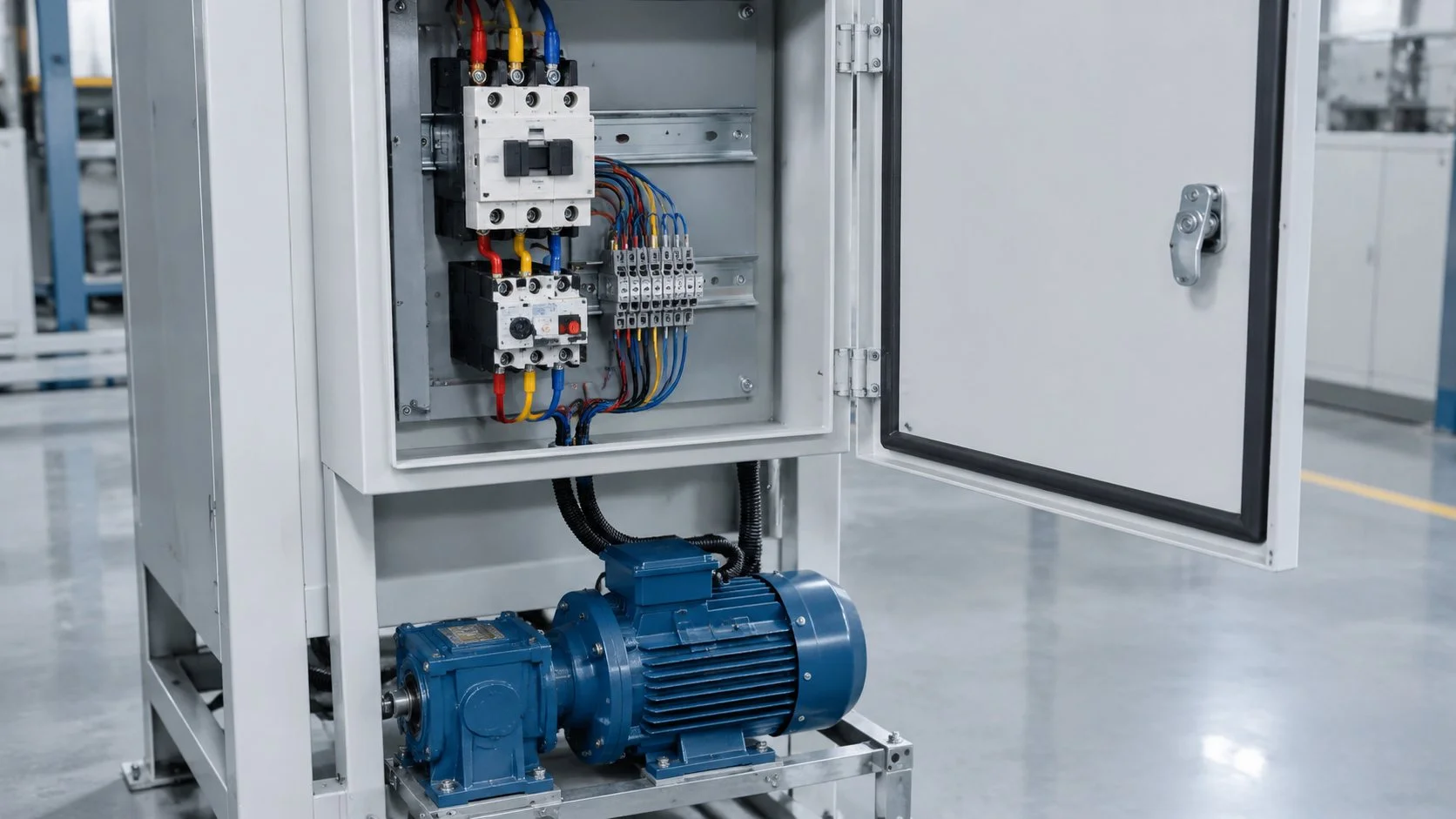
Needs a proper contactor, overload relay and cable sizing
The row that catches buyers is the last one. A 120 W three-phase motor drawing about 0.4 A at full load will pull 2–3 A for the fraction of a second it takes to accelerate. That is trivial for the supply but not trivial for the switchgear if the same panel also feeds a dozen other drives and the contactor was sized on running current alone.
220 V and 380 V are usually the same motor in two connections
A three-phase induction motor has three windings. How you link them decides the voltage each winding sees, and therefore what supply voltage the motor can be connected to.
Star (Y) connection — one end of all three windings is tied together at a neutral point. Each winding sees the phase voltage, which on a 380 V system is about 220 V. Line current equals winding current.
Delta (Δ) connection — the windings are linked end to end in a triangle. Each winding sees the full line voltage, 380 V. Line current is √3 times the winding current.
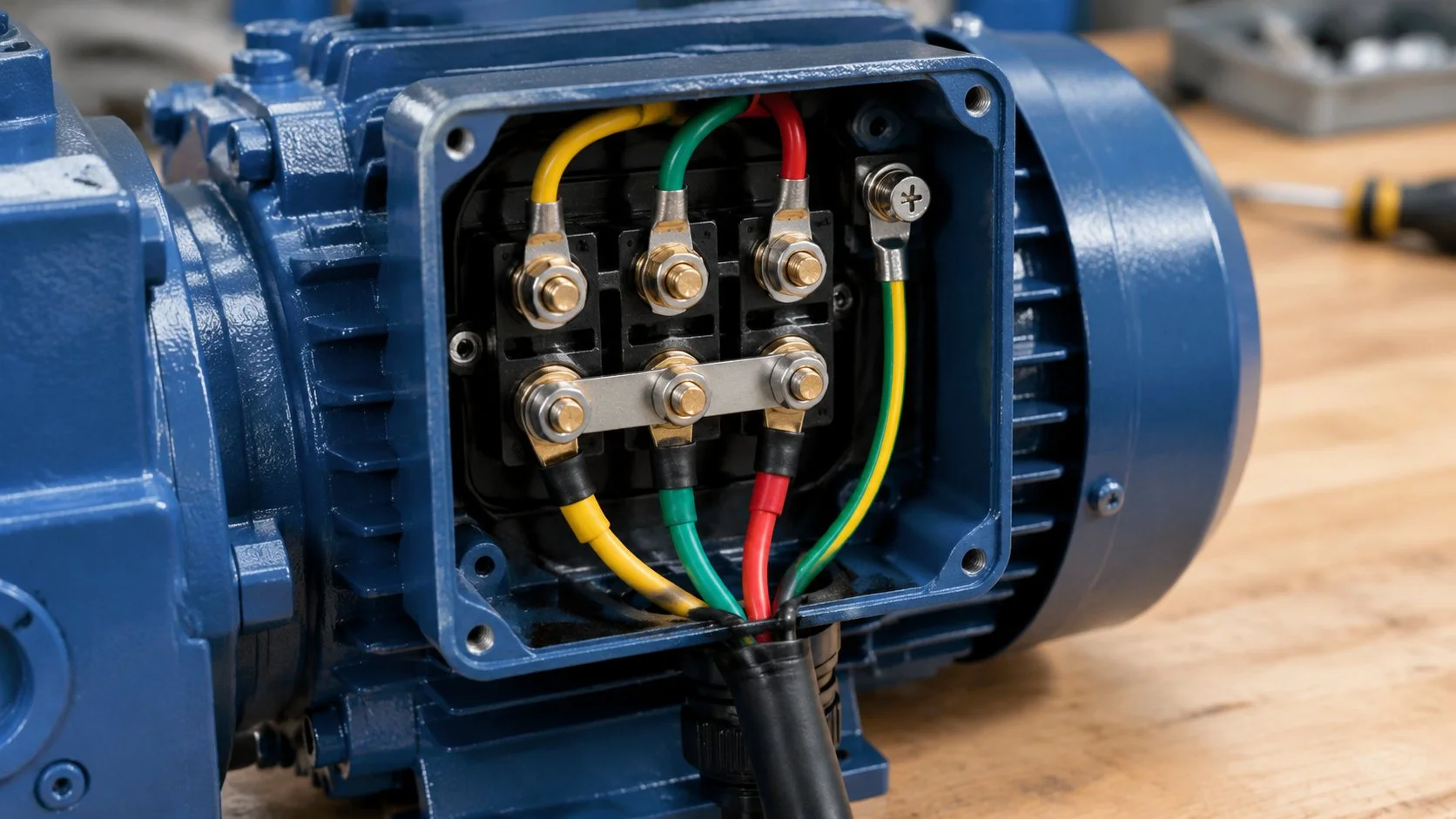
On a dual-rated motor — nameplate reading something like 220 V Δ / 380 V Y — a single link bar across the lower terminals gives star, and three link bars down the columns give delta. The practical rule field electricians use is that the links lie flat for star and stand vertical for delta. Getting it wrong is not a subtle error: a 220 V winding connected to 380 V will draw several times its rated current and destroy itself in minutes, and a 380 V winding connected in star to a 380 V supply will simply produce about a third of its rated torque and overheat under load.
Two details are worth checking before the terminal cover goes back on. First, not every compact gear motor is dual-rated. Many of our small-frame three-phase units are wound for one voltage only — the 40 W three-phase model is a 220 V unit and the 120 W three-phase model is a 380 V unit, even though both sit on the same 90 mm frame. The voltage is a winding choice made at order, not a connection choice made at installation. Second, the earth terminal is separate from the winding terminals and must be landed on the motor frame, not on the terminal block screw.
Read the nameplate before you choose a starter
Four nameplate fields decide the starter, and they are the four most often copied incorrectly onto a purchase order.
Nameplate field
What it fixes
Common error
Voltage and connection (e.g. 380 V Y)
Supply voltage and link configuration
Ordering 380 V for a 220 V three-phase site
Full load current (A)
Overload relay setting and cable size
Setting the relay on motor power instead of current
Frequency (50 or 60 Hz)
Output speed; torque changes with it
Assuming a 50 Hz unit will hold its speed at 60 Hz
Duty (continuous or 30-minute)
How long the motor may run at rated load
Treating a reversible model as a continuous-duty drive
Frequency is the one that surprises people, because the gearbox ratio is fixed while the motor speed is not. A 4-pole motor at 50 Hz runs at about 1350–1400 r/min under load; at 60 Hz the same motor runs roughly 20% faster, so the output shaft speeds up by the same proportion and the available torque at a given power falls by about 17%. If your machine’s cycle time was calculated on 50 Hz and the site runs 60 Hz, the drive will be fast and weak rather than fast and strong. The frequency question, and the single-phase alternative in more detail, is covered in our guide to phase type and supply frequency.
Sizing the circuit: inrush, protection and cable
Three numbers get the electrical design right.
Starting current. Direct-on-line starting draws 4–7 times full load current for the acceleration period. For a compact gear motor this is normally acceptable — the motor is small, the acceleration is short, and star-delta or soft starting is not worth the panel space. It becomes a problem when many drives start simultaneously on a weak supply, or when the supply transformer is already heavily loaded.
Overload relay setting. Set the thermal overload to the motor’s full load current from the nameplate, not to the contactor rating and not to a calculated value. For a 120 W three-phase unit that is typically well under 1 A, which means the relay must be a low-range type; a standard 4–6 A relay cannot protect a motor this small and will never trip before the winding fails.
Cable size. Size on current and volt drop together. On long runs at 380 V, the volt drop matters more than the current capacity, because a motor that sees 10% low voltage draws more current for the same output and runs hotter. A 20 m run to a 400 W drive is unremarkable; the same run to a 0.4 A motor on a thin core is where nuisance trips appear.
Overload relay setting = motor full load current (A) from nameplate
Contactor rating       ≥ motor full load current × 1.25
Cable                  sized on current, then checked for volt drop ≤ 5%
Starting current       expect 4–7 × full load current, DOL
Direction, phase sequence and the two-wire swap
Reversing a three-phase gear motor is done by interchanging any two of the three supply conductors. Two consequences follow, and both cause field problems.
The first is that a motor connected to a supply with an unexpected phase sequence will run backwards on first start. On a gear motor driving a conveyor, a pump or a lifting screw, the first start in the wrong direction can mechanically damage the machine before anyone reaches the stop button. Confirm rotation with the driven element disconnected, or with the coupling removed, before the machine is loaded.
The second is that reversing under load is not the same as reversing at standstill. Interchanging two phases while the motor is running plugs it — the rotating field reverses and the motor acts as a brake until it comes up to speed the other way. That produces several times rated current and a large torque shock through the gearbox. On a reversible-rated gear motor, allow a dwell of at least a few tenths of a second at standstill between direction commands; the exact interval depends on load inertia.
Where the phase choice limits the frame you can order
This is the part of the specification that is decided by the catalogue rather than the engineer. Within the compact AC range the phase options are not uniform across power ratings.
Power band
ফ্রেম
Single-phase
Three-phase
Note
15 W – 25 W
70–80 mm
110 V / 220 V
220 V
Most compact option; three-phase rarely specified at this size
40 W
90 mm
110 V / 220 V
220 V
Three-phase is 220 V, not 380 V — check before ordering
90 W – 120 W
90 mm
110 V / 220 V
380 V
Top of the small frame; 19.6 N·m load ceiling
400 W and above
Medium
Not available
220 V / 380 V
22 mm shaft upward; starter and cable sizing become design inputs
Frame dimensions, shaft sizes and mounting patterns for each of these are collected in the গিয়ার মোটর আকারের চার্ট, which is the faster reference when the question is whether a new drive will bolt onto an existing bracket. If the 90 mm frame is the one that fits your machine, the choice inside it is usually between the 90 W three-phase unit and the 120 W version on the identical mounting pattern — the difference is torque headroom, not footprint.
Running a three-phase gear motor where only single-phase exists
Sites in parts of Southeast Asia frequently have single-phase 220 V available and nothing else, while the machine was designed around a three-phase drive. Three options exist and only one of them is honest.
Buy the single-phase version of the same frame. Where it exists — and up to 120 W it usually does — this is the correct answer. Same mounting, same gearbox, same ratio, no conversion equipment.
Use a variable frequency drive rated for single-phase input. A VFD that accepts 220 V single-phase in and produces three-phase out will run the motor, and gives speed control as a bonus. It must be derated for single-phase input, and the motor must be inverter-capable if the cable run is long.
Use a static or rotary phase converter. Workable for a workshop with several three-phase machines, poor value for one small gear motor, and rotary converters add audible noise and maintenance.
What does not work is wiring a capacitor across one phase of a three-phase motor to “make it single-phase”. The result is low starting torque, unbalanced winding currents and rapid overheating. It is a get-you-home trick, not a design.
Mistakes that repeat in three-phase gear motor projects
Mistake
What actually happens
Fix
Ordering 380 V because the site “has three-phase”
Site turns out to be 220 V three-phase; motor cannot be connected
Confirm line voltage at the board, not the building’s nominal supply
Setting the thermal relay to the contactor rating
Motor burns out without the relay ever tripping
Set on nameplate full load current; use a low-range relay
Assuming 60 Hz is a free speed increase
Machine runs fast, output torque drops ~17% at the same power
Re-check the torque requirement at 60 Hz before approving
Reversing with no dwell
Plugging current and torque shock through the gearbox
Add a standstill delay in the control logic
Ignoring phase sequence on first start
Machine runs backwards under load
Check rotation uncoupled, then connect the driven element
Once these five are settled, the mechanical selection is the easier half: ratio for speed, allowable load for torque, and frame for mounting. The step-by-step order for that is in the practical gear motor selection guide. For most projects built around 90 W to 120 W, the 120 W three-phase gear motor is the natural starting point — 90 mm frame, 380 V three-phase, ratios from 3:1 to 500:1 and a 19.6 N·m allowable load ceiling. If the load is lighter and the site is 220 V three-phase, the 40 W three-phase unit on the same frame is the cheaper answer. Above roughly 200 W the decision moves to the medium frames entirely, where a 400 W three-phase drive brings a 22 mm shaft and a very different mounting and starting story.
উপসংহার
Three-phase gear motor selection is mostly an electrical document problem. Confirm the line voltage and which winding you are being quoted, connect the links to match, set the overload on nameplate current, size the cable for volt drop, verify rotation before loading the machine, and put a dwell in the reversing logic. None of that is difficult, and all of it is cheaper to do before the panel is wired than after.
The mechanical choices — power, ratio, frame — then follow from the load. If you send us the supply voltage, the required output speed and the load torque or the application, we will confirm which frame and winding fits and what the allowable load is at the ratio you need.
প্রায়শই জিজ্ঞাসিত প্রশ্নাবলী
Can I connect a 380 V three-phase gear motor to a 220 V three-phase supply?
Only if the nameplate is dual-rated (for example 220 V Δ / 380 V Y) and you reconnect the windings to delta. A motor wound for 380 V only cannot be run on 220 V without losing most of its torque.
Why is a 40 W three-phase gear motor 220 V while a 120 W one is 380 V?
Because the winding is an order option, not a universal feature. On the same 90 mm frame the manufacturer winds for the market the unit is built for, and small three-phase drives in some regions are specified at 220 V three-phase.
Do I need a star-delta starter for a three-phase gear motor?
No. Star-delta starting is for large motors where the 4–7× inrush is a problem for the supply. On a compact gear motor of a few hundred watts, direct-on-line starting with a correctly set overload relay is simpler and adequate.
How do I reverse a three-phase gear motor?
Interchange any two of the three supply conductors, usually with a reversing contactor. Allow the motor to come to standstill before the next direction command to avoid plugging current.
Is a three-phase gear motor more efficient than a single-phase one?
Yes, typically by a few percentage points, mainly because there is no run capacitor loss and the winding utilisation is better. The bigger practical advantages are higher starting torque and no capacitor to fail.
Can I run a three-phase gear motor from a single-phase inverter?
Yes, with a VFD rated for single-phase input and derated accordingly. It is a common solution where only single-phase power is available, and it adds speed control — but check that the motor is suitable for inverter duty if the cable run is long.
Agitator drives fail on starting torque and thrust load, not on kilowatts. How to calculate impeller power, convert it to shaft torque, and where a gear motor stops being the right drive.
The 30-minute rating on a reversible gear motor is a thermal statement, not a timer. What it limits, how to read your duty cycle against it, and how to run longer without buying the wrong motor.
How a speed controller actually slows an AC gear motor, why torque falls to about a third at the bottom of the range, how to wire it, and when a VFD or a different gear ratio is the better answer.