Parallel-Shaft vs Right-Angle Gear Motor: Which Fits Your Machine
Right-angle vs inline gear motor compared with real allowable load tables: efficiency, torque, the self-locking myth and how to decide in five steps.
Baca Selengkapnya
A 90W gear motor is the middle of the small AC range and the power class most often specified for packaging lines and short belt conveyors. It is also the class where buyers most often assume the wrong thing: that 90W means a fixed amount of torque. It does not. On a 90 mm 5RK frame the bare motor gives 670 mN·m at 1350 r/min, and the gearbox in front of it turns that into anything from 1.54 N·m at 3:1 to 19.6 N·m at 50:1 and above. Pick the ratio first and the torque follows; pick the power first and you will be guessing.
This guide uses the published 5RK 90 mm data for both the 90W and 120W variants so you can size a drive from your own load numbers, check it against the allowable load table, and know exactly where the frame runs out of capability.
Two sets of figures matter and they are measured in different places. Motor-side figures describe the bare motor at rated speed with no load attached. Gearbox-side figures describe what arrives at the output shaft after the reduction ratio and the gearbox losses. Catalogs that quote only one set, or that quietly multiply motor torque by the ratio, are the reason so many 90W drives end up undersized on the first shift.
| Model | Tugas | Power | Tegangan | Frekuensi | Saat ini | Torsi awal | Rated torque | Rated speed | Capacitor |
|---|---|---|---|---|---|---|---|---|---|
| 5RK90GU-CF | Dapat dibalik, 30 menit | 90 W | 1 fasa 220 V | 50 Hz | 0.68 A | 837 mN·m | 670 mN·m | 1.350 putaran per menit | 6/450 μF/VAC |
| 5RK90A-CF | Continuous | 90 W | 1 fasa 220 V | 60 Hz | 0.72 A | 692 mN·m | 544 mN·m | 1.550 putaran per menit | 6/450 μF/VAC |
| 5RK90GU-AF | Dapat dibalik, 30 menit | 90 W | 1 fasa 110 V | 50 Hz | 1.38 A | 837 mN·m | 670 mN·m | 1.350 putaran per menit | 24/250 μF/VAC |
| 5RK90GU-UF | Dapat dibalik, 30 menit | 90 W | 3-phase 380 V | 50 Hz | 0.32 A | 837 mN·m | 670 mN·m | 1.350 putaran per menit | — |
| 5RK120GU-CF | Dapat dibalik, 30 menit | 120 W | 1 fasa 220 V | 50 Hz | 0.95 A | 1137 mN·m | 910 mN·m | 1.350 putaran per menit | 8/450 μF/VAC |
| 5RK120A-CF | Continuous | 120 W | 1 fasa 220 V | 60 Hz | 1,00 A | 955 mN·m | 764 mN·m | 1500 r/min | 8/450 μF/VAC |
Two patterns in this table drive most real selection decisions. First, starting torque is only about 1.25 times rated torque, so a load that needs 2.5 times rated torque to break away will hum instead of turning. Second, the same motor on a 60 Hz supply loses roughly 19% of its rated torque while running 15% faster — the ratio must be recalculated, not carried over from a 50 Hz datasheet.
The output shaft does not deliver motor torque multiplied by the ratio. It delivers what the gearbox is rated to carry at that ratio, which is a thermal and mechanical limit rather than a mathematical one.
| Rasio | Output speed at 50 Hz | 90W max allowable load | 120W max allowable load |
|---|---|---|---|
| 3:1 | 500 r/min | 1.54 N·m (15.7 kg·cm) | 2.11 N·m (21.5 kg·cm) |
| 5:1 | 300 r/min | 2.60 N·m (26.5 kg·cm) | 3.52 N·m (36 kg·cm) |
| 7.5:1 | 200 r/min | 3.86 N·m (39.4 kg·cm) | 5.28 N·m (54 kg·cm) |
| 10:1 | 150 r/min | 5.15 N·m (52.5 kg·cm) | 6.88 N·m (70 kg·cm) |
| 15:1 | 100 r/min | 6.96 N·m (71 kg·cm) | 9.60 N·m (98 kg·cm) |
| 20:1 | 75 r/min | 9.28 N·m (94.6 kg·cm) | 12.4 N·m (126 kg·cm) |
| 25:1 | 60 r/min | 11.6 N·m (118 kg·cm) | 14.5 N·m (148 kg·cm) |
| 30:1 | 50 r/min | 13.9 N·m (141 kg·cm) | 18.5 N·m (189 kg·cm) |
| 40:1 | 37 r/min | 18.5 N·m (189 kg·cm) | 19.6 N·m (200 kg·cm) |
| 50:1 | 30 r/min | 19.6 N·m (200 kg·cm) | 19.6 N·m (200 kg·cm) |
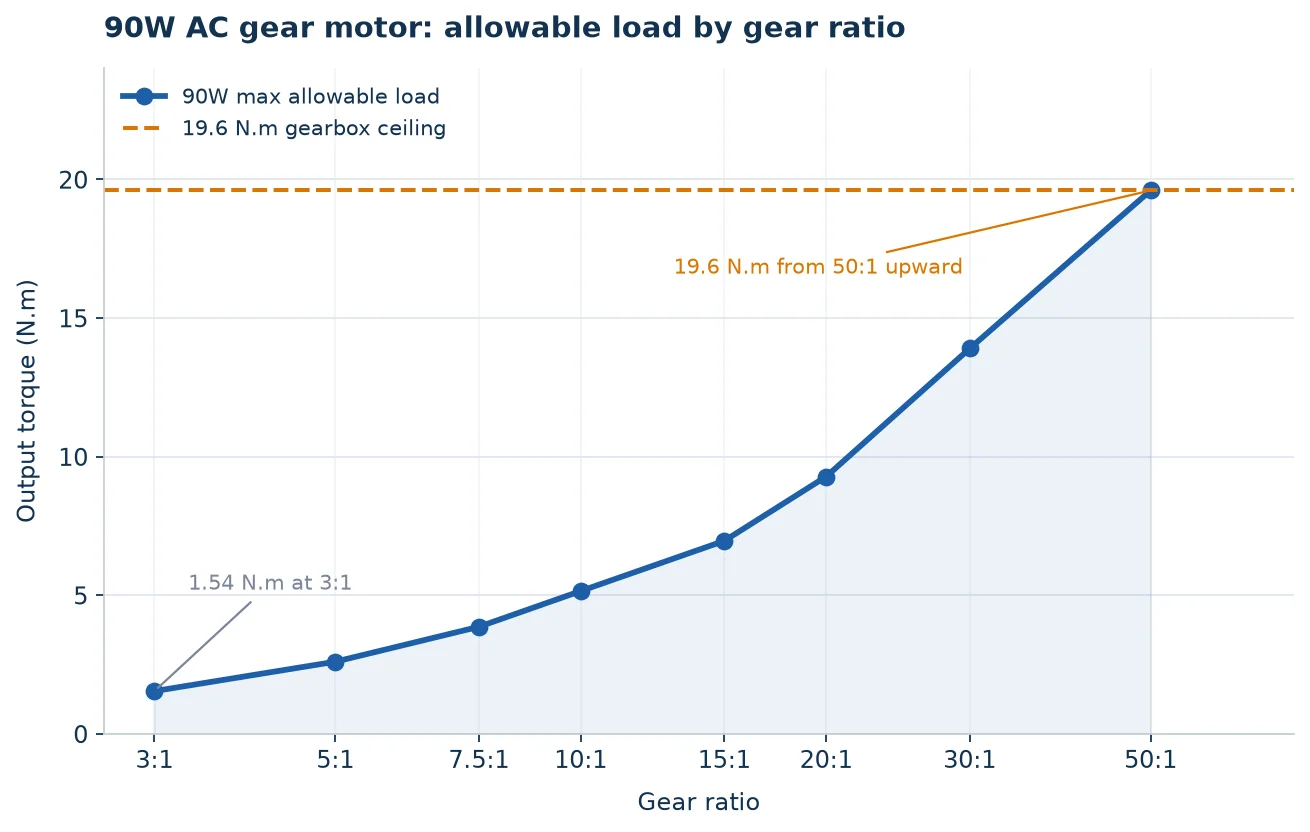
Notice that the 90W and 120W columns converge at 50:1. Beyond that point the gearbox, not the motor, is the constraint, so paying for 120W buys nothing extra at 75:1. That is the single most useful fact in this table for anyone comparing quotes.
Three forces push machine builders towards 90W rather than a step up or down. The 90 mm frame fits inside a standard packaging machine base without a redesign. At 30–50:1 it lands in the 30–50 r/min band where most belt, roller and screw conveyors actually run. And it starts against a modest breakaway load without a soft starter, because 90W single-phase draws under 0.7 A at 220 V and the inrush is manageable on a normal circuit.
The class also sits at the point where a machine is likely to be sold into more than one market. A 90W drive is available in single-phase 110 V and 220 V and in three-phase 380 V on the same frame, so an OEM can serve North America, Southeast Asia and the Middle East from one mechanical design with only the electrical variant changing.
The reliable order is: required output speed, then gear ratio, then load torque read from the table, then electrical and mechanical checks. Working in any other order produces a drive that fits one constraint and fails another.
A carton infeed belt needs 40 r/min at the drive roller and your load calculation gives 11 N·m at the roller shaft, with the belt fed in bursts rather than continuously.
If the ratio arithmetic itself is unfamiliar, the method is set out step by step in how to calculate gear ratio of a gear reduction motor.
Ratios up to 500:1 exist on this gearbox, but the allowable load stops rising at 19.6 N·m. Anything much above 20 N·m at the output shaft is not a 90W or 120W job, regardless of the ratio printed on the nameplate. The practical escapes are:
The GU models carry a reversible 30-minute rating. That figure defines how long the winding can run before reaching its insulation temperature limit at rated load, and it assumes the motor gets rest periods. A GU unit run continuously in one direction will run hotter than the continuous-duty A model of the same power, because the thermal design counts on the pauses.
Decide from the actual cycle. A diverting gate that moves twice a minute for 20 seconds is a reversing application and the GU model is correct. A cooling-fan drive that runs eight hours a day without stopping is continuous duty and the A model is correct, even though the duty label looks less impressive on a quotation. If your cycle gives no real rest period, treat it as continuous.
The mechanical frame is identical across electrical variants; only the winding, the capacitor and the current change. Single-phase 220 V covers most Southeast Asian and Middle Eastern single-phase supplies. Single-phase 110 V suits North American sites and needs the larger 24/250 capacitor. Three-phase 380 V is the better engineering choice wherever a three-phase distribution already exists: no run capacitor to fail, lower current, and no capacitor-induced torque dip at start.
Frequency is the trap. The same unit at 60 Hz runs at 1550 r/min instead of 1350 r/min, so every output speed on the table shifts by about 15% and available torque drops. A ratio chosen from a 50 Hz sheet will over-speed a 60 Hz machine. The wider comparison of phase and frequency effects is covered in single-phase vs three-phase AC gear motors.

The 90 mm frame sits between two neighbours and the choice is usually mechanical rather than electrical.
All frame dimensions across the range are collected in the Tabel Ukuran Motor Roda Gigi if you need to confirm clearances before committing to a layout.
A 90W unit is normally supplied as a flange mount, with foot mount available. Two mechanical checks are routinely skipped. The first is overhung load: a sprocket or pulley sitting far out on the shaft applies a radial force that the output bearing must carry, and that limit is separate from the torque limit. Keep the load close to the housing shoulder and use a support bearing on long shaft extensions. The second is reaction torque: a gear motor needs a torque arm or a solid flange fixing, because the housing will try to rotate in the opposite direction to the shaft.
Flange and coupling options, torque arms and shaft kits are described in the panduan aksesori motor roda gigi.
Yang conveyor gear motor selection guide covers the belt-speed and pulley-diameter side of the same calculation if the driven element is a conveyor.
Suppliers can only quote accurately from a described load, not a power figure. Send: required output speed in r/min, load torque or the mass and radius being driven, duty cycle including starts per hour and whether the drive reverses, supply voltage, phase and frequency, mounting orientation and available space, and any shaft, flange or cable modification required. With those seven items a model and ratio can be confirmed in one exchange instead of four.
Yang 5RK 90W AC gear motor page carries the full motor table and allowable load data for both the 90W and 120W variants, so you can check your own duty against the published figures before contacting us.
19.6 N·m (200 kg·cm) at the output shaft, reached at 50:1 and held on every higher ratio. The bare motor produces 670 mN·m at 1350 r/min; the gearbox supplies the rest.
From 500 r/min at 3:1 down to about 2.7 r/min at 500:1 at 50 Hz, with actual speed running 2–15% below the synchronous figure depending on load.
The reversible GU models are rated 30 minutes. For continuous one-direction duty specify the A model of the same frame and power.
Usually yes for belts up to about 1.5 m carrying light product at 30–60 r/min, provided the calculated load stays below roughly 10 N·m. Inclined belts, heavy product or frequent starts under full load need a 120W or 250W unit.
The GU model is reversible with a 30-minute rating at 50 Hz; the A model is the continuous-duty version, with 60 Hz data published on the same row. Both use the same 90 mm frame.
Yes, with a single-phase speed controller rated for the motor current. Reducing speed also reduces the fan cooling, so a continuous low-speed duty needs a torque and temperature check rather than just a dial setting.
Size a 90W gear motor from output speed and load torque, then confirm the ratio against the allowable load table, then check the 19.6 N·m ceiling before assuming a higher ratio will solve anything. Match voltage, phase and frequency to the site supply, decide reversible or continuous from the real cycle, and verify overhung load and reaction torque at the mounting. Get those five right and a 90W drive will sit inside its thermal and mechanical limits for years.