SEW Gear Motors: Series Overview, Specs & Cost-Effective Alternatives
Diterbitkan: Penulis: Lisa
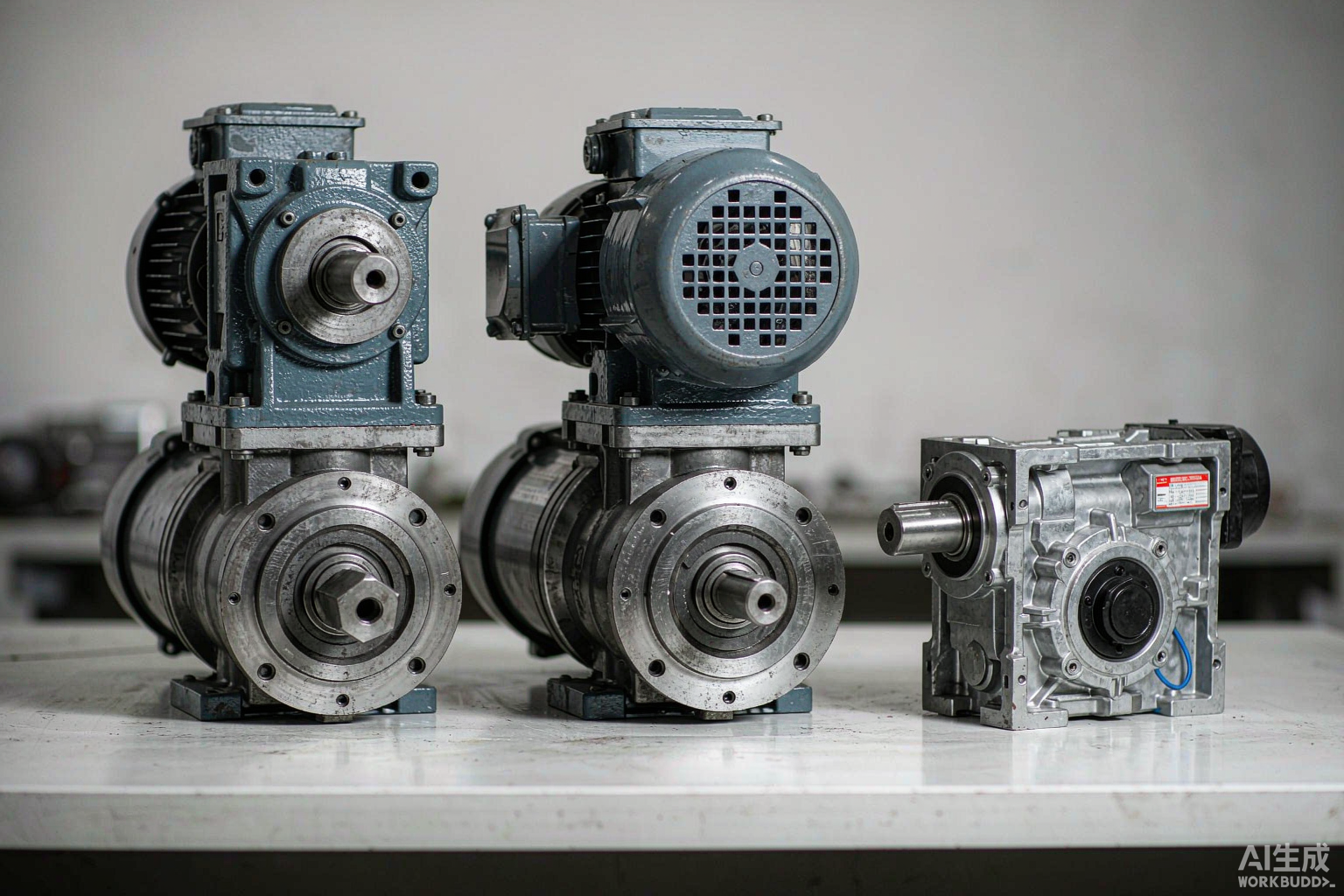
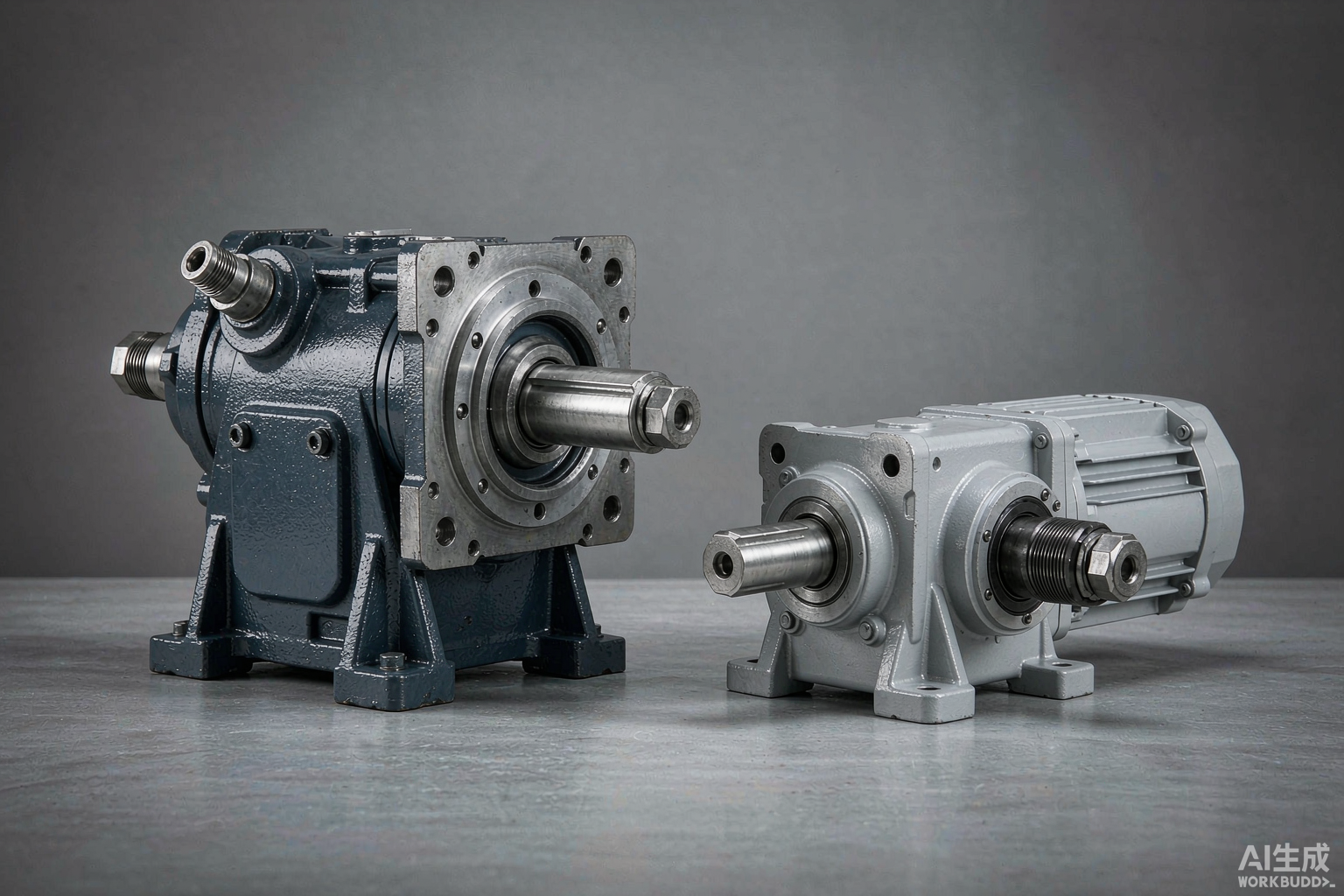
If you have ever specified a gear motor for an industrial line in Europe, North America, or a Tier-1 OEM project, you have almost certainly come across SEW-Eurodrive gear motors. SEW-Eurodrive is the German reference name for helical-bevel, helical-worm, and helical gear units, and SEW part numbers show up in machine drawings from packaging lines to automotive plants. This guide explains what SEW gear motor series are out there, what their specifications really mean on paper, and when a Chinese-made alternative can deliver the same fit, duty, and footprint at a much lower landed cost.
Below you will find a side-by-side look at SEW’s main gear motor families (DRN, K, S, W, and the helical-bevel/spiroplan lines), the specifications procurement engineers compare first, and a practical checklist for sourcing a drop-in SEW-compatible drive without sacrificing build quality.
What Is an SEW Gear Motor?
SEW-Eurodrive is a German drive manufacturer founded in 1931 and headquartered in Bruchsal, Germany. The company built its reputation on modular gear units that combine an AC induction motor with a precision-machined gearbox in one housing, and today SEW gear motors are the de facto European benchmark for helical-bevel, helical-worm, and parallel-shaft drives used in material handling, automotive assembly, food processing, and intralogistics.
An SEW gear motor is, mechanically, the same idea as any other compact drive: an electric motor turning a gear reducer to trade motor speed for output torque. What sets SEW apart is the engineering depth behind it — torque-rated gear teeth, modular mounting feet and flanges, IEC-standard motor frames from 63 to 315, and a worldwide service network. For an engineer who wants a drive that “just fits the drawing,” that combination is why SEW is the default. For an engineer watching cost, it is also why SEW is often the most expensive line item on the gear motor side of the bill of materials. If you are new to gear motors in general, start with how a gear motor works before comparing series.
SEW Gear Motor Series Overview
SEW groups its gear motor range into a few large families. Each family is optimized for a different shaft layout, ratio range, and duty profile. The table below condenses the most-cited SEW lines so you can match a series to a use case at a glance.
Series
Gear Layout
Typical Ratio Range
Power Range
Best Fit For
DRN
Helical-bevel (2-stage, right angle)
3.4:1 – 14,000:1
0.12 – 200 kW
Conveyors, mixers, agitators where a compact right-angle drive is needed
K
Helical-bevel (2-stage and 3-stage)
4:1 – 25,000:1
0.12 – 200 kW
Heavy-duty conveyors, cranes, hoists with high torque at low speed
S
Helical-worm (right angle)
5:1 – 100:1
0.12 – 55 kW
Gates, swing barriers, applications that need partial self-locking
W
Helical-worm (right angle)
5:1 – 80:1
0.12 – 7.5 kW
Light-duty gates, small mixers, packaging accessories
F
Parallel-shaft helical
3.5:1 – 35,000:1
0.12 – 200 kW
Inline drives for conveyors, pumps, fans where shaft layout is in-line
Spiroplan
Single-stage worm-like (right angle)
5:1 – 80:1
0.12 – 3 kW
Low-noise right-angle applications with limited space
Within each series, SEW publishes a wide matrix of frame sizes, gear stages, motor pole counts, and brake / inverter options. A K-series 4-pole 7.5 kW motor mounted to a K97 gearbox with a 38:1 ratio, for instance, is a very different physical package from a K-series 6-pole 0.55 kW motor on a K20. Reading the SEW part number carefully is the single biggest time-saver when cross-referencing drives. For a deeper look at right-angle geometry, see the types of gear motors comparison guide.
Key Specifications to Compare
When engineers evaluate an SEW drive against an alternative, they rarely look at the brochure first. The five numbers that drive most decisions are listed below, in roughly the order most teams work through them.
Output torque (Nm): The rated torque at the output shaft under continuous duty. SEW publishes both maximum and allowable torque for each gearbox size; an alternative must at least match the rated number, ideally with a service factor of 1.2–1.5 above it.
Output speed (RPM): Calculated from motor speed ÷ ratio. SEW spec sheets always show both nominal output speed and the permitted speed range. A drive with the right torque but the wrong output speed will still fail the application.
Ratio (i): The reduction from motor to output shaft. SEW gear units step ratios finely (3.4:1, 4.1:1, 5.0:1, 6.0:1, and so on) because each ratio has a distinct output speed. Pick the closest ratio to your load, not the highest available.
Motor frame and power: SEW units accept IEC-standard motor frames from 63 to 315, in single-phase, three-phase, and inverter-rated versions. A drop-in alternative should keep the IEC frame size, shaft diameter, and B14 / B5 flange pattern to reuse existing mounting plates.
Service factor and duty cycle: SEW ratings assume S1 (continuous) operation under uniform load. Real applications frequently include shock loads, reversing duty, or high switching frequency. Read the application factor table — drives rated for S1 can drop a full gearbox size when used in S4 or S5 duty.
SEW gear motors are not overpriced for no reason — there are clear cases where paying the SEW premium pays for itself.
OEM equipment shipped into the EU. Machinery exported to Europe often expects SEW on the bill of materials because end users already have SEW spare parts, service contracts, and trained technicians in-house.
Continuous-duty, high-cycle lines. Automotive plants, bottling lines, and large distribution centers that run 16–24 hours a day need the gearbox life SEW’s heat treatment and bearing selection provide.
Standardized modularity. When one plant runs twenty K-series drives, standardization on SEW simplifies spares, training, and predictive maintenance. Switching brands on a single drive usually costs more than it saves.
Documented compliance. SEW publishes ATEX, food-grade, and marine certifications up front. For hazardous areas or wash-down food lines, the paperwork alone can justify the brand.
In these situations, the SEW premium is essentially insurance against downtime and certification gaps. The cost question becomes: are you paying for performance, or paying for the name on the nameplate?
Cost-Effective SEW Gear Motor Alternatives
Outside the four scenarios above, many B2B buyers do not need the SEW nameplate to get the same mechanical performance. A Chinese OEM that controls its own gear cutting, heat treatment, and motor winding can deliver an IEC-footprint helical-bevel or helical-worm drive with the same torque rating, the same ratio options, and the same modular flange at 30–60% of the SEW list price. The reason is not cheaper materials — it is a leaner supply chain, lower factory overhead, and direct factory pricing instead of a multi-tier distribution chain.
For applications that are price-sensitive but still need right-angle geometry, a compact AC gear reducer motor such as the 6GU AC right-angle gear reducer motor (120W–300W) delivers a worm-and-wheel right-angle drive in the 120–300 W power range that fits the same mounting footprint SEW uses for small-frame W-series and Spiroplan drives. It is a typical match for swing gates, small conveyors, food processing skids, and packaging accessories where a sub-kW drive replaces an SEW W20 or W30 in the original spec.
The economic logic of alternatives is straightforward. SEW’s list price covers German engineering, European steel, EU factory overhead, and a global distributor margin. An OEM buying directly from a Chinese drive manufacturer with CE / IEC compliance can reinvest that difference into larger motors, more spare units, or shorter delivery times — three things that often matter more on a project than the brand on the gearbox.
How to Specify an SEW-Compatible Replacement
If you are evaluating a SEW replacement for cost or lead-time reasons, walk through this seven-point checklist before signing off.
Capture the existing SEW part number and series. Write down the gearbox size (e.g., K37, K47, DRN71), the motor frame (e.g., 71M, 80M, 90L), the pole count (4P / 6P), the ratio, and any brake or encoder option. Without all five, the alternative supplier is guessing.
Confirm output torque and speed. Use the SEW datasheet (or, in its absence, the nameplate) to record rated torque in Nm and output speed in RPM. Cross-check against your drive’s load profile.
Match the IEC mounting interface. Foot-mount (B3), flange-mount (B5), face-mount (B14) — note the exact flange diameter and bolt circle. The single most common failure in a “drop-in” alternative is a 5 mm mismatch on the flange PCD.
Match the output shaft. Diameter, length, and key size must all match. If the SEW unit uses a 30 mm × 60 mm shaft with an 8 mm key, the alternative cannot deliver that with a 25 mm shaft.
Verify electrical compatibility. Voltage (380 V / 400 V / 460 V three-phase), frequency (50 / 60 Hz), insulation class, IE efficiency class, and inverter-duty windings. SEW units often ship inverter-ready; confirm whether the replacement is too.
Request the alternative’s life and duty rating. Ask for the rated service factor at S1 / S3 / S5, the L10 bearing life, and the permissible radial and axial loads at the output shaft. If the alternative cannot publish these numbers, the price advantage is not real.
Run a sample under load before bulk release. One pre-production sample mounted to the actual machine, run through the real duty cycle for at least 50 hours, is worth more than any datasheet comparison.
If you are new to the underlying terminology — what ratio, service factor, or IEC frame actually means — revisit how a gear reducer motor works before completing the spec.
Common Mistakes When Sourcing SEW Alternatives
Matching by power only. A 0.75 kW SEW and a 0.75 kW Chinese drive with the same motor frame can deliver very different output torque if the gearbox sizes are different. Always cross-check gearbox size and ratio, not just motor power.
Ignoring the service factor. SEW ratings are typically based on a 1.0–1.5 service factor over the actual load. Buying a drive with the same nameplate power but a lower service factor quietly halves the gearbox life.
Trusting “SEW compatible” marketing claims. Many Chinese factories advertise “SEW equivalent” or “SEW-compatible” without controlling the gear-cutting tolerances or heat treatment that make SEW ratings reliable. Ask for the underlying test report.
Skipping the sample run. Catalog numbers are easy; real-world fit under load is what determines whether the alternative saves money or costs more in warranty claims.
Forgetting certification for destination markets. CE is standard, but ATEX, UL, CCC, or food-grade (NSF / FDA grease) certifications are not. Confirm the certifications needed for the destination market before placing the order.
Conclusion: SEW When It Earns Its Place, Alternatives When It Doesn’t
SEW gear motors are the European benchmark for a reason: modular design, IEC compliance, global service, and proven long-life ratings. For OEM equipment shipped into the EU, for continuous-duty industrial lines, and for projects that need documented certifications, the SEW premium is a rational cost. For swing gates, small conveyors, packaging accessories, food skids, and other price-sensitive applications where the duty is lighter and the destination market does not demand the SEW nameplate, an IEC-footprint Chinese-made right-angle drive such as the 6GU AC gear reducer motor (120W–300W) can deliver the same mechanical fit and torque at a fraction of the cost.
Start by capturing the full SEW part number, output torque, output speed, IEC frame, and mounting details. Match those five numbers exactly on the alternative, run a sample under load, and the SEW-versus-alternative decision becomes a clear engineering choice rather than a brand question.
Pertanyaan yang Sering Diajukan
What series is the most popular SEW gear motor?
The K-series helical-bevel gear motor is the most widely specified SEW line for industrial conveyors, hoists, and mixers, followed by the DRN series for right-angle compact drives and the F-series parallel-shaft helical drives for inline applications.
Can a Chinese gear motor really replace an SEW?
For non-critical applications and IEC-footprint mounts, yes — as long as the alternative matches gearbox size, ratio, output torque, output speed, IEC motor frame, and the output shaft dimensions, and has been validated on a real-load sample. For ATEX or marine-certified projects, SEW’s documentation is hard to replicate.
How long do SEW gear motors typically last?
An SEW gear motor typically runs 20,000–40,000 hours under continuous S1 duty with the correct service factor. Reducing the service factor, running in S4 or S5 reversing duty, or exceeding thermal limits shortens that figure significantly.
What is the difference between SEW K and DRN series?
Both are helical-bevel right-angle drives. The K-series is a 2-stage and 3-stage line optimized for high-ratio, high-torque applications up to 25,000:1. The DRN-series is a 2-stage line focused on compact right-angle drives up to 14,000:1, with a smaller overall footprint.
What is the smallest SEW gear motor available?
The SEW Spiroplan and small W-series gear units start at 0.12 kW (about 1/8 hp) with single-phase or three-phase IEC 63-frame motors. Below that, very small drives (such as sub-100 W right-angle gear motors for vending and door openers) are typically sourced from specialty compact-drive makers rather than SEW.
How do I read an SEW gear motor part number?
An SEW part number reads roughly as: Series + gearbox size + motor frame + pole count + ratio + mounting + options. For example, K37 DRS71M4 BE1 translates to a K-series gearbox, size 37, mounted to a DRS 71M 4-pole motor with a BE1 brake option. Cross-referencing the SEW catalog with that string is the fastest way to find the specifications.
Practical guide to selecting a gear motor for door openers: calculate required torque and output speed, understand self-locking worm gear drives, and match the right AC gear motor to your door type.
Selection guide for gear motors used in hospital beds, infusion pumps, ventilators, lab equipment and other medical devices. Covers noise, precision, IEC 60601-1 safety, IP rating and self-locking requirements, plus a step-by-step selection workflow and application table.
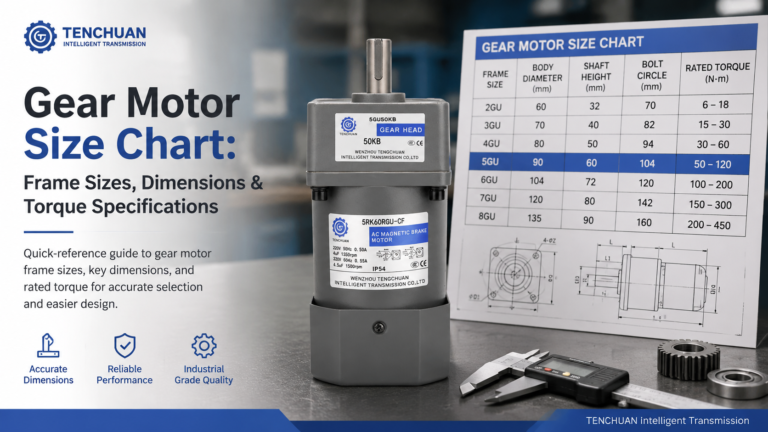
Read a practical gear motor size chart for small AC gear motors. Frame sizes 60-104 mm, dimensions, rated torque and RPM at common ratios, mounting styles.