Gear Motor Parts: Complete Identification & Replacement Guide
Diterbitkan: Penulis: Lisa
Knowing how to identify motor roda gigi parts is essential for maintenance teams, procurement engineers, and OEM buyers. A single mismatched shaft diameter, gear ratio, or mounting flange can turn a routine replacement into a costly production delay. This guide explains the main components inside a gear motor, how to read nameplate data, common failure signs, and a practical replacement checklist you can use today.
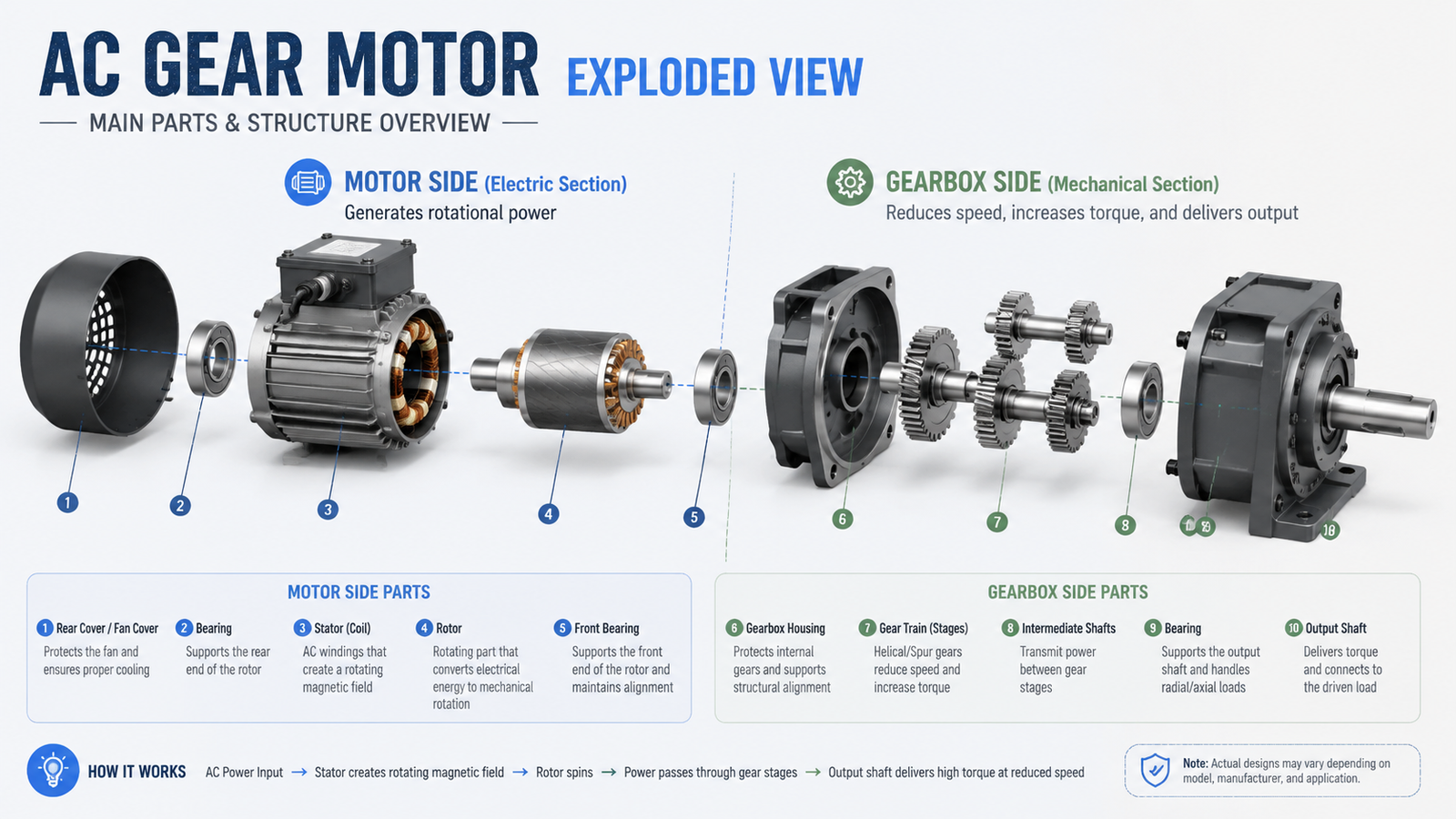
What Are the Main Parts of a Gear Motor?
A gear motor is an integrated assembly that combines an electric motor with a gearbox. Each side has its own set of parts, and each part affects performance, fit, and service life.
Motor-Side Components
Stator: The stationary part that creates the magnetic field. In AC gear motors it carries the winding; in permanent-magnet DC motors it holds the magnets.
Rotor / Armature: The rotating assembly that converts electrical energy into mechanical motion. It includes the shaft, core, windings, and commutator on brushed motors.
Commutator: Found on brushed DC motors, this rotating switch reverses current direction so the rotor keeps turning in one direction.
Brushes: Carbon or graphite blocks that press against the commutator to transfer current. They wear over time and are common replacement items.
Bantalan: Support the rotor shaft and reduce friction. Worn bearings cause noise, vibration, and overheating.
Housing / End Bells: Protect the motor internals, dissipate heat, and align the bearings.
Gearbox-Side Components
Gear Train: The set of gears that reduce speed and multiply torque. Common layouts include spur, helical, bevel, worm, and planetary.
Input Pinion: The small gear on the motor shaft that drives the first reduction stage.
Output Shaft: Delivers final torque to the driven machine. It may be solid, hollow, keyed, or splined.
Gearbox Housing: Encloses and aligns the gears while holding lubricant and keeping out dust and moisture.
Seals and Gaskets: Prevent oil leakage and contamination at shaft exits and housing joints.
Lubricant: Oil or grease that reduces gear and bearing wear. The wrong lubricant or level shortens gearbox life.
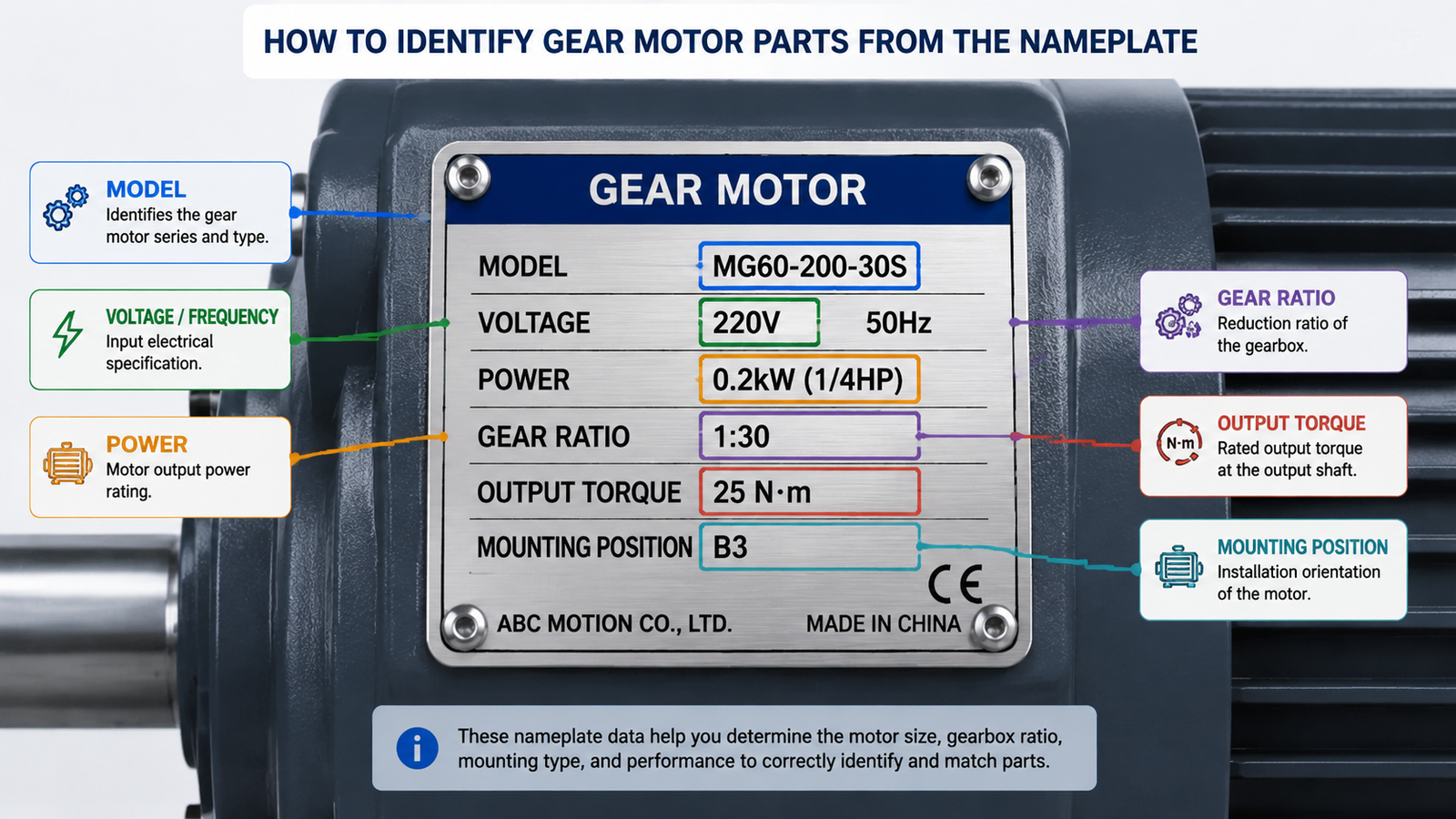
How to Identify Gear Motor Parts from the Nameplate
The nameplate is the fastest way to identify a gear motor and its parts. Before ordering any replacement, photograph the full nameplate and record every field. Even a single suffix letter can indicate a special shaft, brake, or mounting position.
Motor Nameplate Data
Data Point
Mengapa Hal Ini Penting
Power (W or kW)
Defines motor size and thermal capacity.
Voltage / Frequency
Must match the supply (e.g., 220V 50Hz or 460V 60Hz).
Phase
Single-phase, three-phase, or DC.
Rated Speed (RPM)
Used with gear ratio to calculate output speed.
Insulation Class
Sets maximum operating temperature.
Duty Cycle / IP Rating
Tells you how long the motor can run and how well it is protected.
Gearbox Nameplate Data
Data Point
Mengapa Hal Ini Penting
Model / Size
Determines gearbox frame and mounting dimensions.
Gear Ratio (i)
Sets output speed and torque multiplication.
Output Torque (Nm)
Must exceed the application’s continuous load.
Mounting Position
Affects oil level, plug location, and bearing loading.
Output Shaft Diameter
Must match couplings, pulleys, or sprockets.
Service Factor
Safety margin for shock loads and daily duty.
Common Wear Parts and Failure Signs
Not every gear motor failure requires a complete replacement. Many issues start with one or two wearing parts. Recognizing the early signs can prevent unplanned downtime.
Bagian
Common Failure Signs
Typical Cause
Brushes
Sparking, uneven speed, loss of power
Normal wear, dust, incorrect spring pressure
Commutator
Scoring, discoloration, excessive sparking
Worn brushes, overload, poor ventilation
Bantalan
Noise, vibration, overheating, shaft play
Lubrication breakdown, contamination, fatigue
Gears
Grinding noise, metal particles in oil, backlash
Overload, misalignment, lubricant degradation
Seals
Oil leakage around shaft or joints
Aging, heat, chemical exposure
Armature Windings
Burn smell, open circuit, low torque
Overheating, voltage spikes, moisture
If the motor still runs but shows one of these symptoms, start with the smallest replaceable part. A brush or bearing replacement is far cheaper than replacing the entire unit.
Gear Motor Replacement Checklist
Use this checklist when you need to replace a gear motor or a major part. It reduces the risk of ordering the wrong model and helps suppliers quote faster.
Record the full model number. Copy every letter, number, and suffix from the motor and gearbox nameplates.
Photograph the nameplates. Include the full nameplate and a wide shot showing the motor orientation.
Measure the output shaft. Note diameter, length, keyway size, and whether it is solid or hollow.
Confirm mounting dimensions. Record flange size, bolt circle, foot-hole spacing, and center height.
Verify electrical data. Match voltage, frequency, phase, power, and rated speed to the supply.
Check the gear ratio and output speed. Use the formula Motor RPM ÷ Ratio = Output RPM and confirm it meets the machine requirement.
Assess the application duty. Note daily operating hours, starts per hour, load type, and any shock or reversing duty.
Confirm the installation position. Horizontal, vertical, or angled mounting can change oil levels and sealing needs.
Request dimensional drawing. Before final purchase, ask the supplier for a drawing to verify mechanical fit.
When to Replace Individual Parts vs. the Whole Gear Motor
Deciding between a repair and a full replacement depends on cost, availability, and the condition of the rest of the motor.
Replace individual parts when:
The failure is limited to brushes, bearings, seals, or a speed controller.
The gearbox and windings are in good condition.
The part is readily available and the repair can be done safely.
Downtime for repair is shorter than lead time for a new motor.
Replace the complete gear motor when:
The gearbox has broken teeth, pitting, or severe backlash.
The armature windings are burnt or shorted.
Multiple failures happen within a short period.
The original model is obsolete and no spare parts are stocked.
A new unit offers better efficiency, ratio options, or warranty support.
Finding the Right Replacement Parts
Once you have the nameplate data and measurements, contact a supplier that can cross-reference the original model. Provide the checklist above and ask for confirmation on ratio, output speed, torque, and mounting dimensions.
For small AC gear motor systems, replacement controllers, armatures, and gear motor accessories can often restore a unit without a full motor change. For example, a speed controller armature with precision-wound copper windings and a balanced rotor can replace a worn armature in automation, conveying, and packaging equipment.
Before ordering, compare the supplier’s drawing against your measured shaft, flange, and mounting dimensions. Even motors with the same power and ratio can differ in physical size.
Conclusion
Identifying gear motor parts starts with the nameplate and ends with careful dimensional verification. By understanding the roles of the stator, rotor, gears, bearings, seals, and output shaft, you can make faster repair decisions and avoid ordering mistakes. Keep a replacement checklist on hand, monitor wear signs early, and work with suppliers who can cross-reference both electrical and mechanical data.
What information do I need to order a replacement gear motor?
You need the full model number, voltage, frequency, power, rated speed, gear ratio, output torque, output shaft dimensions, mounting type, and installation position. A photo of the nameplate and a few measurements are usually enough for a supplier to quote.
Can I replace just the gearbox or just the motor?
Sometimes. Many gear motors are modular, so the motor and gearbox can be separated and replaced individually if the interface matches. Always confirm the flange pattern, shaft size, and ratio before mixing units.
How do I know if my gear motor bearings are failing?
Common signs include increased noise, vibration, overheating, and play in the output shaft. If the motor runs hotter than usual or you hear a rumbling sound, inspect the bearings before the failure spreads to gears or windings.
Why is the gear ratio important when replacing parts?
The ratio determines output speed and torque. A wrong ratio makes the machine run too fast or too slow, which can damage equipment or reduce productivity. Always match the original ratio unless the application requirements have changed.
What is the most common replaceable part in a brushed gear motor?
Brushes are the most common wear item. They are inexpensive and easy to replace, but worn brushes can also damage the commutator if left too long. Replace brushes at recommended intervals to extend motor life.
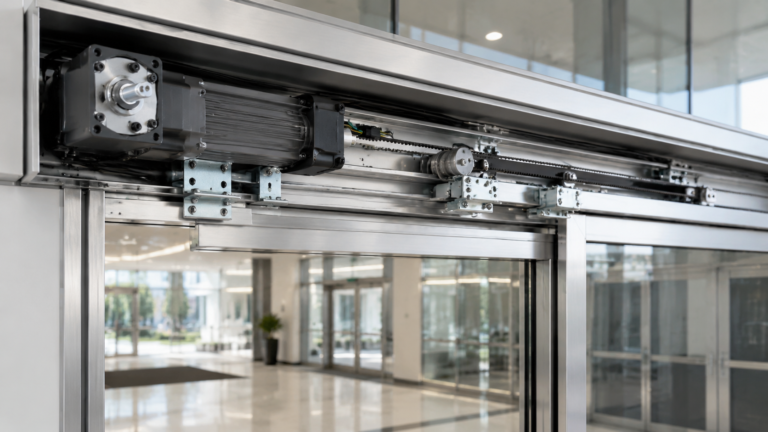
Practical guide to selecting a gear motor for door openers: calculate required torque and output speed, understand self-locking worm gear drives, and match the right AC gear motor to your door type.
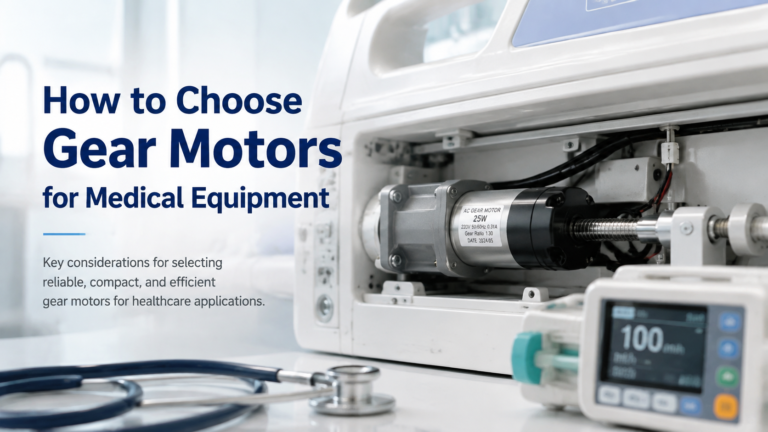
Selection guide for gear motors used in hospital beds, infusion pumps, ventilators, lab equipment and other medical devices. Covers noise, precision, IEC 60601-1 safety, IP rating and self-locking requirements, plus a step-by-step selection workflow and application table.
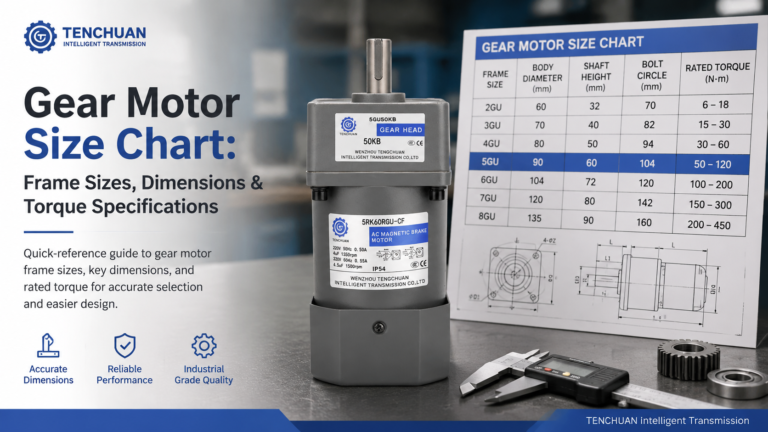
Read a practical gear motor size chart for small AC gear motors. Frame sizes 60-104 mm, dimensions, rated torque and RPM at common ratios, mounting styles.