Most gear motor guides for food plants start with washdown. That is the wrong starting point for the majority of food machinery. On a real food line, the wet, caustic, high-pressure zone is the processing area — mixers, slicers, blanchers, filling heads. One wall away sits the packaging hall: cartoners, case packers, labellers, checkweighers, film wrappers, date coders and outfeed conveyors. That hall is dry, wiped down with a damp cloth, and runs 25–300 W drives on almost every station. This guide covers that zone specifically: how to size a compact AC gear motor for food packaging and conveying equipment, what protection level is actually realistic, and where a standard industrial gear motor stops being the right answer.
Why the packaging hall is a different drive problem
Three things separate a packaging-hall drive from a processing-hall drive:
- The environment is dry but not clean. Flour dust, film offcuts, cardboard fibre and the occasional sugar or seasoning spill. That is a dust and debris problem, not a water-ingress problem.
- Cleaning is manual and occasional. A wipe-down at shift end, not a 60 °C pressure wash with alkaline foam. Nozzles are not pointed at the gearbox.
- Duty is start-stop but not continuous reversing. A cartoner infeed indexes a few times a second on light load. A case conveyor runs for hours. Both are well inside the thermal envelope of a reversible 30-minute-rated AC gear motor.
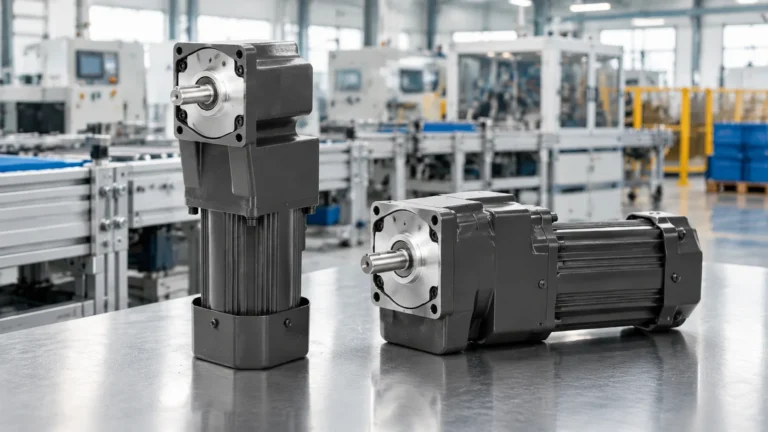
This is exactly the operating window a standard động cơ giảm tốc AC cỡ nhỏ is built for. Buying an IP69K stainless unit for a cartoner that never gets hosed down is the single most common overspend in food equipment drive selection — often two to three times the unit cost for a protection level the machine never needs.
The four numbers that size a food packaging drive
1. Output speed at the driven shaft
Work backwards from the machine, not forwards from the motor. A labeller needs its applicator roller at a surface speed matched to the line; a case conveyor needs belt speed in metres per minute. Convert to output rpm first, then pick the ratio.
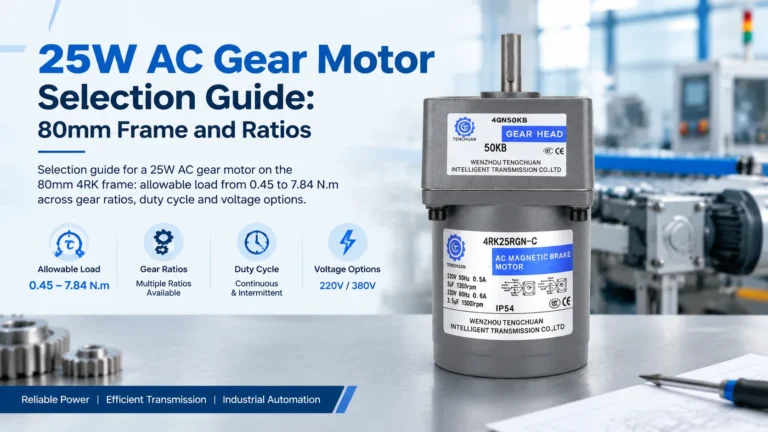
On our 25 W 4RK series (80 mm frame, 50 Hz), the available output speeds run from 500 r/min at 3:1 down to 5 r/min at 300:1. A packaging station almost always lands in the 20–120 r/min band.
2. Running torque, then breakaway torque
Running torque on a horizontal conveyor is friction-dominated and roughly flat once the belt moves. Breakaway is not: a fully loaded belt that stopped mid-cycle needs two to three times the running torque to restart. Size on breakaway, then confirm that the running point sits comfortably inside the allowable load.
3. Allowable load at the chosen ratio
This is where most selection guides go wrong, because they treat torque as a property of the motor. It is not. On a fixed frame size, allowable output load rises as the ratio rises and the output speed falls. Real data from our 25 W 4RK unit:
| Tỷ lệ | Tốc độ đầu ra (vòng/phút, 50 Hz) | Tải trọng tối đa cho phép |
|---|
| 3:1 | 500 | 0.45 N·m (4.5 kg·cm) |
| 10:1 | 150 | 1.55 N·m (15.7 kg·cm) |
| 30:1 | 50 | 4.12 N·m (42 kg·cm) |
| 100:1 | 15 | 7.84 N·m (80 kg·cm) |
| 300:1 | 5 | 7.84 N·m (80 kg·cm) — gearbox limit |
Note the ceiling: past roughly 100:1 the gearbox, not the motor, sets the limit. Adding ratio stops buying you torque. If your application needs more than 7.84 N·m at 15 r/min, the answer is a larger frame — a 60 W or 90 W unit — not a deeper ratio on a 25 W.
4. Duty cycle and thermal rating
Our small AC series carries a reversible 30-minute rating. That is a nhiệt rating, not a licence for continuous reversing. A cartoner indexing continuously in both directions is not the same load as a conveyor running one way. If the machine reverses more than roughly 10–15 times per minute on a sustained basis, add a cooling pause, drop one frame size in load, or move to a drive rated for that duty.
What protection level is realistic
Be precise here, because this is where catalogue claims and factory reality diverge.
- IP54-class industrial gear motors handle dust and splash. This covers the packaging hall, dry conveying, cartoning, labelling, case packing and outfeed handling. It does không cover direct hosing.
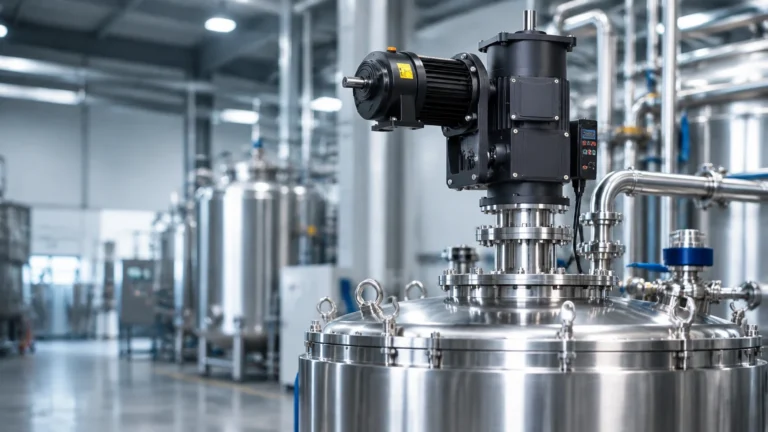
- If the machine gets washed, the correct engineering answer is usually a mechanical one: mount the drive outside the splash zone, enclose it in a stainless shroud with a drain, or couple it through a shaft so only the shaft sees water. This costs a fraction of a fully sealed stainless gear motor and is what most equipment builders actually do.
- True washdown drives need stainless or epoxy housings, H1 registered lubricant, smooth crevice-free surfaces and IP66/IP69K sealing. That is a different product category with a different price. If your line genuinely needs it, buy it — but confirm it against the machine’s cleaning SOP rather than assuming.
One more point buyers rarely check: the output shaft and oil seal are the weakest ingress path on any geared motor, and they are not covered by the housing IP rating in the way most people assume. Direct spray at the shaft end defeats an IP65 housing quickly. That is another argument for mechanical shielding over rating escalation.
Matching power tier to station
| Station | Typical power | Why |
|---|
| Date coder, small indexing gate, film feed assist | 15–25 W | Very light load, tight space, 70–80 mm frame |
| Labeller applicator, small infeed conveyor, reject pusher | 40–60 W | Needs breakaway margin without frame growth |
| Case conveyor, carton erector flap drive | 90–120 W | Continuous running with moderate torque |
| Case packer, pallet index, heavy infeed | 200–300 W | High breakaway, larger shaft, 90 mm frame |
| Full case conveyor trunk, incline section | 400–750 W | Transition to medium-duty three-phase frames |
A 4GN 25 W right-angle unit is the usual pick for a coder or gate where the drive has to turn 90° inside a narrow frame. An inline 5RK 60 W or 6RK 120 W suits a straight conveyor run where the shaft can exit along the belt axis.
Speed control on a packaging line
Food packaging lines change format — a 250 g pack runs slower than a 1 kg pack. Rather than fitting a variable-frequency drive to every station, our small AC series can run with a matched speed controller on the single-phase units. Two practical notes:
- Torque falls as you reduce speed below roughly 50% of rated, so check the allowable load at the lowest speed you intend to run, not at rated speed.
- Reversing with a controller adds current inrush. Confirm the controller rating against the motor’s starting current, not its running current.
Five selection mistakes specific to food packaging
- Sizing on running torque only. Jams and cold starts are what break gearboxes, and both are breakaway events.
- Escalating ratios to gain torque. Past the gearbox limit you gain nothing and lose efficiency.
- Buying washdown protection for a dry hall. Cost without benefit, and stainless housings often run hotter.
- Ignoring overhung load. A pulley or sprocket mounted far out on the shaft applies a bending moment the gearbox bearing was not sized for. Keep the load close to the housing and use a support bearing on long shafts.
- Assuming the gearbox is self-locking. It is not on a spur or bevel right-angle unit. If a vertical axis must hold position on power loss, specify a brake or a mechanical stop.
Where a standard AC gear motor is the wrong choice
Be honest about the boundary. Choose something else when:
- The drive sits inside the washdown zone and is directly sprayed — you need a sealed stainless unit.
- The station needs positioning feedback or repeatable stopping — an AC gear motor has no encoder and cannot position a load. Use a servo or add sensors and mechanical stops.
- The load exceeds roughly 3.7 kW — that is above the top of our range and belongs to industrial gear units.
- The axis must hold a static load indefinitely without a brake.
For everything else in the packaging hall — dry, dust-exposed, intermittent, 15 W to 750 W — a compact AC gear motor is the most cost-effective drive on the market, and the one that is easiest to replace when a line stops at 2 a.m.
Câu hỏi thường gặp
Can I use a standard AC gear motor in a food factory?
Yes, in dry zones: packaging halls, cartoning, labelling, case packing, dry conveying and outfeed handling. It is not suitable for direct washdown or for areas sprayed with cleaning chemicals.
What IP rating do I need for a packaging machine?
IP54 covers dust and splash and is enough for most packaging stations. Escalate only if the machine’s cleaning procedure puts water on the drive. If it does, shielding the drive mechanically is usually cheaper and more reliable than buying a higher IP rating.
How do I keep flour dust out of the gearbox?
Dust enters mainly at the shaft seal and the breathing path. Fit a shaft seal rated for dusty duty, mount the unit so the shaft points downward or horizontally rather than upward, and enclose it in a shroud with a filtered vent if the local dust load is high.
What is the smallest drive that will run an outfeed conveyor?
Usually 25–40 W for a short, light outfeed at low speed. Size on breakaway torque with a loaded belt, not on the running load — a 25 W unit at 30:1 gives 4.12 N·m of allowable load, which is often ample, but only if the ratio is chosen for the speed you need.