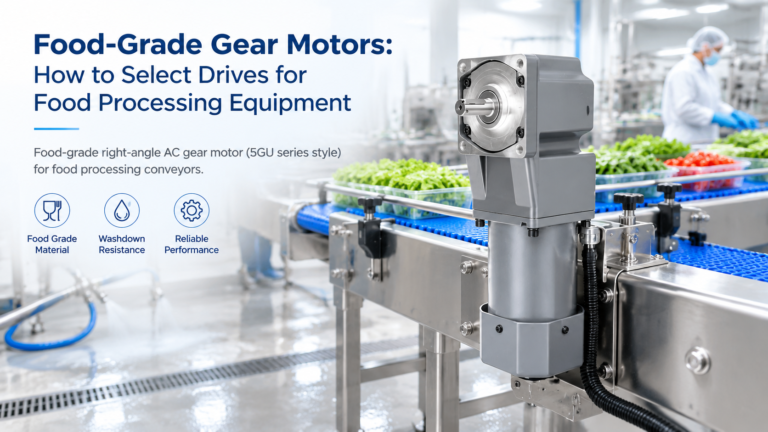
Gear Motors for Agricultural Machinery: Selecting Drives for Harsh Environments
Ngày đăng: Tác giả: Lisa
Lựa chọn một gear motor for agriculture is different from selecting a drive for a clean factory line. Farm machines run beside grain dust, fertiliser powder, washdown water and wide temperature swings, and they usually need low output speed with high torque at the shaft. Get the torque, ratio, duty and enclosure right and the drive will outlast the season; get them wrong and you will be replacing motors in the middle of harvest. This guide explains where agricultural gear motors are used, which specifications matter in a harsh environment, and how to work through a practical sizing example.
Where agricultural machinery uses gear motors
Gear motors on farms and in food-handling facilities almost always do the same class of job: turning a shaft slowly with controlled torque so that grain, feed, seed, fertiliser or water moves at a predictable rate. Typical drive points include:
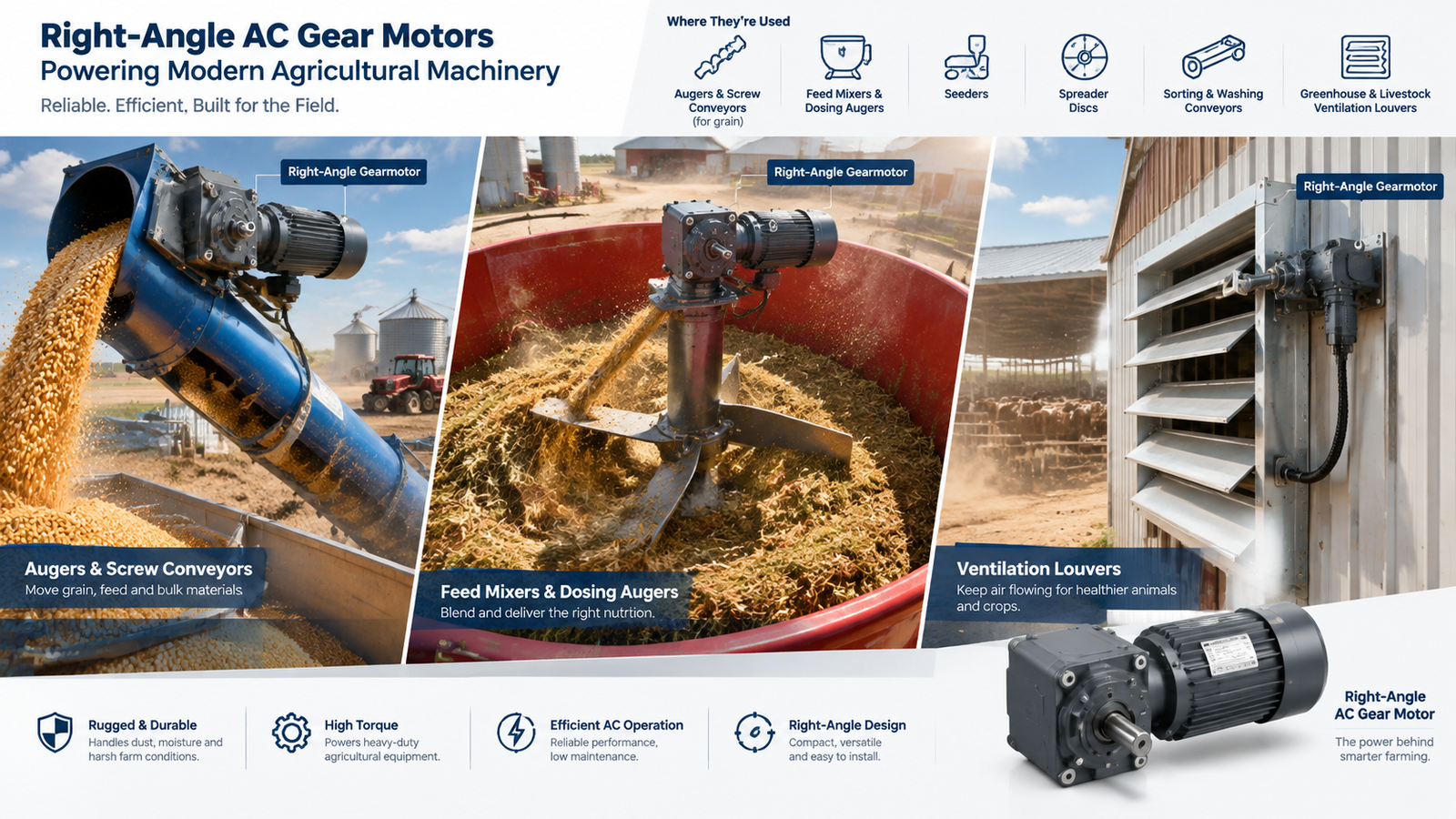
Augers and screw conveyors that move grain, seed and feed between bins, mixers and transport hoppers.
Feed mixers and dosing augers that blend rations and meter feed into troughs or automatic feeding lines.
Seeders and planters where a metering shaft feeds seed or fertiliser at a set rate per row.
Fertiliser and lime spreaders that rotate a distribution disc or agitator at a steady low speed.
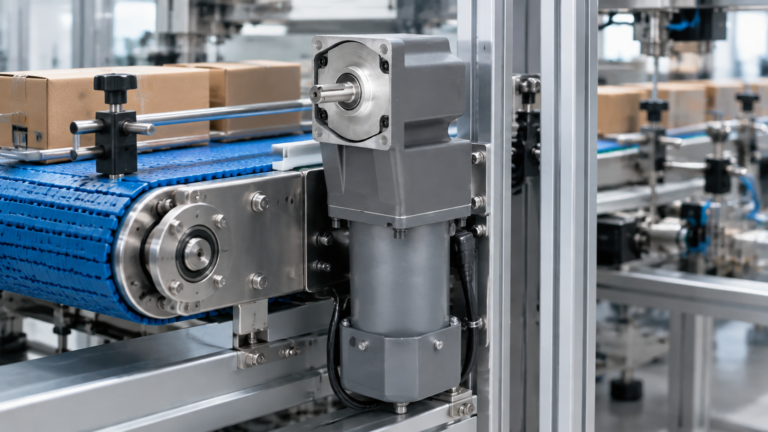
Sorting, grading and washing conveyors on packing lines for fruit, vegetables and eggs.
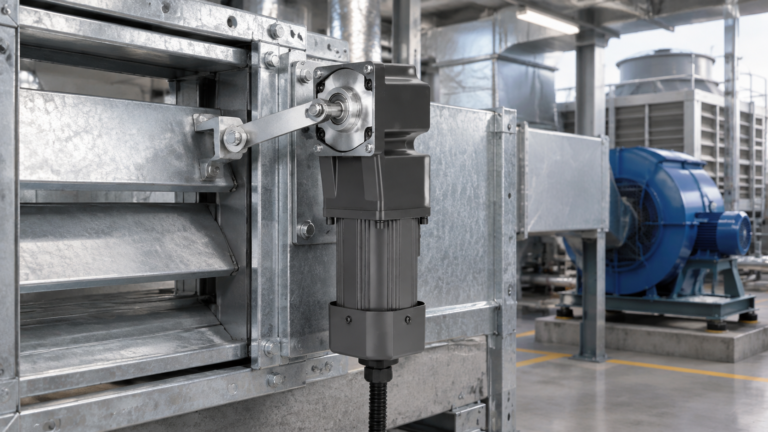
Greenhouse and livestock ventilation drives for louvers, shutters and circulation fans that must start and stop reliably for years.
Sprayers and irrigation dosing pumps that need repeatable speed under load.
Almost every one of these applications is intermittent by nature — it runs for part of an hour, stops, and restarts, sometimes dozens of times a day. That pattern matches the rating philosophy of most small AC gear motors, which are specified for short-run reversible duty rather than continuous 24/7 operation.
Typical drive requirements by machine type
The table below summarises realistic starting points for common farm and packing-line drives. Treat the numbers as sanity checks; the final value always comes from your own load calculation.
Machine type
Typical output speed
Typical output torque
Duty pattern
Sensible power range
Small grain/seed auger
60–300 r/min
8–25 N·m at the screw
Short runs, frequent starts
120–300 W
Feed mixer agitator / dosing auger
30–120 r/min
10–30 N·m
Repeated mixing batches
120–300 W
Seeder / planter metering shaft
20–90 r/min
3–10 N·m
Continuous during field work
40–140 W
Spreader disc or agitator
150–600 r/min
2–8 N·m
Batch operation
40–140 W
Sorting / grading conveyor
20–80 r/min at roller
5–20 N·m
Long running per shift
120–300 W
Ventilation louver / shutter
5–30 r/min
5–15 N·m at pivot
Very short, high cycle
25–90 W
Two observations from the table matter for selection. First, the torque figures are at the driven shaft — after the gearbox — which is why a small 40 W motor can still turn a heavy agitator when it is paired with the right reduction ratio. Second, duty cycle varies so much between machines that you should always check the motor’s rated run time against your real cycle, not against the machine type name.
Why the farm is a harsh environment
A drive that performs perfectly in a workshop can fail quickly in the field, and the causes are predictable. Match these environmental hazards to specific countermeasures before you finalise a gear motor specification.
Hazard
Typical failure mode
Countermeasure
Grain, feed or fertiliser dust
Dust packs into the cooling fan and windings; abrasive particles wear shaft seals
Totally enclosed motor with external cooling, protected leads, sealed or shielded output shaft
Moisture, humidity and washdown
Condensation inside the motor; corrosion of the shaft and terminal box
Adequate IP rating for the machine’s washdown regime, drainage, stainless or coated shaft extension
Fertiliser and chemical exposure
Corrosion of housing, fasteners and electrical connections
Corrosion-resistant coating, sealed terminal box, fasteners and connectors kept out of the chemical path
Temperature swings and sunlight
Grease thins or thickens; insulation stress; UV damage to plastics
Motor sized with margin, correct grease grade for ambient range, UV-stable covers
Rigid mounting, correct shaft alignment, occasional re-torque of fixings
Voltage variation on farm supply
Weak starting torque, overheating on long single-phase runs
Confirm the local supply (110/220/380 V, 50/60 Hz) and pick single- or three-phase accordingly
The honest takeaway is that “harsh environment protection” is a specification, not a feature that every gear motor ships with. Tell your supplier where the machine will sit, whether it is hosed down, and what the machine handles, so the enclosure, seals and coatings can be matched to the real exposure.
Key specifications for agricultural gear motors
Manufacturers list dozens of values. For farm and food-handling machinery, these seven specifications carry most of the selection weight.
Specification
What it controls
Typical range for agricultural duty
Output torque at the driven shaft (N·m)
Whether the auger, paddle or roller can start and run under full load
3–30 N·m for small to medium machines
Tỷ số truyền
Sets the torque/speed trade-off from the motor’s rated speed
10:1–300:1, up to 500:1 in compact right-angle gearboxes
Output speed (r/min)
Determines material flow rate and process quality
20–300 r/min for most augers, mixers and conveyors
Duty cycle / rated run time
How long the motor can run before it needs to cool
Reversible 30-minute rated is typical; confirm against your cycle
Motor power (W)
Overall energy capacity; must cover output power plus gearbox and friction losses
25 W (small auxiliaries) to 300 W (augers, mixers)
Voltage and phase
Compatibility with the farm or facility supply
Single-phase 110/220 V AC or three-phase 220/380 V AC, 50/60 Hz
Enclosure and environmental rating
Survival in dust, moisture and washdown conditions
Two specifications deserve special attention. Torque must be checked at the starting condition — an auger loaded with grain has far higher starting torque demand than its steady running value. And the duty rating must be matched to how often the machine cycles, because a motor rated for 30 minutes of reversible running will overheat if it runs continuously through a shift. If you are comparing motor types for a battery-powered or variable-speed machine, our comparison of geared DC motors vs geared AC motors explains where each family has the advantage.
Sizing an auger drive in five numbers
A quick first-pass calculation for a small inclined grain auger keeps the selection honest. Worked example for an auger moving about 3 tonnes of grain per hour:
Estimate load torque. Assume an effective drag force of roughly 300 N acting at the screw’s mean radius of 0.05 m: T = 300 × 0.05 = 15 N·m at the screw shaft.
Choose output speed. For gentle, low-damage grain handling on a small auger, target about 60 r/min at the screw.
Pick the ratio. Divide motor speed by output speed: 1350 / 60 = 22.5, so a 25:1 ratio is the nearest standard step.
Check allowable output load at that ratio. On the 6GU right-angle range at 25:1, a 120 W model allows roughly 16.9 N·m at the output and a 140 W model about 19.7 N·m — the 140 W unit covers the 15 N·m estimate with a more comfortable margin for grain surges at start-up.
Confirm power and margin. Output power at 15 N·m and 60 r/min is about 94 W; adding gearbox and motor losses points to a 120–140 W motor, which is exactly the frame size the load check suggested.
The same five numbers apply to mixers, dosing augers and conveyors — replace the screw radius and drag force with the paddle radius and mix resistance, or the roller diameter and belt load. If ratio and torque conversions are new to you, our guide to how to calculate the gear ratio of a gear reduction motor works through the formulas step by step.
Right-angle AC gear motors in agricultural machinery
Many farm machines benefit from a right-angle gearmotor layout, where the motor axis runs across the machine and the output shaft comes out at 90°, along the auger or paddle axis. This keeps the drive compact, lets the motor sit clear of the product flow, and — with a worm-type right-angle stage — can hold the output shaft in place when power is off, which is useful for louvers, shutters and mixer doors.
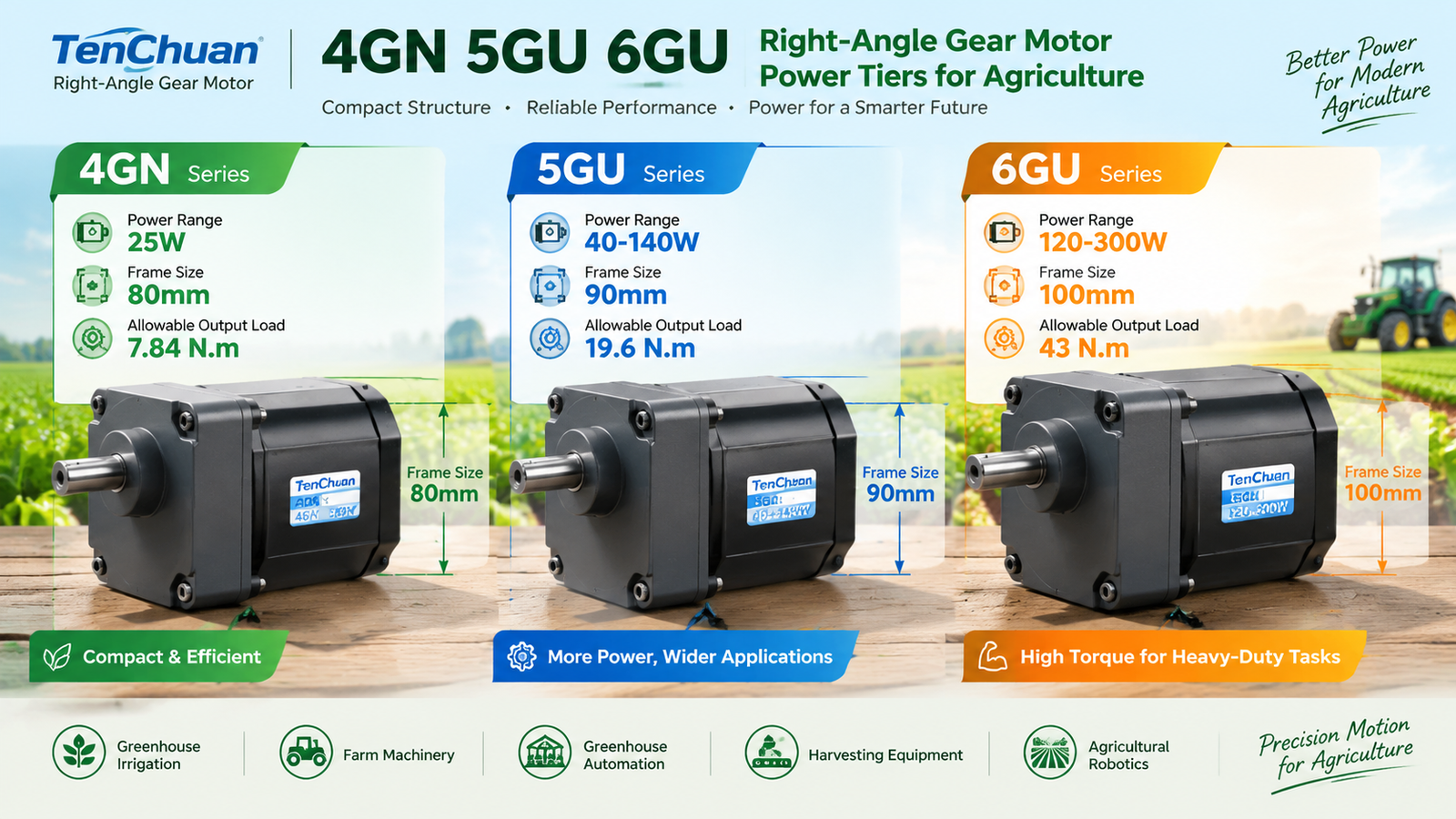
TenChuan’s right-angle range covers the power bands most small and medium agricultural machines need:
4GN series (25 W, 80 mm frame). A compact 80 mm frame motor with rated torque of 154–220 mN·m at 1250–1550 r/min and ratios from 3:1 to 300:1, with maximum allowable output load up to 7.84 N·m. It suits louvers, shutters, dosing flaps and light metering shafts.
5GU series (40–140 W, 90 mm frame). A sturdy 90 mm frame motor with rated torque of 246–670 mN·m, ratios from 3:1 to 500:1 and maximum allowable output load up to 19.6 N·m — a natural fit for seeders, spreader discs and small mixers.
6GU series (120–300 W, 100 mm frame). A heavy-duty 100 mm frame motor with reinforced gearbox, rated torque of 740–1840 mN·m, ratios from 3:1 to 500:1 and maximum allowable output load up to 43 N·m — the range for augers, conveyor drives and batch mixers.
All three series are available as reversible, 30-minute-rated units in single-phase 110 V or 220 V, with three-phase 220 V or 380 V options where continuous or higher-duty running is needed. The 6GU AC right-angle gear reducer motor 120–300 W is the usual starting point for auger and mixer duty; step down to the 5GU AC right-angle gear reducer motor 40–140 W for lighter metering and spreading tasks, or to the 4GN AC right-angle gear reducer motor 25 W for small auxiliaries. For machines that are hosed down or sit in heavy dust, tell the supplier the exposure level so the motor can be specified with the right enclosure, sealed leads and shaft protection rather than a standard open unit.
Selection checklist and common mistakes
Before you finalise a gear motor for an agricultural machine, run this checklist:
Output torque calculated at the driven shaft for the starting condition, with a 20–50% margin for grain surges, cold grease and jamming.
Gear ratio chosen to reach the required output speed from the motor’s rated speed, and checked against the gearbox’s allowable load table at that ratio.
Duty cycle confirmed: does the motor’s rated run time cover your longest continuous run and your start frequency?
Voltage and phase match the actual farm or facility supply (110/220/380 V, 50/60 Hz).
Enclosure specified for the real exposure: dust, humidity, washdown or chemical contact.
Mounting and output shaft match the machine — flange or foot, shaft diameter, and whether a self-locking right-angle stage is needed to hold position.
Spare motor or gearbox strategy agreed with the supplier before the season starts.
The most common mistakes are sizing on watts instead of output torque, checking torque only at the running speed instead of at start-up, assuming a continuous-duty motor is required when a reversible 30-minute rating is the correct and cheaper match, and ordering a standard motor for an application that will be hosed down or buried in fertiliser dust. Starting load is where agricultural drives are most often underestimated — if in doubt, go one frame size up rather than down.
Conclusion
Selecting a gear motor for agricultural machinery is a torque-and-duty exercise in a dirty environment. Define the starting torque and output speed your auger, mixer, seeder or conveyor needs, pick the ratio that delivers both, match the motor’s rated run time to your real cycle, and specify the enclosure for the dust, moisture and chemicals the machine actually sees. When those four things line up, a compact right-angle AC gear motor will run reliably through the season with minimal attention.
Start your selection from the right-angle gear reducer motor range and confirm the environmental rating with the supplier before ordering — a drive specified for the real conditions of your machine will always outlast one specified from the nameplate alone.
Câu hỏi thường gặp
What gear motor is used in agricultural machinery?
Most small and medium farm machines use a gear reduction motor that turns an auger, mixer, metering shaft or conveyor at low speed with controlled torque. Right-angle AC gear motors from about 25 W to 300 W cover augers, seeders, spreaders, mixers and ventilation drives, with output torque typically from a few N·m up to roughly 40 N·m depending on ratio.
How much torque does a gear motor for a grain auger need?
A small inclined grain auger moving a few tonnes per hour typically needs about 8–25 N·m at the screw shaft, depending on length, incline and grain type. Calculate the drag force at the screw’s mean radius, then add a 20–50% margin for start-up surges before checking the gearbox allowable load at your chosen ratio.
What gear ratio should an agricultural gear motor have?
Divide the motor’s rated speed by the required output speed. A 1350 r/min motor driving an auger at 60 r/min needs roughly a 22.5:1 ratio, so a standard 25:1 gearbox is the practical choice. Ratios of 10:1–100:1 cover most augers, mixers and conveyors; very slow actuators use up to 300:1 or 500:1.
Are agricultural gear motors AC or DC?
Stationary, mains-powered machines such as augers, mixers, conveyors and ventilation drives normally use AC gear motors — single-phase 110/220 V where three-phase is not available, or three-phase where it is. DC gear motors are the norm on battery-powered equipment such as self-propelled spreaders and planters where variable speed and soft starting matter.
How do I protect a gear motor from dust and moisture on a farm?
Choose a totally enclosed motor, protect the terminal box and electrical leads, and specify sealed or shielded output shafts for dusty positions. Where the machine is hosed down, match the motor’s IP rating to the washdown regime and keep the terminal box and connections out of the direct water path.
Can a small gear motor run continuously through a shift?
Standard small AC gear motors with capacitor start are usually rated for reversible 30-minute duty, not continuous running. If a machine runs for hours at a time, either specify the three-phase or continuous-duty version of the same frame, add a larger frame with more thermal margin, or confirm the running profile with the supplier before ordering.
Practical guide to sizing gear motors for HVAC dampers and fan drives: damper torque from blade area and static pressure, gear ratio for travel time, and 25 W to 300 W frame choices.
Practical selection guide for choosing a right-angle AC gear motor for packaging machines — covering speed, torque, frame size, duty cycle and voltage.
How to select gear motors for food processing: food-grade materials, NSF H1 lubricants, IP65-IP67 washdown ratings, torque/speed matching, and cleanable mounting for conveyors, augers and mixers.