Động cơ bánh răng cho cửa xoay: Hướng dẫn lựa chọn thiết bị tự động hóa cổng và cửa
Ngày đăng: Tác giả: Lisa
Sizing a gear motor for swing door automation is not the same calculation as sizing one for a sliding door. A sliding leaf is a force problem: you add up seal drag, track friction and wind, and you push along one straight line. A swing leaf is a moment problem. Every load acts through a lever arm that changes length as the door travels, and one of those loads — the door closer spring — exists only on swing doors. Get the arc geometry wrong and the operator will stall a few centimetres from the closed position, which is exactly where a swing door is hardest to move.
This guide walks through the six numbers that decide whether a compact right-angle AC gear motor suits a swing door, shows where the arm linkage quietly eats your torque, and explains honestly what a 25 W class drive can and cannot hold.
Why a swing door is a torque problem, not a force problem
On a swing door, the drive does not move the leaf — it rotates it about the hinge axis. Every requirement is therefore a torque in newton-metres at that axis, not a force in newtons. Three consequences follow, and all three are swing-specific.
The load changes through the arc. Inertia, friction, closer spring force and wind each produce a different hinge torque at 5°, at 45° and at 90°. The peak almost never sits at the mid-point of the travel.
The mechanical advantage of the arm changes through the arc. An articulated or scissor arm converts a fixed gear motor torque into a varying hinge torque. Near the closed position the arm is often at its worst advantage, which is why breakaway is the hardest part of the cycle.
The leaf acts as a sail. A swing leaf presents a large flat area to the wind at a moment arm of roughly half the leaf width. A sliding leaf on the same opening does not.
One useful simplification: with a vertical hinge axis on a level floor, leaf weight produces no torque about the hinge, because gravity acts parallel to the axis. Gravity only enters the calculation when the hinge axis is inclined or the mounting surface slopes.
The five numbers that size a swing door gear motor
Số
What to measure
Why it decides the drive
1. Leaf inertia
Leaf mass and width, plus opening time
Sets the acceleration torque, usually the largest term at breakaway
2. Hinge friction
Hinge type and condition; torque check with the leaf disconnected
Adds a constant drag that never goes away, even at zero speed
3. Closer spring torque
Closer model, or a spring scale reading at the leaf edge
Must be overcome on every opening; also closes the door when power is off
4. Wind moment
Leaf area, exposure, and design wind speed
Frequently dominant on exposed leaves — and the easiest to forget
5. Arm ratio
Linkage geometry at the worst point of the stroke
Converts gear motor output torque into hinge torque; it is not a constant
Step 1: Work out the hinge torque the leaf needs
Start with inertia, because it is the term you can calculate exactly. For a uniform rectangular leaf swinging about one edge:
J = (1/3) × m × w²
T_inertia = J × α      α ≈ 4θ / t²
Here m is leaf mass in kilograms, w is leaf width in metres, θ is the total swing in radians (1.571 rad for 90°), and t is opening time in seconds. The approximation for α assumes a trapezoidal motion profile, a reasonable model for a fixed-speed operator with a ramp.
Ví dụ minh họa. A 25 kg leaf, 0.9 m wide, opening 90° in 4 seconds: J = (1/3) × 25 × 0.9² = 6.75 kg·m², α ≈ 4 × 1.571 / 16 = 0.39 rad/s², so T_inertia ≈ 2.7 N·m. Hinge friction on a healthy pair of bearings is small but not zero; a practical allowance for a light leaf is 0.5–1.5 N·m, and on worn or unlubricated hinges it can be several times that. Measure it rather than assuming it. Adding 1 N·m brings the running requirement to roughly 3.7 N·m at the hinge — and we have not yet added the closer or the wind.
Step 2: Add the door closer spring — the load most people forget
Most swing doors carry a mechanical closer or overhead spring. That spring works against you on every opening, then closes the door for you when power is removed. Its torque is not trivial: commercial swing door operators are commonly specified with closing torques in the 20–50 N·m range, and that is the load the drive has to beat, not the inertia of the leaf.
Measure it rather than guess. Disconnect the operator, pull the leaf to the open position, and read the force needed at the leaf edge with a spring scale. Then T_closer = F_edge × w.
This is the single most common reason a gear motor for swing door operators stalls in the field. If the leaf carries a heavy closer and you intend to drive it with a compact AC gear motor, either replace the closer with a lighter one matched to the operator, or step up a frame size. No gear ratio makes an undersized motor beat a stiff spring.
Step 3: Convert hinge torque to gear motor torque through the arm
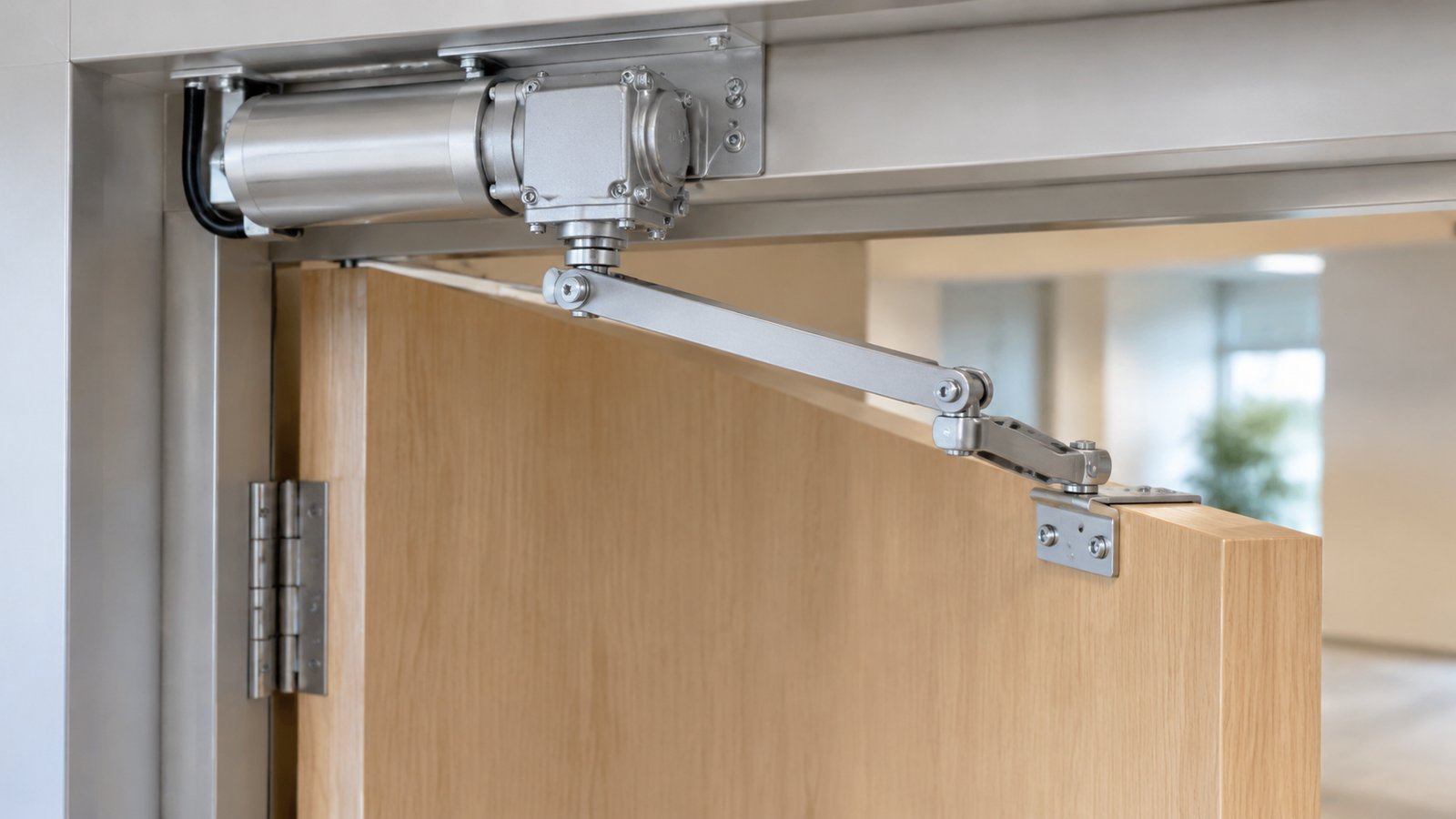
Unless the drive is a concealed floor unit coupled directly to the hinge, there is an arm between the gear motor and the leaf, and the arm is not a simple multiplier. For a push arm, the force at the contact point is the output torque divided by the arm radius, and the hinge torque is that force times the perpendicular distance from the hinge to the line of action:
T_hinge = T_output × (d / r_arm)
Here d is the perpendicular distance from the hinge axis to the arm’s line of action and r_arm is the arm radius. The ratio d / r_arm changes continuously through the stroke, and on many push-arm linkages it is smallest with the door nearly closed — precisely when the closer spring is also at its stiffest. Check the geometry at that worst position, not at mid-travel, then add a service factor of 1.3–1.5 for seal ageing, temperature and wear.
Step 4: Treat wind as a moment, not a force
Wind on a swing leaf is a distributed pressure on a flat plate, and what matters is the moment it creates about the hinge:
q = 0.613 × V²        (Pa, with V in m/s)
F_wind = q × A × C_d    (N, C_d ≈ 1.2 for a flat plate)
T_wind = F_wind × w / 2   (N·m)
The results are sobering, and they are why a compact drive belongs on sheltered indoor leaves. A 0.9 m × 2.0 m leaf in a 15 km/h breeze — 4.2 m/s, barely enough to move a flag — develops about 23 N of force and roughly 10 N·m of hinge moment. That alone exceeds the allowable load of many small right-angle gear motors at usable ratios.
So be explicit about exposure. On an indoor swing door with no through-draught, wind is negligible and the closer spring plus inertia decide the drive. On an exposed entrance or gate leaf, wind will usually dominate, and the answer is a larger frame size plus a mechanical holding device — not a bigger gear ratio on the same motor.
Step 5: Set opening time and pick the output speed and ratio
Opening time is a specification, not a preference: pedestrian swing doors typically open 90° in 2–4 seconds. Convert that into output shaft speed. Coupled directly to the hinge:
n_out = θ / t × 9.55 (rpm, with θ in radians and t in seconds)
For 90° in 3 seconds that is about 5 rpm. With an arm linkage the output shaft turns faster, because the arm only travels through part of the arc — expect 20–60 rpm depending on the linkage. The ratio then follows from the motor’s loaded speed, roughly 1350 rpm at 50 Hz and 1550 rpm at 60 Hz, so a direct-coupled 5 rpm output needs a ratio near 300:1.
Two things change at high ratios, and both matter. Output torque capacity rises, but so do reflected inertia and backlash, and starting efficiency drops. If you need to reconcile speed, ratio and torque for a specific unit, a gear ratio calculation walkthrough is the fastest way to check your numbers before committing to a frame size.
Step 6: Decide what holds the door when the power is off
A swing door has to behave predictably at zero power, and this is where the honest limits of an AC gear motor matter.
There is no brake. A standard AC gear motor has no holding brake. Whatever holds the leaf is either the closer spring or the geometry of the gear train.
Self-locking is a geometry property, not a safety function. A right-angle reducer with a worm first stage can resist back-driving above a certain ratio, but that behaviour varies with ratio, load and lubrication. It is not a certified hold-open device and it will not stop a person pushing the leaf.
There is no position feedback, no soft start and no obstacle detection. An AC gear motor is a fixed-speed drive. It cannot reverse on contact, report leaf position, or ramp its acceleration, which places it in simple swing operators and OEM mechanisms rather than touchless pedestrian operators that must meet accessibility and safety standards.
If the application needs hold-open, add a mechanical hold-open arm or an electric lock. If it needs reversal on obstruction, that has to come from the controller and sensors, not from the motor.
Duty cycle and cycle count: where a compact AC drive really fits
Door operators are reversing, intermittent-duty machines, so check the duty designation before anything else. In the 4RK series the GN suffix denotes a reversible 30-minute rating and the A suffix denotes continuous duty. A swing door in a busy lobby can cycle hundreds of times a day, and although individual cycles are short, total on-time and heat soak in the gearbox add up.
Practically: keep the reversible variant to genuinely intermittent duty, choose the continuous-duty variant for heavy cycle counts, and fit a thermal overload relay. Induction motors have no brushes to wear out, so the wear items on a compact AC swing door drive are the capacitor, the bearings and the gear train — not the winding. That is a maintenance schedule you can plan around.
Matching a 4RK 25 W right-angle gear motor to a swing door
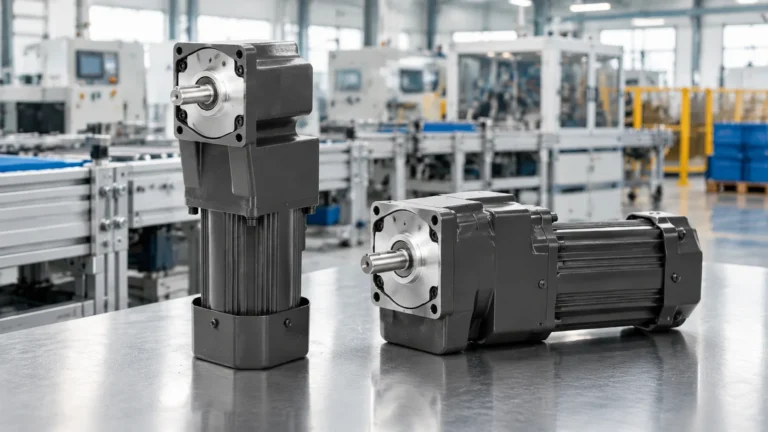
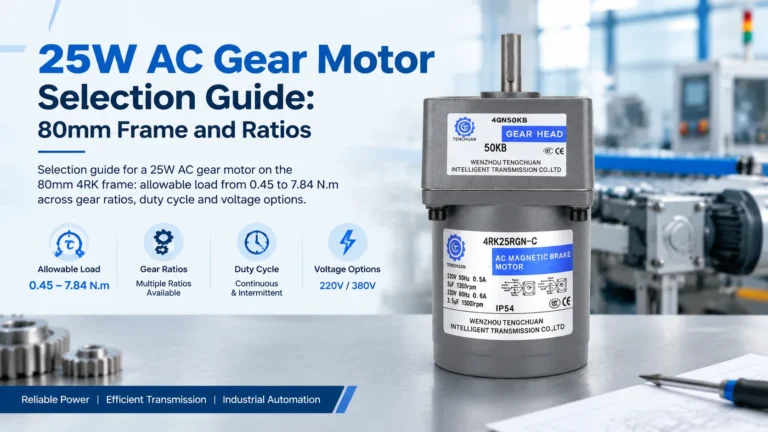
Cái 4RK 25 W right-angle gear motor uses an 80 mm frame with a 90-degree output, single-phase 110 V or 220 V and three-phase options, and ratios from 3:1 to 300:1. Rated torque at the motor shaft is 185 mN·m at 50 Hz and 154 mN·m at 60 Hz, so the figure that actually limits a swing door is the gearbox output limit, which rises sharply with ratio.
Output speed (50 Hz)
Tỷ lệ
Tải trọng tối đa cho phép
Typical swing door fit
300 vòng/phút
5:1
0.79 N·m
Too fast and too weak for a leaf; linkage or latch mechanism only
100 rpm
15:1
2.25 N·m
Light assisted-opening mechanisms, not a full automatic swing
50 vòng/phút
30:1
4.12 N·m
Very light sheltered leaf with a light closer and a good arm ratio
30 vòng/phút
50:1
6.18 N·m
Light indoor swing leaf, sheltered, moderate opening time
20 rpm
75:1
7.84 N·m
Best usable torque for slow, light indoor swing doors
5–15 rpm
100:1–300:1
7.84 N·m (capped)
Direct-coupled slow swing operators on light leaves
Read that table together with the exposure rule. A 25 W right-angle gear motor suits a light, sheltered indoor swing leaf with a light closer and a well-designed arm — the classic lobby, office or equipment-cabinet door. It is not the right drive for an exposed gate leaf, a leaf carrying a heavy closer, or an opening where wind moment runs into the tens of newton-metres. For those, step up to a 40–140 W right-angle gear motor or, for genuinely heavy leaves and gate automation, a 120–300 W frame. Confirm frame dimensions, shaft and mounting footprint against a Bảng kích thước động cơ bánh răng before finalising the housing.
Common swing door gear motor selection mistakes
Sai lầm
What actually happens
Correct approach
Sizing on running torque instead of breakaway
The door stalls just before reaching the closed position, where the closer and arm geometry are worst
Check torque at the worst point of the arc, then apply a 1.3–1.5 service factor
Ignoring the closer spring
The drive cannot open the door at all, or overheats trying
Measure spring force at the leaf edge and convert it to hinge torque
Treating the arm as a fixed multiplier
Calculated torque looks fine, but real hinge torque is far lower near closed
Evaluate the linkage at its worst angle, not at mid-travel
Assuming self-locking is a safety device
The leaf can still be pushed open; a hold-open requirement is unmet
Add a mechanical hold-open arm or an electric lock
Overlooking wind on exposed leaves
The drive is overwhelmed by a moderate gust
Calculate the wind moment early and step up a frame size if it dominates
Using a reversible 30-minute motor on a high-cycle door
Thermal degradation and premature capacitor or bearing failure
Match the duty rating to the cycle count, or specify continuous duty
Kết luận
Choosing a gear motor for swing door duty comes down to one habit: express every load as a torque at the hinge, then check it at the worst point of the arc rather than at its mid-point. Inertia you can calculate; hinge friction and closer spring torque you should measure; wind you must calculate before choosing an exposure class; and the arm ratio you have to read off the linkage geometry at the closed position. Once those five numbers are in hand, frame size and gear ratio usually pick themselves, and a compact right-angle AC gear motor is a clean, brushless, maintenance-predictable answer for light sheltered leaves.
Light swing doors and small gate leaves are usually driven by a compact right-angle gear reducer motor in the 25 W to 140 W class, mounted in the frame or header with a push or scissor arm. Heavier or wind-exposed leaves use larger drives, often brushless, plus a mechanical holding device.
How much torque does a gear motor for swing door operators need?
It depends almost entirely on the closer spring and the exposure. A light sheltered indoor leaf with a light closer may need only a few newton-metres at the hinge, while a commercial operator with a full-size closer is commonly specified with closing torques of 20–50 N·m. Measure the closer force at the leaf edge and convert it to hinge torque before choosing a frame size.
Does a swing door gear motor need to be self-locking?
Not necessarily, and self-locking should never be treated as a safety function. On most swing doors the closer spring already returns the leaf when power is removed. If the door must hold open, specify a mechanical hold-open arm or an electric lock rather than relying on the gear train.
How do I choose the gear ratio for a swing door?
Work backwards from the opening time. Convert the required swing angle and time into output shaft speed, then divide the motor’s loaded speed by that output speed. A direct-coupled 90-degree swing in 3 seconds needs roughly a 300:1 ratio; an arm linkage needs less because the output shaft turns faster.
Why does wind matter more on a swing door than a sliding door?
Because the leaf presents its full area to the wind at a moment arm of about half the leaf width, so wind becomes a torque about the hinge rather than a force along a track. A 0.9 m × 2.0 m leaf in a light 15 km/h breeze develops around 10 N·m of hinge moment — already more than many small gear motors can hold.
Can a 25 W gear motor open an automatic swing door?
Yes, for a light sheltered indoor leaf with a light closer and a well-matched arm linkage — that is the intended duty for this frame size. It will not open a heavy leaf, beat a full-size commercial closer, or hold position against wind, and it offers no position feedback, soft start or obstacle detection.
So sánh động cơ bánh răng góc vuông và động cơ bánh răng thẳng dựa trên bảng tải trọng cho phép thực tế: hiệu suất, mô-men xoắn, “lầm tưởng về khả năng tự khóa” và cách đưa ra quyết định qua năm bước.
Hướng dẫn lắp đặt động cơ bánh răng 750W (khoảng 1 HP): những điểm khác biệt giữa lắp đặt theo phương thẳng đứng và phương ngang, mức dầu, bảo vệ phớt, tải trọng dọc trục và mô-men xoắn theo tỷ số truyền.
Cách lựa chọn công suất cho động cơ giảm tốc AC 25W trên khung 4RK 80 mm: tốc độ đầu ra, tải cho phép từ 0,45 đến 7,84 N·m, mô-men xoắn tối đa, chu kỳ làm việc và các lựa chọn điện áp.