A gear motor almost never works alone. The drive itself — whether you have picked a compact small AC unit, a right-angle 90° reducer, or a higher-power helical-bevel line — needs a handful of mechanical and electrical support parts to bolt it down, transmit its output, and protect it from the shock loads and vibration of real production environments. Engineers lump all of these parts together as gear motor accessories, and treating them as an afterthought is one of the most common reasons a perfectly good drive fails prematurely on the line.
This guide walks through every accessory category you are likely to specify — torque arms, mounting flanges and foot kits, couplings, shaft connectors, speed controllers, and replacement spares — and explains what each one does, when you actually need it, and how to size it for the gear motor on your drawing. If you are still deciding on the drive itself, start with our overview of gear motor types before you commit to a frame size, then come back here for the parts that go around it.
What Are Gear Motor Accessories?
Gear motor accessories are the auxiliary mechanical, electrical, and structural components that support a gear motor between the moment it arrives on the receiving dock and the moment it is bolted, coupled, wired, and running under load. Strictly speaking, the gear reducer and the motor are the drive; everything that surrounds them — every flange, every coupling, every brake, every controller — is an accessory.
That wider definition matters because the failure rate of a drive is rarely the drive itself. It is the misalignment caused by a sloppy coupling, the axial shock that an undersized torque arm could not absorb, or the brush wear in a speed controller that nobody had on the preventive-maintenance list. Good accessories are not optional extras: they are what makes the rated torque, the rated life, and the rated IP protection real.
The Main Categories of Gear Motor Accessories
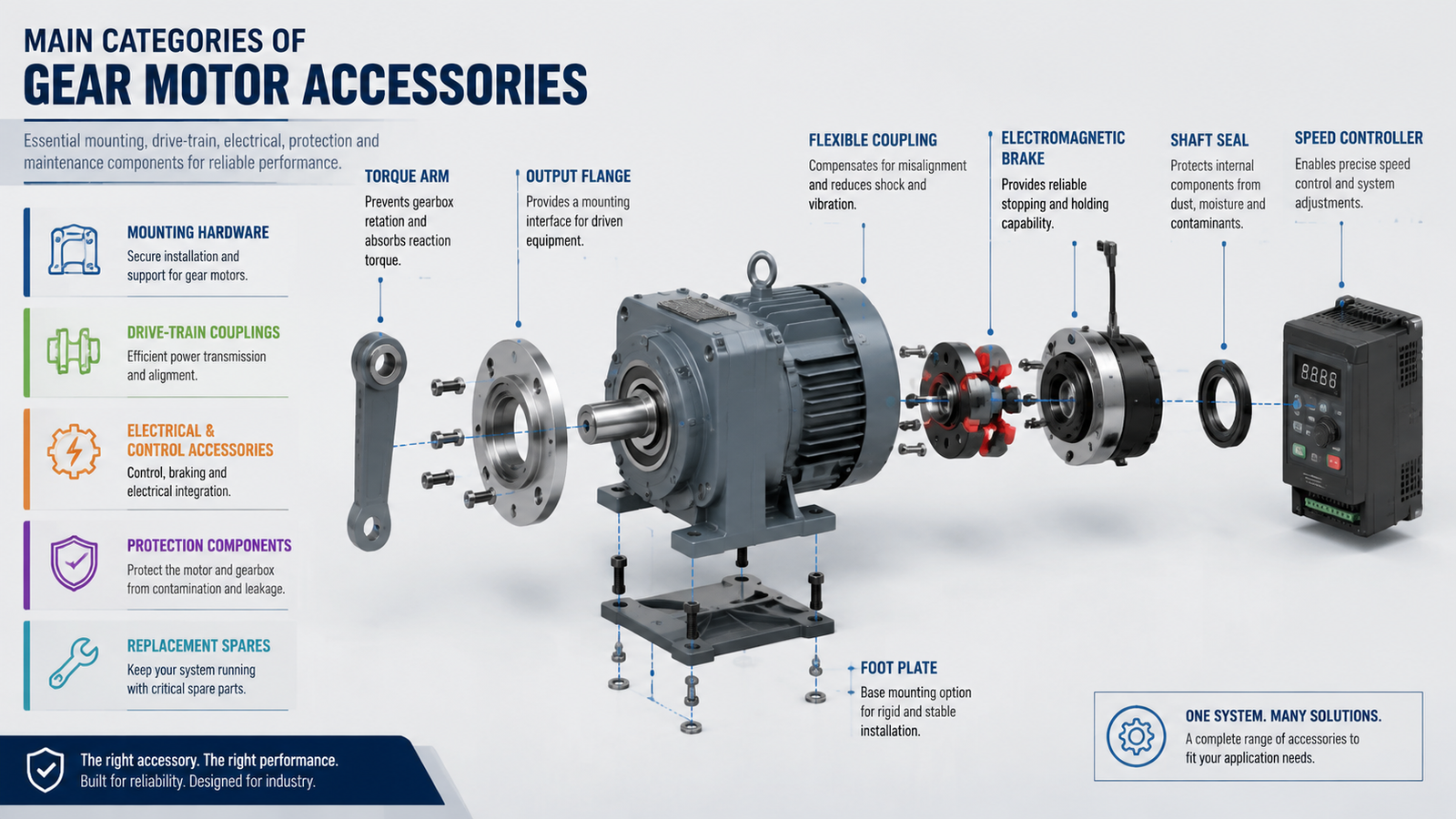
Most procurement teams end up ordering from five accessory categories. The exact naming varies by supplier, but the functional split is consistent across the industry.
Replacement spares — armatures, brushes, bearings, gaskets and small wear parts.
The headline product carrying the Tenchuan gear motor accessories line today is a precision speed-controller armature, but the same engineering standards apply across the whole accessory family.
Mounting Hardware: Torque Arms, Flanges, and Mounting Kits
Mounting hardware is the accessory group you will specify on almost every gear motor, regardless of whether it sits inside a packaging machine, a conveyor, or an automatic door. The three parts that come up most often are torque arms, output flanges, and foot / face mounting kits.
Torque Arms
A torque arm is a rigid bracket that bolts to the side of a right-angle gear motor and ties the housing to the machine frame so the motor cannot rotate when the gearbox delivers torque. Without a torque arm, the reaction torque tries to spin the whole motor in its mounts, which quickly shears the bolts or cracks the housing feet. Select a torque arm rated for at least the peak torque of the gear motor, and mount it on the side that best counteracts the load direction.
Output Flanges and Face Plates
Output flanges convert a foot-mounted gear motor into a flange-mounted unit, which is useful when you want the output shaft to couple directly into a gearbox or a large-diameter input flange without adding a coupling in between. Standard B5 and B14 flange kits are the most common pattern, and they should be ordered to the exact motor frame size (80 mm, 90 mm, 100 mm and so on) so the bolt circle and pilot diameter match without machining.
Foot Plates and Resilient Mounting Kits
Foot plates let you re-orient a face-mounted gear motor back to a foot mount, which is helpful when the production line changes and you inherit a drive with the wrong mounting style. Resilient mounting kits — vibration isolators between the foot plate and the machine frame — are worth their cost in any application with frequent start-stop cycles, where reaction torque can otherwise telegraph into the frame and cause noise or fatigue cracks.
Drive-Train Couplings and Shaft Connectors
Couplings and connectors live between the gear motor output shaft and the driven load. They protect the gearbox from misalignment, isolate the driven machine from shock loads, and let you size shafts independently on either side of the coupling.
Flexible Couplings
Flexible couplings absorb the small parallel, angular, and axial misalignments that always appear once you bolt a real machine to a real gear motor. Jaw couplings, spider couplings, and Oldham-style couplings are the everyday workhorses; for high-torque lines, gear-type and disc-style flexible couplings are worth the extra cost. A good rule is to select a coupling with a rated torque at least equal to the gear motor’s maximum output torque, and to verify its misalignment range against the worst-case assembly tolerances of your machine.
Rigid Sleeves and Shaft Connectors
For low-speed, precisely aligned drives — index tables, small conveyors, many kinds of small AC gear reducer motors — a rigid sleeve or bored-to-size shaft connector is often preferable. Rigid couplings transfer full torque without damping, so they require accurate alignment but do not introduce the small backlash that a flexible coupling always adds.
Output Shaft Seals
Shaft seals look like a minor part until dust or washdown water starts creeping past them and contaminates the gearbox. V-ring seals, lip seals, and IP-rated bellows all live in the accessory family, and replacing them on a planned schedule is far cheaper than rebuilding a gearbox that has ingested moisture.
Electrical and Control Accessories
Most modern lines need at least one electrical accessory between the supply and the gear motor. For a small AC drive the most common ones are speed controllers, capacitors, terminal boxes and electromagnetic brakes.
Speed Controllers
Speed controllers adjust the voltage and current sent to the motor so the driven equipment runs at the speed the process needs instead of the motor’s fixed rated speed. In an AC gear motor accessory lineup this is typically where you find the controller armature — the rotating copper-and-laminated-core component that the speed controller drives, and the part that actually sets the regulation accuracy of the whole loop. Quality here matters: a precision-wound armature with a balanced rotor keeps current transmission stable and keeps vibration low across the entire speed range.
Capacitors and Start Relays
Single-phase AC gear motors need a start capacitor and, on reversible models, a run capacitor and a start relay. The capacitor is a wear part: it loses capacitance over time and eventually fails, and it lives inside a small housing that is usually treated as an accessory rather than part of the motor itself.
Electromagnetic Brakes and Encoders
Electromagnetic brakes — friction brakes that engage when the coil is de-energized — give a gear motor a holding torque without depending on the self-locking geometry of a worm reducer. Encoders and resolvers feed back shaft position for any closed-loop control scheme. Either of these accessories adds length to the motor, so when you specify them, confirm the motor frame plus brake / encoder will fit the original mounting envelope. For right-angle gear reducer motors used in doors or lifts, an electromagnetic brake is often the difference between a safe installation and an unsafe one.
How to Select Gear Motor Accessories
Match the accessories to the application instead of the other way around. The four questions below cover most real-world selections.
What load does the drive see? A continuous conveyor with smooth torque and a punch press with shock loads need completely different coupling and torque-arm selections, even with the same rated gear motor.
What is the mounting style and the available envelope? Foot, flange, or face mount dictates which accessories stay in scope and which would require a redesign.
Does the process require speed adjustment or holding torque? Both move an electrical accessory into the bill of materials.
What environment is the gear motor in? Dust, water, food contact, or outdoor duty drive the IP rating of seals, terminal boxes and the speed-controller housing.
For a more structured walk-through of the upstream selection that produces the spec the accessories have to satisfy, the SEW-compatible cost discussion in our SEW gear motor alternatives guide shows how a typical European spec translates to a Chinese-made drive with the same accessory footprint.
Matching Accessories to Your Existing Gear Motor
Many plants are not buying accessories for a new drive — they are replacing worn parts on an existing one. In that case, treat the accessories as a replacement problem instead of a new design problem:
Confirm the frame size and shaft diameter of the existing gear motor before ordering couplings, flanges, or torque arms.
Replace brushes, armatures, and bearings only with parts that match the original winding and balance class — a heavier armature or a stiffer brush grade changes the speed-controller loop behavior.
Keep a small stock of common spares on the shelf: one or two speed controller armatures, a set of brushes, a couple of shaft seals, and the most common mounting bolts.
Common Mistakes When Sourcing Gear Motor Accessories
A few recurring mistakes account for most accessory-related failures on the line. They are easy to spot, and easy to fix at the quote stage.
Under-specifying the torque arm. A torque arm rated exactly to the rated motor torque is too small — size it for at least peak torque plus a generous safety margin.
Ignoring coupling misalignment. Ordering a rigid coupling without measuring the actual shaft alignment almost always leads to premature bearing wear.
Mixing electrical accessories from different series. A speed controller designed for one motor series will not necessarily match the impedance of another, even at the same rated voltage.
Skipping environmental sealing. An outdoor or washdown installation needs IP-rated seals on every accessory that has a shaft or a junction box — not only on the motor itself.
Treating spares as a one-off. Buying a single replacement armature when the line goes down is expensive; a planned spare list is cheap.
Installation and Maintenance Tips
Accessories are easy to install correctly but quick to install badly. A few habits pay dividends:
Torque every mounting bolt to the manufacturer’s value with a calibrated wrench — a loose bolt on a torque arm is the same as no torque arm.
Verify coupling alignment with a dial indicator before energising the drive; check it again after the first 50 hours of run time.
Keep the commutator clean on any brushed speed controller and replace brushes before they score the commutator.
Lubricate seals lightly during planned maintenance so they seat properly instead of running dry.
Store spare accessories in a dry, vibration-free cabinet so bearings and copper windings do not degrade before they ever reach the line.
Frequently Asked Questions About Gear Motor Accessories
What counts as a gear motor accessory?
Anything outside the motor and the gearbox that supports mounting, transmission, control, or protection of the drive. The most common examples are torque arms, flanges, couplings, speed controllers, brakes, encoders, shaft seals, and replacement spares like armatures and bearings.
Do I need a torque arm on every gear motor?
Not on every motor. Foot-mounted gear motors usually do not need one because the foot bolts resist reaction torque directly. Right-angle gear motors almost always do, because the output shaft reaction has no flat foot to push against. If the gearbox is face-mounted to a mating flange, the flange bolts take the reaction and a separate torque arm is normally unnecessary.
Can I use accessories from one brand with a different brand of gear motor?
Often yes, as long as the frame size, shaft diameter, pilot diameter, and electrical specification match. The exceptions are electrical accessories — speed controllers, brakes and encoders — which have loop characteristics tuned to a specific motor series and should be bought together as a set.
How do I know which speed controller armature my gear motor needs?
Match the armature to the controller model and to the motor frame size. Confirm the rated voltage, the armature winding resistance, and the commutator surface finish before fitting. For a drop-in replacement on a Tenchuan assembly, the published armature specs in the Tenchuan gear motor accessories category will list the compatible frame sizes and motor series.
Should I stock spare gear motor accessories?
Yes. A small stock of armatures, brushes, couplings and shaft seals — the wear parts — turns a multi-day line stoppage into a 30-minute swap. Most plants find that holding 5 to 10 percent of installed-drive value as spare accessories pays for itself in the first year.
Where can I source replacement gear motor accessories?
Genuine replacement parts come from the original gear motor manufacturer or from a specialist accessory supplier. For Tenchuan-equipped drives, the gear motor accessories product range carries the factory-supported spares, and the engineering team will confirm compatibility against the existing frame size before shipment.
Bringing It All Together
Gear motor accessories are not an afterthought line on the BOM — they are what turns a bare drive into a reliable production asset. Get the torque arm, flange, coupling, speed controller and seals right, and the gear motor will deliver its rated torque, run quietly, and last the full design life. Get them wrong and the same gear motor will fail long before its rated service hours, regardless of how carefully the drive itself was specified.
If you are sourcing a new build or rebuilding an existing line, start with a complete accessory list alongside the gear motor spec — frame size, shaft diameter, environmental rating, duty cycle, and the controller electrical interface — and the supply side will treat the package as one job. Send your BOM to the Tenchuan engineering team for a matched gear motor and accessory quote, and your drive will arrive ready to bolt in and run.
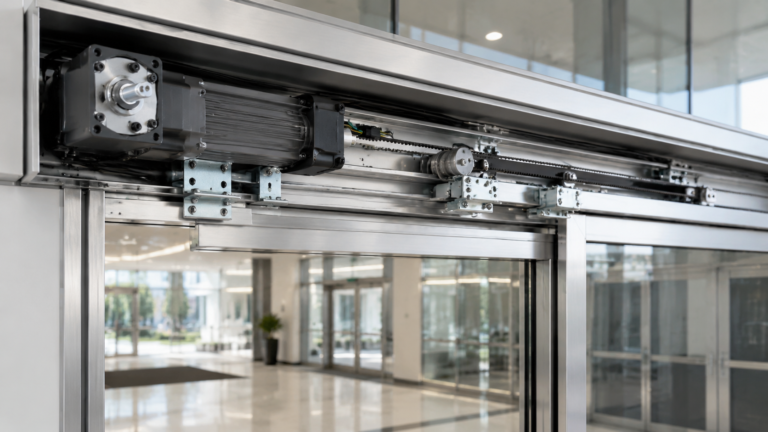
Practical guide to selecting a gear motor for door openers: calculate required torque and output speed, understand self-locking worm gear drives, and match the right AC gear motor to your door type.
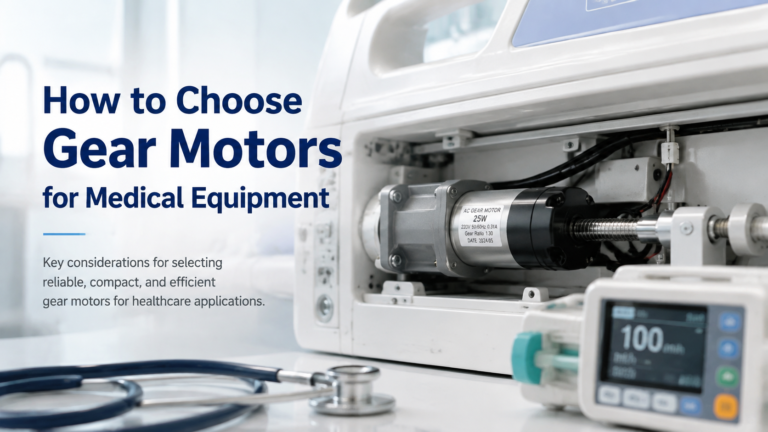
Selection guide for gear motors used in hospital beds, infusion pumps, ventilators, lab equipment and other medical devices. Covers noise, precision, IEC 60601-1 safety, IP rating and self-locking requirements, plus a step-by-step selection workflow and application table.
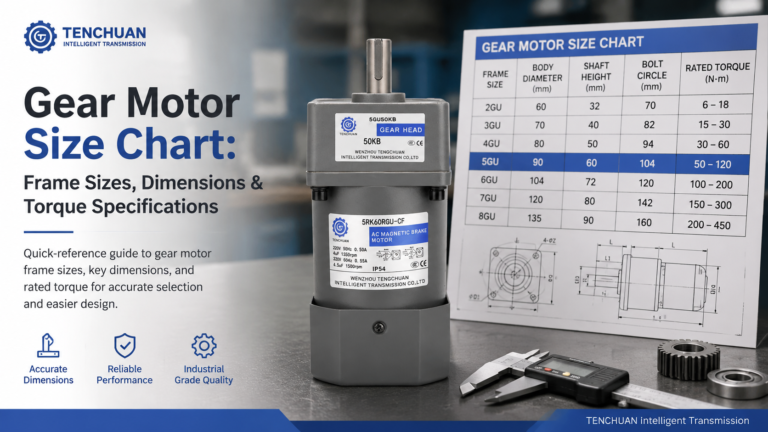
Read a practical gear motor size chart for small AC gear motors. Frame sizes 60-104 mm, dimensions, rated torque and RPM at common ratios, mounting styles.