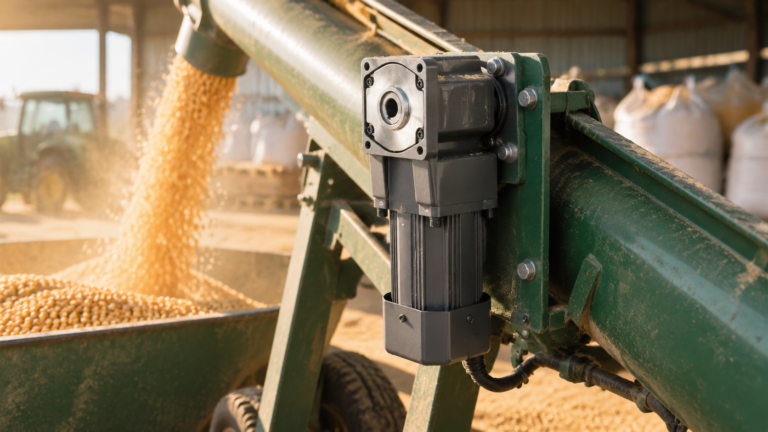
Food-Grade Gear Motors: How to Select Drives for Food Processing Equipment
Published: Author: Lisa
Food processing lines are among the harshest environments a gear motor will ever face: daily washdowns with high-pressure hot water, caustic cleaning chemicals, flour dust, condensation, and temperatures that swing from freezer cold to oven heat. Selecting a gear motor for food processing is therefore not just about torque and speed — it is about material compatibility, sealing, surface finish, and cleanability. This guide explains what makes a drive food-grade, how to match torque and speed to common food machines, which IP and material choices survive washdown, and the design details that keep a conveyor line running without unplanned stops.
What Does “Food-Grade” Mean for a Gear Motor?
In food equipment, “food-grade” is a layered requirement, and only part of it concerns the gearbox itself. There are four distinct aspects to check:
Contact-safe materials — any part that can touch food must use FDA-compliant or food-contact-approved materials. This applies mainly to exposed shafts, seals, and coatings, not the internal gearing.
Food-grade lubricants — the gearbox must be filled with NSF H1 registered food-grade grease or oil, so a seal leak cannot contaminate product. H1 lubricants are edible-contact-safe while still protecting steel gears.
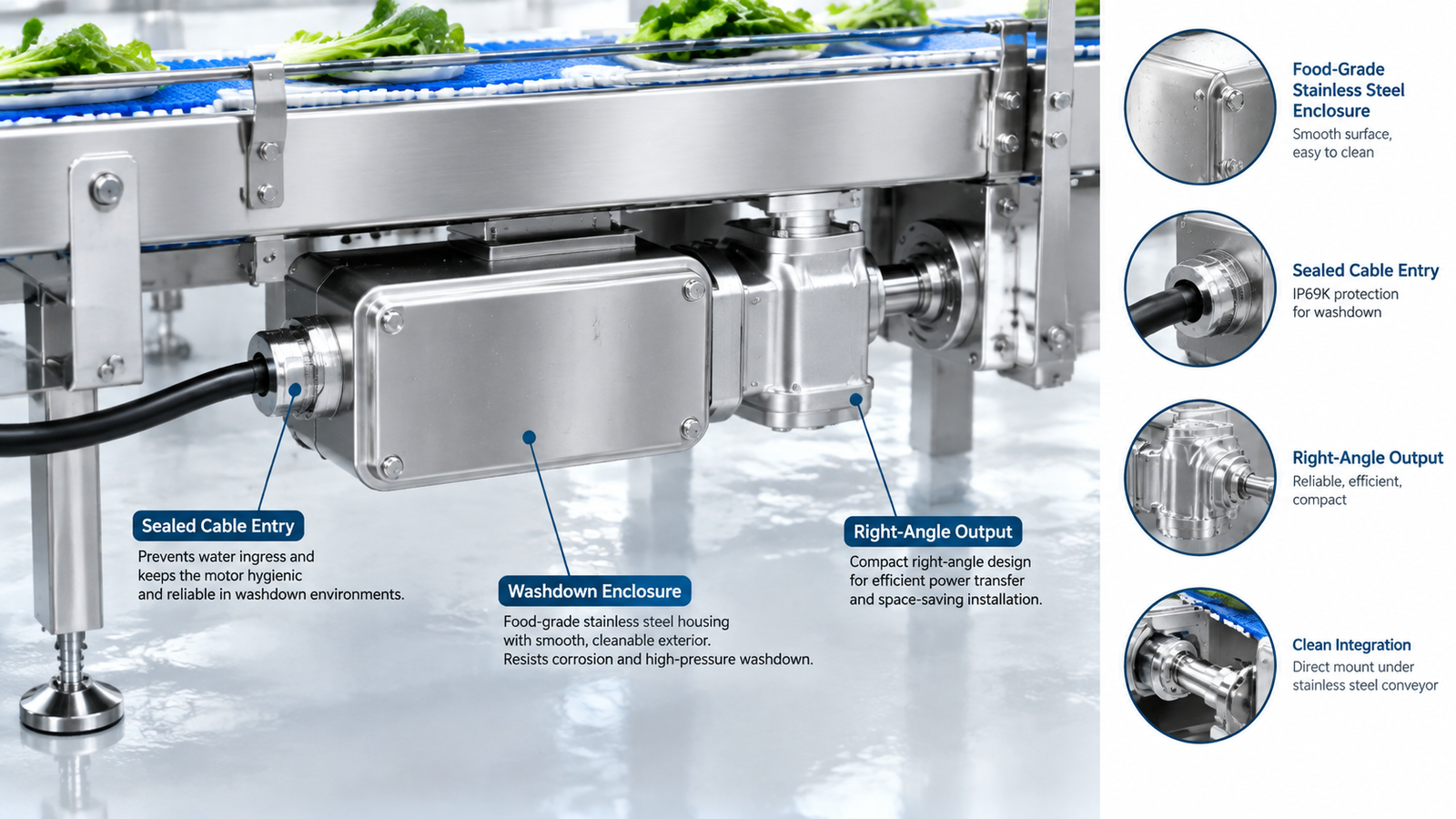
Cleanable exterior — smooth, crevice-free housings with no exposed fasteners or rough welds that trap food residue and harbour bacteria.
Washdown-tolerant construction — corrosion-resistant paint or stainless steel, sealed conduit entries, and a high ingress-protection rating so water and chemicals cannot reach the motor or gearcase.
A motor that meets only some of these is not a food-grade drive. A washdown-rated unit with the wrong lubricant is still a contamination risk; a unit with H1 grease but a painted, pitted housing will fail its first hygiene audit.
Common Food Processing Drive Applications
The torque and speed requirements in a food plant span a wide range, and most map cleanly onto small AC gear motor frames such as the 5GU right-angle series (40–140 W). Typical duties include:
Application
Typical speed
Load character
Drive notes
Packaging and labelling conveyors
10–60 r/min
Low to medium, steady
Compact right-angle units with encoder feedback for indexing
Auger feeders and dosing screws
5–40 r/min
Medium, starts under load
High start torque, IP65 or better
Dough mixers and kneaders
20–60 r/min
Variable, high during mix
Intermittent duty rating, overload margin
Bottle and jar fillers
30–90 r/min
Low, cyclic stop/start
Frequent reversing possible; brake or mechanical stop
Belt and roller transfers
40–120 r/min
Low, continuous
Standard right-angle or parallel shaft units
Because most of these machines run intermittently — start, pause, reverse, dwell — the duty cycle matters as much as the running torque. A conveyor that indexes every three seconds is far harder on a gearmotor than one that runs continuously, and the duty rating (S1 continuous vs S3/S5 intermittent) must match the real cycle.
Torque and Speed Selection for Food Machines
Selecting the right reduction ratio is the core engineering step. The output speed you need is set by the process — a dosing auger turns slowly, a transfer belt faster — and the required torque is set by the load mass, friction, and any start-up inertia.
Work out the required output speed
For a conveyor, output speed (r/min) = belt speed (m/min) ÷ (pulley circumference in m). For an auger or paddle, the speed is usually dictated by throughput and the geometry of the screw. Most food applications on right-angle gearmotors fall in the 5–120 r/min band after reduction.
Estimate the torque and add a service factor
Compute the torque from the force and radius, then apply a service factor — typically 1.25–1.5 for food conveyors and 1.5–2.0 for augers and mixers with start-under-load duty. The service factor covers washdown-induced seal drag, voltage variation, and occasional overloads, and it is the margin that separates a drive that lasts five years from one that fails in six months. The sizing method is covered in detail in our gear motor selection guide.
Match the frame to the mounting
Right-angle gearmotors with a hollow or solid output shaft suit augers and mixers where the drive mounts directly to the machine frame. Where space is tight — under a conveyor bed or inside a machine leg — a compact 40–140 W right-angle unit keeps the envelope small while still delivering 10–60 N·m after reduction.
IP Ratings and Washdown Survival
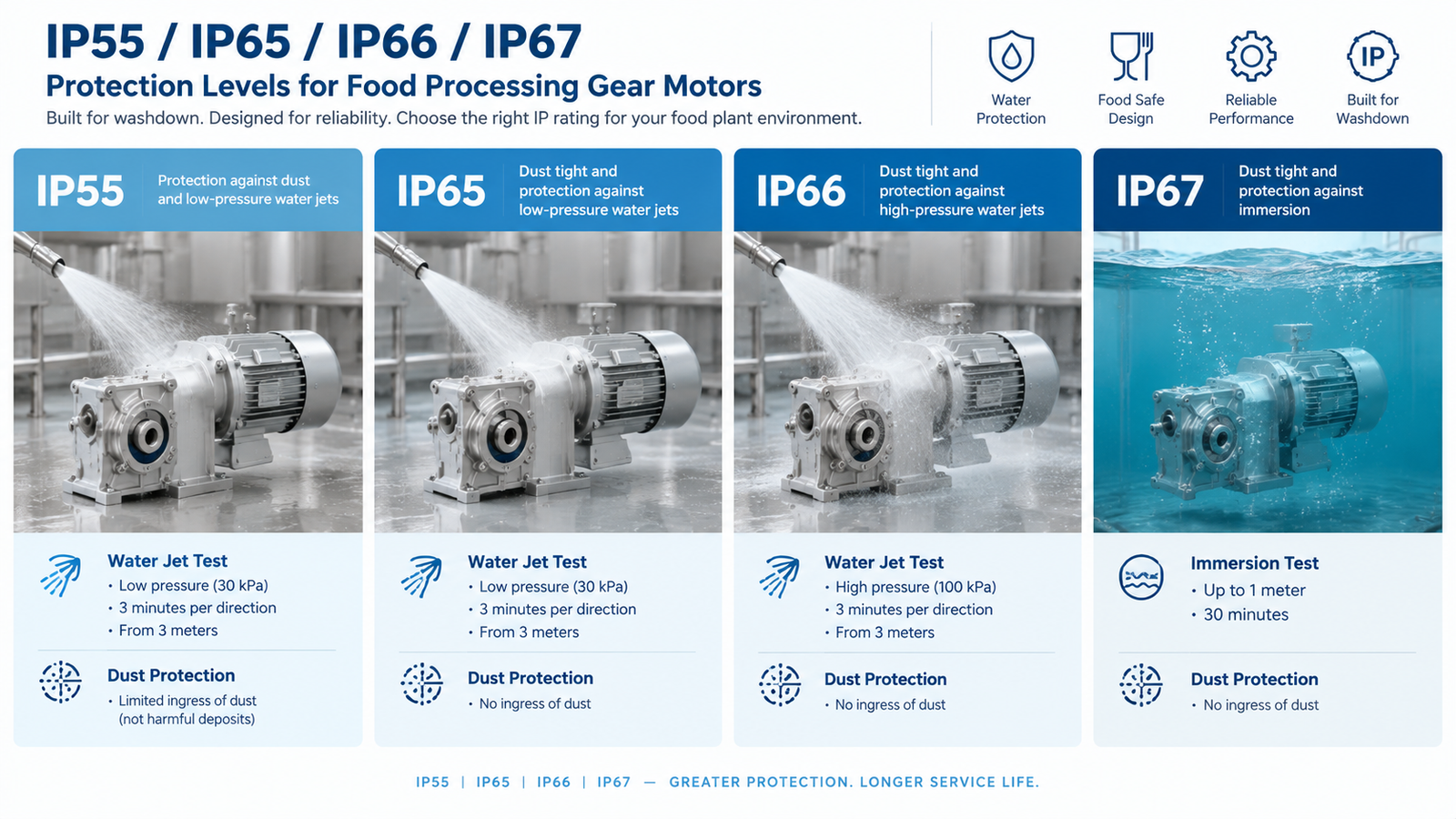
Water is the number-one killer of food-plant gearmotors, and the IP rating is the first line of defence. For food processing, treat IP65 as the minimum and IP66/IP67 as the norm for equipment that is washed daily.
IP55 — protected against water jets but not designed for repeated high-pressure washdown; acceptable for dry food areas with wipe-down cleaning only.
IP65 — jet-proof from any direction; the practical entry point for most wet food areas.
IP66 — powerful water jets; suited to daily plant washdown at close range.
IP67 — temporary immersion; for equipment that sits in standing water or is fully flooded during cleaning.
Sealing is only as good as its weakest point. The cable entry must be a sealed gland, the shaft seal must be double-lipped or a food-grade lip seal, and any breather or drain plug must be positioned so water cannot enter when the motor cools and draws air in. A unit with an IP65 motor but a vented gearbox breather is not IP65 as an assembly — check the whole drive, not just the motor end.
Material and Surface Finish Choices
Corrosion is the second enemy. Washdown chemicals and salty, acidic food residues attack ordinary painted housings within months.
Aluminium with food-safe coating
Many washdown gearmotors use a cast aluminium housing with a high-build, corrosion-resistant finish. This is lighter and cheaper than stainless, and adequate when the coating is maintained — but any chip or scratch becomes a corrosion and bacteria site.
Stainless steel housings and shafts
For the harshest zones — meat, dairy, wet processing — stainless steel (304 or 316) housings, output shafts, and fasteners eliminate the corrosion risk entirely. The trade-off is weight and cost, which is why stainless drives are used selectively on the machines that need them most rather than across the whole line.
Surface finish details
Look for housings with smooth radii instead of sharp corners, sealed or blanked unused cable ports, and no exposed threads or open fasteners. These are the details hygiene auditors check, and they are the details that make a drive genuinely cleanable rather than merely washable.
Mounting, Position, and Chemical Resistance
How the gearmotor is mounted determines how much washdown it actually receives. A drive mounted under a conveyor with its cable entry pointing up collects water on every wash; the same drive mounted with the gland pointing down drains cleanly. Where possible:
Mount the motor so the cable gland points down or to the side, never up.
Keep the drive out of direct splash zones where a deflector shield or recessed position can protect it.
Use stainless or plastic-coated hardware on all mounting points, and allow access for cleaning behind the motor.
Confirm the housing paint or finish withstands the specific cleaning chemicals used on site — caustic soda and peracetic acid are common in food plants and both attack standard paints.
Chemical resistance tables from the finish supplier are worth asking for before purchase. “Washdown rated” is not a single standard; a drive that survives mild detergent may fail after six months of caustic or chlorine-based washes.
Lubrication and Lifecycle Considerations
Gearmotors in food plants are sealed for life more often than in other industries, specifically to avoid the maintenance that would expose the gearcase. Two points matter:
Output shaft and seal options for food duty are part of the wider gear motor parts and replacement guide, which lists the seal and housing components you may need to specify for washdown zones.
NSF H1 lubricant as standard
Confirm the gearbox is filled with NSF H1 food-grade lubricant and that this is stated on the datasheet. If a unit arrives with standard mineral grease, it is not food-plant ready regardless of its IP rating.
Sealed-for-life versus serviceable
Sealed-for-life units eliminate routine oil changes and the risk of over- or under-filling, at the cost of replacing the whole drive at end of grease life. Serviceable units with a drain and fill point need a documented schedule, and any service work must keep the unit clean. Most food-plant operators standardise on sealed-for-life for small right-angle drives and serviceable units only for large, expensive gearboxes.
Temperature is the hidden lifecycle factor. Washdown water at 60–80 °C heats the housing, and in a cold store the same unit must start at −20 °C. Check the ambient range on the datasheet and remember that frequent hot-cold cycling accelerates seal wear — a good reason to keep spare shaft seals and a spare drive on the shelf for critical machines.
Selection Checklist for Food-Grade Gear Motors
Before ordering a drive for a food line, confirm the following in writing:
Output speed and torque — with a service factor of at least 1.25, higher for start-under-load duties.
Duty cycle — continuous or intermittent, with the matching motor duty class.
IP rating — IP65 minimum; IP66/IP67 for high-pressure or immersion washdown zones.
Materials — aluminium with food-safe coating or stainless steel, matching the plant’s cleaning chemicals.
Working with a supplier who understands food plants matters as much as the hardware. A compact right-angle drive such as the 5GU AC gear reducer series is a common starting point for conveyors and feeders, and the full small-power gear motor range covers the speed and torque combinations found across a typical processing line.
Conclusion
A food-grade gear motor is selected with the washdown hose in one hand and the hygiene audit in the other. Match the torque and speed to the machine with a proper service factor, then close the loop on the four food-plant requirements: contact-safe materials, NSF H1 lubricant, a cleanable smooth housing, and an IP rating that survives the actual cleaning regime. Get those right and the drive becomes one less thing the maintenance team has to think about on a busy production day.
Frequently Asked Questions
What is the difference between food-grade and washdown gear motors?
Food-grade adds contamination safety — FDA-compliant contact materials and NSF H1 lubricant — while washdown refers to the drive’s ability to survive water and chemical cleaning via its IP rating and corrosion-resistant finish. A true food-plant drive needs both.
Are stainless steel gear motors necessary for food processing?
Not always. Aluminium housings with food-safe coatings are adequate in many dry or lightly washed areas. Stainless (304/316) is reserved for wet, acidic, or caustic zones where corrosion and bacteria risk are highest.
What IP rating do food gear motors need?
Treat IP65 as the minimum for wet food areas and choose IP66 or IP67 where high-pressure washdown or standing water is routine. Check the whole assembly including cable glands and breathers, not just the motor enclosure.
Can I use a standard gear motor if I just add a cover?
Not reliably. Standard gearmotors have non-food-grade grease, vented or unprotected seals, and painted housings that fail washdown. Shrouds help with splash but do not fix lubrication or seal issues.
What lubricant is used in food-grade gearboxes?
NSF H1 registered food-grade grease or oil. H1 lubricants are safe for incidental food contact while still protecting steel gears, and are required in any drive that operates in a food processing area.
How often should food-plant gearmotors be replaced or serviced?
Sealed-for-life units need no routine lubrication and are replaced at end of grease life, often after years of service depending on duty. Serviceable units should follow the manufacturer’s interval and a documented plant maintenance schedule, with spare seals and drives stocked for critical lines.
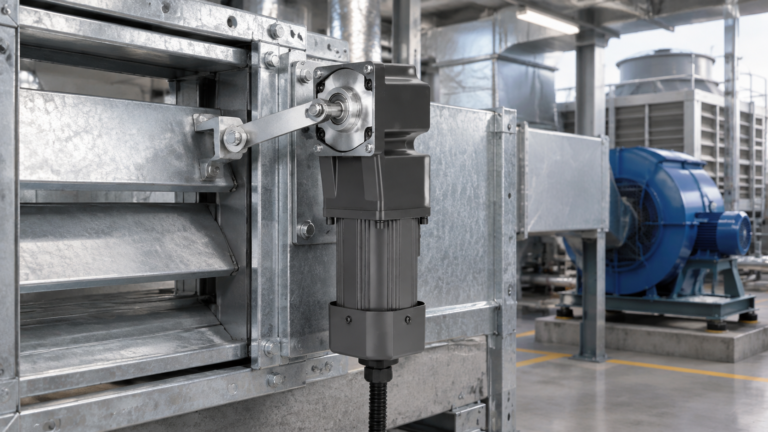
Practical guide to sizing gear motors for HVAC dampers and fan drives: damper torque from blade area and static pressure, gear ratio for travel time, and 25 W to 300 W frame choices.
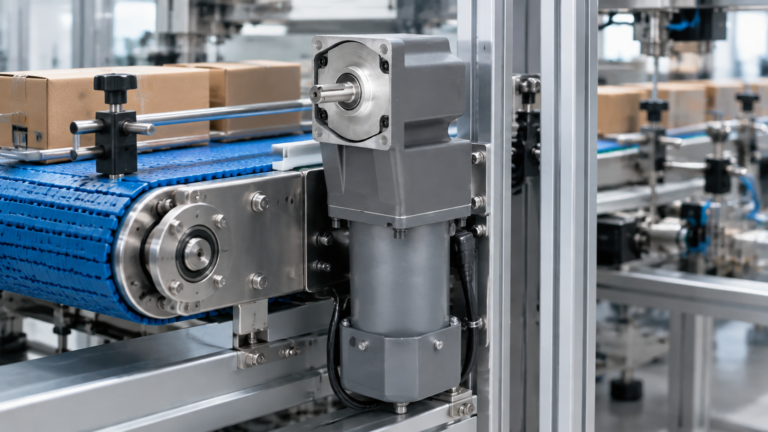
Practical selection guide for choosing a right-angle AC gear motor for packaging machines — covering speed, torque, frame size, duty cycle and voltage.