Mitra Terpercaya Anda dalam Bidang Reductor
Twelve compact AC gear motors from 15 W to 300 W, built on the 3RK, 4RK, 5RK and 6RK series. Gear ratios run from 3:1 to 500:1, with up to 32.5 N·m of allowable load on the gearbox shaft. Single-phase 110/220 V or three-phase 220/380 V, 80–100 mm flange. Pick a frame from the torque table, or send us the load and the speed you need and we will size the small gear reduction motor for you.
Size it in three steps
A small geared electric motor is usually fixed by one constraint first. Most buyers arrive with the power on the machine already locked, then work back to speed and torque. Start with whichever line below is not negotiable in your design.
Start from the wattage already on your drawing: 15–25 W, 40–90 W, 120–140 W or 160–300 W. Each band keeps one frame and one shaft size, so brackets carry over.
A 90 W mini reducer motor carries 1.54 N·m at 3:1 and 19.6 N·m at 50:1. Read the allowable load at your ratio before you choose the wattage — it often changes the answer.
A 90° small gearbox motor puts the output shaft at right angles to the motor, so the drive sits alongside the conveyor instead of at the end of it. Saves 100–200 mm of machine length.
Single-phase 110 V and 220 V for panel-fed machines; three-phase 220 V and 380 V for line equipment that runs all shift. Both 50 Hz and 60 Hz windings are stocked.
Every model below is a standard build and can be sampled from one to five pieces. Open any wattage for its full winding, ratio and dimension table — or use the torque table underneath to pick the frame first and the wattage second. The same range is listed on the small AC gear reducer motors category page if you prefer to browse by product family.
Dampers, lab feeders, dispensing heads and door latches. Light mechanism, short duty, load under roughly 8 N·m on the shaft.


The most common small AC gear reduction motor range: packaging indexers, small conveyors, gate operators and agitators. 5RK frame, 90 mm flange.
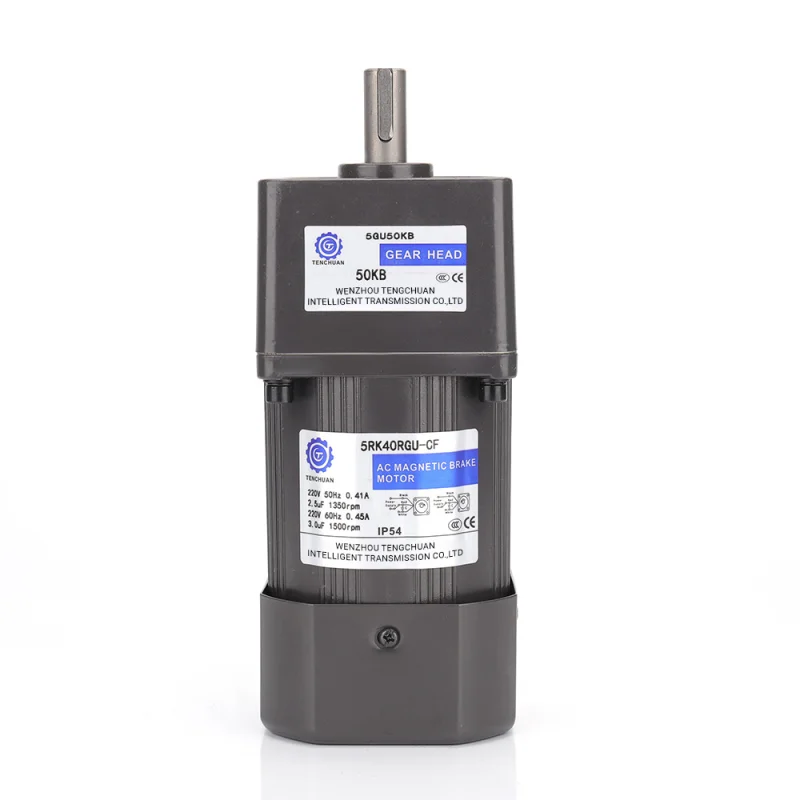

5RK60 series · up to 19.6 N·m shaft load · 90 mm flange

Same flange and shaft as the 90 W unit, roughly 40 % more shaft load. Use it where a 90 W motor runs hot at the top of its ratio range.


6RK140 series · up to 32.5 N·m shaft load · 100 mm flange
6RK frame, 100 mm flange. Belt conveyors, rotary tables and gate drives that run a full shift without stopping.
6RK series · 100 mm flange · load table on request
6RK series · 100 mm flange · load table on request
6RK series · 100 mm flange · load table on request
6RK series · 100 mm flange · load table on request
6RK series · 100 mm flange · load table on request
This is the table our engineers use first. Read across a row to see how much shaft load a given wattage carries as the ratio increases, then compare that number with the torque your mechanism actually needs at stall and at running speed. A compact gear reduction motor is normally chosen on shaft load, not on wattage.
| Output power | Motor series | Frame / flange | 3:1 | 5:1 | 10:1 | 15:1 | 20:1 | 30:1 | 50:1 |
|---|---|---|---|---|---|---|---|---|---|
| 15 W | 3RK15 | 80 mm | 0.28 | 0.48 | 0.93 | 1.47 | 1.67 | 2.35 | 3.92 |
| 25 W | 4RK25 | 80 mm | 0.45 | 0.79 | 1.55 | 2.25 | 3.10 | 4.12 | 6.18 |
| 40 W | 5RK40 | 90 mm | 0.72 | 1.18 | 2.40 | 3.53 | 4.28 | 6.24 | 9.64 |
| 60 W | 5RK60 | 90 mm | 1.08 | 1.77 | 3.57 | 4.80 | 6.24 | 9.64 | 14.4 |
| 90 W | 5RK90 | 90 mm | 1.54 | 2.60 | 5.15 | 6.96 | 9.28 | 13.9 | 19.6 |
| 120 W | 5RK120 | 90 mm | 2.11 | 3.52 | 6.88 | 9.60 | 12.4 | 18.5 | — |
| 140 W | 6RK140 | 100 mm | 2.46 | 4.11 | 8.02 | 11.8 | 14.4 | 21.7 | 32.5 |
Figures are the maximum allowable load on the gearbox output shaft, in N·m, taken from the Tenchuan 4RK, 5RK and 6RK load tables. Stay at or below the value for your ratio: above it the gear stage, not the motor, becomes the wear item. 160–300 W units use the 100 mm 6RK frame — ask for the load table of the exact wattage.
Contoh soal yang telah diselesaikan. A packaging indexer needs 8 N·m at 25 rpm. From the table, 60 W at 30:1 carries 9.64 N·m and 25 rpm — that is the smallest frame that holds the load with margin. A 40 W unit at the same ratio only carries 6.24 N·m, so it would run at its limit. If your figure sits between two rows, size up: the next frame costs less than a gearbox replacement. See cara menghitung rasio roda gigi for the speed side of the same calculation.
Six numbers decide whether a unit bolts straight onto your machine or needs a new bracket. They are also the six answers we need before quoting.
Four frames cover the range: 3RK at 15 W, 4RK at 25 W, 5RK from 40 to 120 W and 6RK from 140 to 300 W.
Two- and three-stage helical reduction. The same motor body reaches 500 rpm at 3:1 and single-digit rpm at the top of the range.
Pick the ratio from the speed your mechanism runs at, then check the shaft load at that ratio in the table above.
50 Hz and 60 Hz windings both stocked. Single-phase units are supplied with their run capacitor matched to the winding.
Three-phase motors are continuous rated. Single-phase reversible models carry a 30-minute rating, which suits indexing and door duty.
Foot mount or flange mount. Shaft, flange and terminal-box position can be changed on OEM orders without a new tooling cycle.
The same 15–300 W range covers machinery from a laboratory analyser to a pallet conveyor. What changes is the duty cycle and the shaft load — both are covered in the application guides below.
Belt and roller drives, transfer units and accumulation tables — the classic small gearbox motor duty.
Selection guide →Damper actuators and valve drives where holding torque matters.
Selection guide →Tenchuan is a gear motor manufacturer, not a trading desk. That matters most in the two places buyers get stuck: a non-standard ratio and a sample order smaller than a container.
Motor and gearbox assembly under one roof in Zhejiang, so a ratio change does not wait on a third-party gear shop.
Custom windings, shaft and flange drawings, and the gear ratio that matches your output speed rather than the nearest catalogue step.
Prototype and pilot runs from a handful of pieces, then volume on the same line and the same inspection sheet.
Send load in N·m, output rpm, supply and mounting. We return the series, ratio, frame and price — usually the same working day.
Load in N·m or kg·cm, output rpm, supply voltage, duty cycle and a photo of the mounting.
Series, ratio and frame come back with the shaft load checked against the table above — plus a price.
One to five pieces, typically with your nameplate data if you have it. Test on the real mechanism, not a bench.
Volume on the same line, same inspection sheet and same winding, with packing matched to your line-side handling.
Not in the product itself — both names describe an AC motor with a gearbox on the front. In catalogues, “gear motor” is used loosely for any motor with reduction, while “gear reduction motor” usually implies the reducer is the reason for the purchase: low output speed and high torque at the shaft. Specify the output rpm and the shaft load and the naming stops mattering.
“Mini” usually refers to the smallest frames — our 15 W and 25 W 3RK and 4RK units at 80 mm flange. “Compact” is about envelope rather than power: a 300 W unit on a 100 mm flange is still compact relative to a worm gearbox of the same torque. If the constraint is space, look at the flange size and the shaft position, not the wording.
At the gearbox shaft, from 0.28 N·m (15 W at 3:1) up to 32.5 N·m (140 W at 50:1) on the standard load tables. Torque rises with the ratio, so the highest figure always comes from the highest reduction — and the output speed at that ratio is only a few rpm. The full matrix is in the torque table above.
Roughly 12.5:1 to 15:1 for a 4-pole motor at 50 Hz, because synchronous speed at the motor shaft sits near 1250–1500 rpm before slip. On 60 Hz windings the same 15:1 unit turns about 20 % faster. If 100 rpm is a hard requirement, tell us the target and we will pick the ratio and confirm the actual speed on the nameplate.
No — the winding is fixed at build. Order the 110 V or 220 V single-phase version for panel-fed machines, or the 220 V/380 V three-phase version for line equipment. Single-phase units need their matched run capacitor; three-phase units do not use one. The mechanical parts — flange, shaft and gearbox — are identical, so a later voltage change does not require a new bracket.
Yes. Ratios reach 500:1, which puts output speed in the single digits and shaft load at the top of the table for that frame. Two things to check first: a high-ratio stage is less efficient, so continuous reversing duty may not suit it, and a smaller motor at a higher ratio can be cheaper than a larger motor at a low ratio for the same shaft torque.
When machine length, not power, is the problem. A right-angle unit turns the output 90° from the motor axis so the body sits beside the driven shaft. It costs a little efficiency and a little money; it saves 100–200 mm of machine length and often removes a belt or chain from the design. Our right angle gear reducer motors cover 25–300 W.
Samples from one piece for standard builds, so you can test on the real mechanism before committing. Volume orders run on the same line with your nameplate and packing. Send the model, ratio and quantity through the contact form for a dated quote — custom windings and shafts add a step to the schedule.
If you are still at the drawing stage, these six articles answer the questions that come before a quote — sizing, ratio maths, frame dimensions and the difference between a small gear motor and a standard induction motor.
Send the load in N·m, the output rpm, the supply and a photo of the mounting. We will come back with the series, ratio, frame and price — or tell you the mechanism needs a different arrangement.
Kami akan menanggapi pertanyaan Anda dalam waktu 24 jam
Kami menghargai privasi Anda
Kami menggunakan cookie untuk meningkatkan pengalaman penjelajahan Anda, menampilkan konten yang disesuaikan, dan menganalisis lalu lintas situs kami.