How to Request an AC Gear Motor Quotation: The 8 Specifications Suppliers Need
Diterbitkan: Penulis: Lisa
Most gear motor quotations are slow because the enquiry was incomplete, not because the factory is slow. A supplier who receives “please quote your best price for a small gear motor, 100 units” has to guess at output speed, torque, duty, voltage and mounting before a model number can even be chosen. The guess becomes a follow-up question, the follow-up question becomes a day of email, and the buyer concludes that Chinese suppliers are unresponsive.
This guide is about the enquiry itself. It lists the eight fields that actually change what comes back on a compact AC gear motor quotation, explains how each one moves the price and the lead time, shows the three fields that most often force a re-quote, and ends with a copy-and-paste template. It is aimed at OEM buyers, machine builders and maintenance engineers who want a usable quotation in one exchange rather than three.
The Eight Fields That Change the Quote
Technical completeness matters, but not every missing detail costs the same. The table below ranks the fields by how much they move the commercial answer. A quote that is missing the first four is not a quotation at all; it is an indicative price for a class of product.
#
Field
What to write
What it changes in the quote
1
Kecepatan keluaran
rpm at the gearbox shaft, with the acceptable range
Fixes the gear ratio, and therefore the gearbox model and number of stages
2
Continuous torque
N·m at the output shaft, plus how you derived it
Fixes frame size and whether the ratio falls inside the allowable load table
3
Tugas
Running hours per day, starts per hour, reversing or not
Chooses between reversible and continuous-duty motor variants
4
Electrical supply
Voltage, phase, frequency
Fixes winding and run capacitor; determines whether the model exists for your market
5
Mounting and shaft
Foot or flange, shaft diameter, keyway, orientation, envelope limits
Chooses parallel-shaft or right-angle gearbox and the output configuration
6
Lingkungan
Ambient temperature, dust or water exposure, cleaning method
Enclosure and finish; may force a frame step up for thermal derating
7
Quantity
First order quantity and expected annual volume
Unit price tier, and whether the factory stocks or produces
8
Delivery terms
Target date, destination, Incoterm
Decides stock allocation versus production scheduling; affects the freight component
Two of these deserve special emphasis because buyers routinely leave them out and then complain about the answer.
Quantity. In a factory that builds gear motors in batches, annual volume influences the unit price more than any single technical field. The same model, same ratio, same voltage can price very differently at 50 units and at 2,000 units per year, because the setup cost is amortised across the batch and because a volume commitment justifies a winding batch dedicated to your voltage. If you are at an early stage, say so and give an honest estimate rather than inflating it. Suppliers plan capacity on the number they were given, and a collapse from “10,000 per year” to 200 damages the relationship more than a modest number stated up front.
Duty. Duty determines the motor variant, and the variant is one of the few spec items that changes the price only slightly while changing the service life dramatically. A reversible motor with a 30-minute rating and a continuous-duty induction motor are often within a few percent of each other on price, so there is no commercial reason to accept the wrong one. The difference between them is explained in the reversible versus continuous-duty article.
Write the Speed at the Shaft, Not the Motor
The most common single error in a gear motor enquiry is quoting motor speed. “1450 rpm motor” describes the input side of a gearbox the buyer has not chosen yet, and it tells the supplier nothing about the machine.
Write the output speed and, if you only know a linear speed, give the pulley or sprocket diameter so the supplier can convert it:
Output speed from line speed:
n = v x 1000 / (pi x D)      v in m/min, D in mm

Torque from a known force:
T = F x D / 2000             F in N, T in N.m
The same applies to torque. A number without a basis is a guess, and a supplier can either accept it or quietly use a different assumption. Stating the basis, even briefly, tells the supplier how much margin to apply. The torque calculation guide sets out the full chain from load to output torque, and the gear ratio guide covers the speed side.
The Three Fields That Cause a Re-Quote
Some omissions produce a question. Others produce a quotation that has to be redone, and a re-quote is where lead time is really lost. In practice three fields cause most of it.
Field
What the supplier assumed
What changes when the truth arrives
Frequency, 50 or 60 Hz
50 Hz because that is the domestic standard
Different rated speed and torque at 60 Hz, so a different ratio to hit the same output speed
Duty, reversible or continuous
Reversible, because it is the default small-frame variant
Different motor model, different price line, and a warning about continuous operation
Mounting orientation
Foot mounted, horizontal
A right-angle gearbox may be required, or a different orientation code, changing both price and envelope
The frequency item catches buyers in export markets most often. On the same 90 mm frame, the 90W motor is rated 670 mN·m at 1350 rpm on 50 Hz and 544 mN·m at 1550 rpm on 60 Hz. If you need a specific output speed, the ratio that delivers it is not the same in both cases. The single-phase, three-phase and 50/60 Hz guide covers the selection logic.
Two Quotes That Look Different Are Usually Answering Different Questions
Comparing quotations is where procurement effort pays off, and where it most often goes wrong. Two prices for “a 90W gear motor with a 30:1 ratio” can differ by 30 percent without either supplier being dishonest, because the scope is not the same.
Check these items line by line before comparing the numbers:
Is the gearbox included, and is it the same type? A parallel-shaft unit and a right-angle unit at the same power and ratio are different products with different costs.
Is the ratio a catalogue ratio? A ratio that exists arithmetically but not in the production table will be quoted as a special, with a longer lead time.
What is in the box? Run capacitor, terminal box type, cable length, output key, mounting bolts, and instruction sheet are all sometimes optional.
What is the price basis? Ex-works, FOB and CIF prices for the same unit differ by the inland freight, export clearance and sea freight, and the difference is often larger than the unit price gap being argued over.
Is the torque quoted at the rated speed or at the catalogue synchronous speed? The two differ by a few percent, and a quote built on the higher figure has less margin than it appears.
Ask each supplier to state the selected model, ratio, output speed, output torque, motor power, voltage and frequency, and lead time in a single block. A quote that cannot be reduced to those seven values cannot be compared technically, and price comparison without it is a comparison of assumptions. The OEM gearmotor buying guide takes this further into sample validation and the cost that does not appear on the quote.
A Template You Can Send Today
Copy this into an email, fill in what you know, and mark the rest as “to confirm”. A good supplier will answer with a model recommendation and a list of the assumptions they made, which is exactly what you need to close the gaps.
Subject: RFQ - AC gear motor for [machine type], qty [n]

1. Application: [what the motor drives, one sentence]
2. Output speed: [x] rpm  (line speed [v] m/min on [D] mm pulley)
3. Output torque: [x] N.m continuous / [x] N.m starting
   Basis: [calculated / measured current / existing motor nameplate]
4. Duty: [x] hours per day, [x] starts per hour, reversing [yes/no]
5. Supply: [1-phase 220V 50Hz | 3-phase 380V 50Hz | ...]
6. Mounting: [foot / flange], shaft [d] mm, keyway [yes/no],
   orientation [horizontal / vertical], envelope limit [WxHxL]
7. Environment: ambient [x] C, [dust / splash / washdown / clean]
8. Quantity: first order [n], annual [n]
9. Delivery: need by [date], destination [port/city], Incoterm [FOB/EXW/CIF]
10. Attachments: [drawing / photo / nameplate of existing unit]
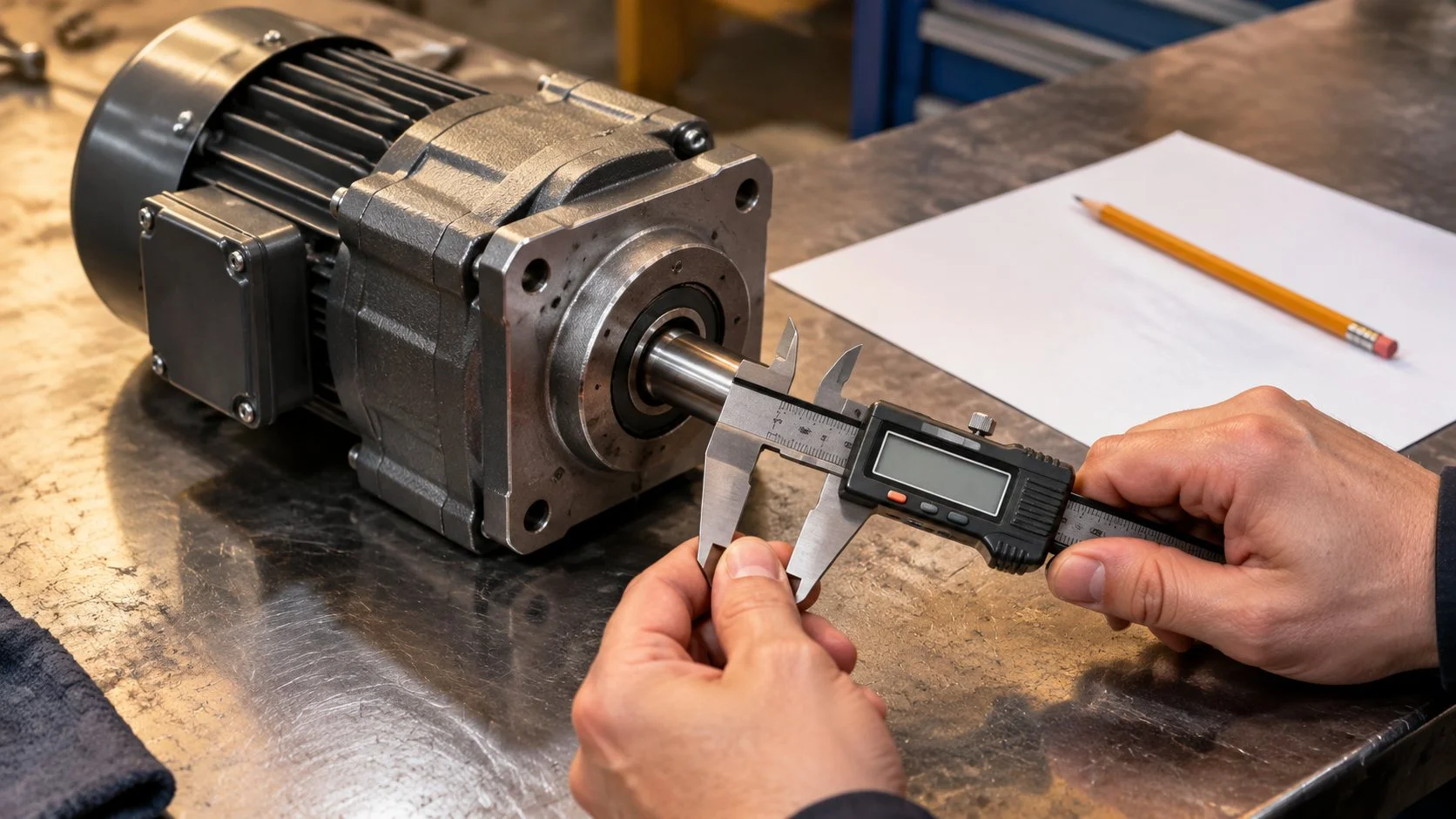
Field 10 is worth using even when everything else is complete. A photo of the existing unit with a ruler alongside the shaft, or a drawing of the mounting plate, resolves more ambiguity than three paragraphs of description. For a replacement order, the nameplate photograph alone often lets the supplier reconstruct most of fields 2 to 5.
What to Do With the Answer
A usable quotation comes back with a model number, a ratio, an output speed, a torque figure and a lead time. Read it in that order and check three things:
Does the quoted output speed match the number you sent? If the supplier changed it, they should say why, usually because the nearest catalogue ratio lands slightly off your target.
Is the torque inside the allowable load table for that ratio? Ask for the table if it was not sent. This is the single check that prevents an undersized gearbox from being ordered on the strength of a motor rating. Frame-by-frame data is on the Tabel Ukuran Motor Roda Gigi.
Is the lead time for stock or for production? A standard ratio in stock and the same ratio built to order can differ by weeks, and the quotation rarely says which one you were given.
If the answer is a model you did not expect, that is not automatically a problem. Suppliers sometimes select a smaller frame at a lower ratio, or a larger frame at a higher ratio, to hit the same duty with better margin. What matters is that the output speed, output torque and duty all still match your requirement, and that the reasoning is visible.
Kesimpulan
An AC gear motor quotation becomes fast and accurate when the enquiry contains output speed, output torque with its basis, duty, electrical supply, mounting and shaft details, environment, quantity and delivery terms. Eight fields, most of them things the machine design already contains. The three that most often force a re-quote, frequency, duty variant and mounting orientation, are also the three that cost the least to confirm early.
Send the template above with whatever you have and mark the gaps. We would rather reply with a model recommendation plus a short list of assumptions than wait for a perfect enquiry, and you get a quotation you can compare line by line instead of a price that has to be taken on trust.
Pertanyaan yang Sering Diajukan
What information do I need to get an accurate gear motor quotation?
At minimum: output speed in rpm, continuous torque in N·m at the output shaft, duty cycle, voltage, phase and frequency, and mounting arrangement. Quantity and delivery terms then determine the commercial side. Anything you cannot supply can usually be estimated by the supplier if you describe what the motor has to drive.
Why do two suppliers quote very different prices for the same specification?
Usually because the scope is different. Check whether the gearbox type matches, whether the ratio is a catalogue ratio or a special, what accessories are included, whether torque is quoted at rated speed or synchronous speed, and whether the price basis is ex-works or delivered. A like-for-like comparison requires the same model, ratio, torque and Incoterm on both sides.
Is it worth asking for a quotation before the machine design is finished?
Yes, with the gaps marked. Early quotations expose which part of the design is driving cost, usually the ratio or the voltage variant, while there is still time to change it. State clearly that the enquiry is preliminary so the supplier knows the numbers may move.
Should I give an annual volume I am not sure about?
Give a realistic range and say it is an estimate. Factories plan capacity and price tiers on stated volume, and a very large number that does not materialise damages the relationship more than a modest, accurate one.
What does a gear motor quotation usually exclude?
Commonly the run capacitor, output key, mounting bolts, cable and plug, and packaging beyond standard export cartons. Freight and insurance are excluded unless the price is quoted on a delivered basis. Ask for the inclusion list explicitly rather than assuming.
MOQ, lead time and sample policy follow from how gear motors are built. The three MOQ tiers, the lead time stages you can influence, and the levers that lower a first order.
The dry side of a food factory fails drives with dust, not water. Station-by-station sizing, four dust failure mechanisms, and where a standard gear motor must not be used.
Why constant motor speed is not constant surface speed, which textile axes suit a fixed-ratio AC gear motor, and how lint and ambient heat decide the service life.