Gear Motors for Dry Food Conveying and Packaging Halls
Diterbitkan: Penulis: Lisa
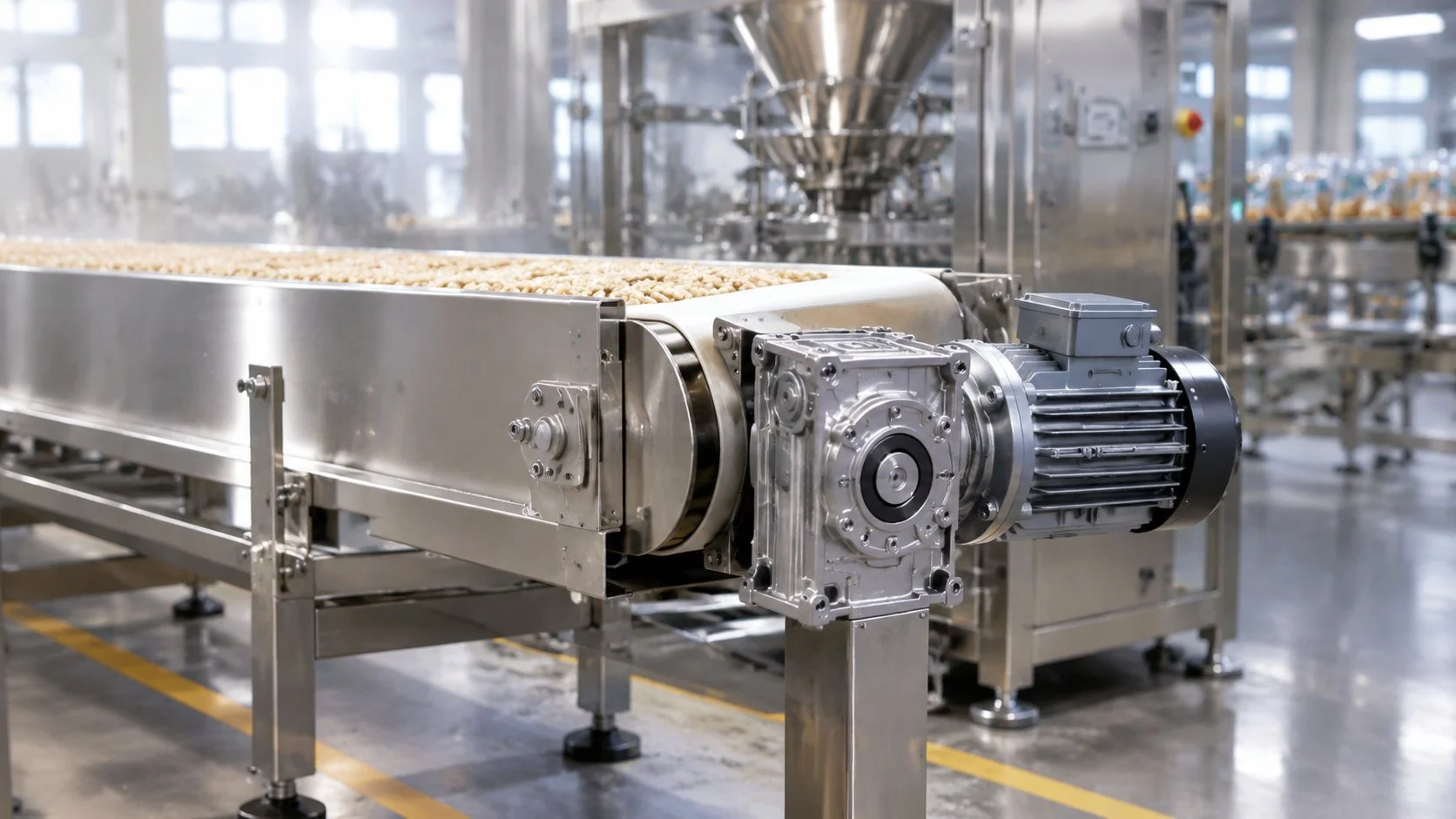
Most guidance on food industry gear motors is written around washdown areas: stainless steel, high IP ratings, sloping surfaces, chemical-resistant seals. That guidance is correct for a dairy or a ready-meal line, and it is largely irrelevant to the dry side of the same factory. A biscuit line, a flour silo discharge, a pasta dryer, a snack seasoning drum or a pet food bagging hall has almost no water. It has dust, heat, and a cleaning regime built on brushes and vacuum cleaners rather than hoses.
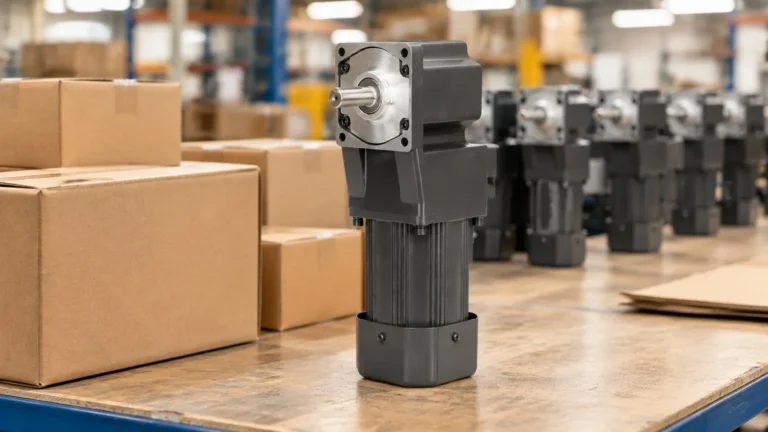
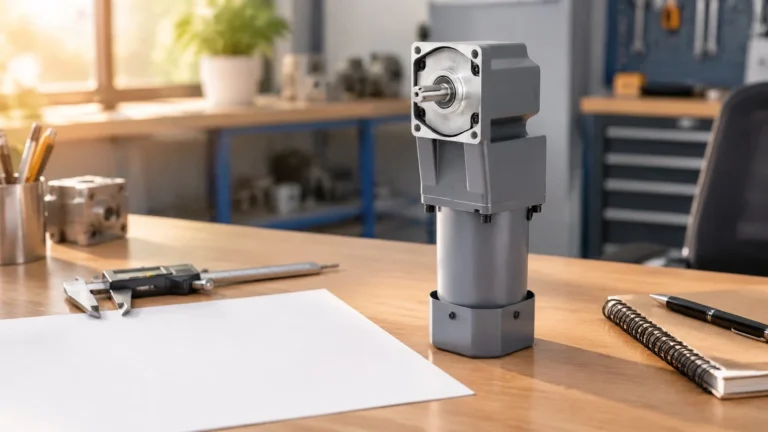
This guide covers gear motor selection for dry food conveying and packing halls, where the product is a solid and the main environmental threat is airborne powder rather than water. It focuses on the 25W to 300W compact AC range that drives most individual stations, and it draws a clear line between what a standard gear motor can do in that environment and where a certified hazardous-area motor becomes mandatory.
Why the Dry Side Is a Different Drive Problem
Water causes visible, immediate failures: a motor that ingests water either trips on earth fault or rusts internally within weeks. Dust is slower and more deceptive. It builds up on fins, works its way through cable entries, abrades shaft seals, and insulates surfaces that are supposed to dissipate heat. A drive in a dusty hall rarely fails dramatically. It fails early, and usually in a way that looks like an electrical fault rather than a housekeeping problem.
There is also a difference in process demand. Dry conveying is generally lighter than wet conveying, because the product does not adhere to belts and screws the way wet or sticky product does. Torque requirements per metre of conveyor are lower, and the drives are smaller. The 25W to 120W frames that are common on dry snack and pasta lines would be marginal on a wet washdown conveyor handling the same tonnage.
Finally, the cleaning method matters as much as the environment. A hall cleaned with a pressure washer and a hall cleaned with a brush and an industrial vacuum impose opposite requirements on the same motor. Choosing an IP65 motor for a dry hall that is never washed does not add protection; it adds cost and, on some designs, traps dust behind a lip that cannot be cleaned. If your line does include wet areas, the food packaging 25–300W drive selection guide covers the wet-side requirements, and the packaging machine selection guide works through the sealing and forming stations in more detail.
Mapping the Stations Before Choosing Any Motor
A dry food packing hall is a series of stations with very different duty profiles. Buying one motor specification across the whole line is a common way to overspend on some stations and undersize others. The table below is a practical starting map; the numbers are typical for small and medium lines and should be checked against your own speeds and loads.
Station
Typical motion
Frame and power
Susunan roda gigi
Duty note
Belt conveyor, dry product
Constant speed, continuous
25W to 90W, 80 or 90 mm
Parallel shaft, 10:1 to 50:1
Genuine continuous duty
Incline or cleated conveyor
Continuous with product lift
90W to 250W
Parallel shaft, plus a brake if it can run back
Holding when stopped
Screw feeder / auger
Continuous, high breakaway torque
120W to 300W
Parallel shaft, low speed high ratio
Start loaded; check stall torque
Bucket elevator
Continuous, out-of-balance load
250W to 750W, medium frame
Right angle for compact head rooms
Shock load at each bucket pick-up
Rotary valve / airlock
Continuous, tight clearance
120W to 250W
Right angle, direct coupled
Stall damage risk if a foreign body enters
Bag former / vertical sealer
Cyclic, high starts per hour
40W to 120W
Parallel shaft or right angle
Starts per hour, not running hours
Case packer / reject pusher
Intermittent reciprocating
60W to 120W
Right angle with crank or cam
Reversing and dwell
The bucket elevator row is the one most often undersized. The load is not smooth: every bucket pick-up produces a torque pulse, and the out-of-balance weight of a loaded ascending side pulls the drive in one direction. A 250W frame with a service factor allowance is a more realistic starting point than a 120W frame sized on average torque.
What Dust Actually Does to a Gear Motor
There are four distinct mechanisms, and they call for different countermeasures. Treating them as one problem called “dust” is why some installations buy an expensive enclosure and still lose motors.
Cooling loss through a blocked fan cowl. The same mechanism as lint in a textile mill. Flour and seasoning dust cements onto the cowl grille and between the cooling fins. A half-blocked cowl can remove a large part of the cooling capacity, and the winding then runs hot at unchanged load. This is the single most common cause of early failure in dry halls.
Ingress at cable entries and the terminal box. Fine powder migrates along cables and through an unused gland opening. Inside the terminal box it settles on insulating surfaces, and in humid conditions it becomes conductive enough to track. Correct gland sizing and blanking plugs cost almost nothing and prevent most of these failures.
Seal abrasion at the output shaft. Abrasive powder at the oil seal lip wears the seal and then the shaft surface. The visible symptom is grease weeping from the gearbox, followed by grease loss and eventually gear wear. A dust lip or a shaft protector is the usual fix where the shaft is exposed to product.
Build-up on hot surfaces. Grease and dust combine on a warm gearbox housing into a crust that both insulates and holds moisture. It also hides the leak that would otherwise have been noticed.
None of these four is solved by motor power. Three of them are solved by housekeeping, gland discipline and a shaft seal detail, and only one of them is a thermal design issue.
IP Rating: What the Second Digit Does and Does Not Do
In an IP rating, the first digit is solids and the second is water. A rating like IP54 means dust-protected rather than dust-tight, and protected against splashing water. A rating like IP65 means dust-tight and protected against jets. The distinction that matters in a dry hall is between “dust-protected” and “dust-tight”, not between IP54 and IP65.
Two practical points follow:
Higher IP is not automatically better in a dry hall. A dust-tight enclosure with no breather can hold heat in, and some designs include a pressure-equalising membrane that is itself a dust path if it is not specified correctly. Confirm how the enclosure breathes before assuming that a higher number is safer.
The gearbox matters as much as the motor. Small frames in this range are typically grease-filled and sealed for life, which is a genuine advantage in a dusty hall: there is no oil breather to vent dust-laden air in and out on every thermal cycle. Larger medium-frame units are often oil-filled with a breather, and the breather position then has to be set for the mounting orientation.
If the model you are ordering has a published IP rating, use it as a starting point and then confirm the two details above. If the datasheet does not state an IP rating, do not assume one, especially for a hall that gets washed at changeover.
The Boundary You Must Not Cross: Combustible Dust
This is the part of the specification where honesty matters more than sales. Flour, starch, sugar, cocoa, milk powder and many seasoning blends are combustible dusts. If the hall has been classified as a dust hazard zone, a standard totally enclosed fan-cooled gear motor is not an acceptable drive, whatever its IP rating.
The rating that matters in a classified area is not IP but the equipment protection level for the dust atmosphere, together with a maximum surface temperature appropriate to the dust’s ignition characteristics. Those are hazardous-area certifications, and they are a different product category from a general industrial gear motor.
A practical decision rule:
Unclassified hall, normal housekeeping: a standard gear motor with sensible gland discipline and a cleaning schedule is appropriate. This covers most small and medium dry packing halls, and most of the stations in the table above.
Local dust cloud risk but no classified zone: reduce the risk mechanically. Enclose the transfer points, extract at the bagging head, keep the motor out of the falling product stream. The drive stays standard, the dust exposure drops.
Classified dust zone: a certified hazardous-area motor is required. Say so at the specification stage, because substituting a standard unit later means re-engineering the mounting and the cable entry, not just swapping a part number.
Being clear about this boundary protects the machine builder. A standard drive that fails in a classified area is not a warranty conversation, it is a compliance conversation.
Sizing a Dry Product Conveyor
The arithmetic for a horizontal dry belt conveyor is simple and worth doing explicitly, because most sizing errors in this range come from guessing rather than from the physics being difficult.
Belt speed to shaft speed:
n = v x 1000 / (pi x D)     v in m/min, D = pulley diameter in mm

Belt pull to torque:
T = F x D / 2000           F = belt pull in N, T in N.m

Belt pull estimate (horizontal, dry product):
F = mu x (m_product + m_belt) x g + F_scraper
A worked case: a 6 m horizontal belt carrying 0.4 kg per metre of dry snack, belt mass 1.2 kg/m, friction coefficient 0.25 at the slider bed, and a scraper contributing 40 N. The friction term is roughly 0.25 x (2.4 + 7.2) x 9.81, or about 23.5 N, plus 40 N for the scraper, giving about 64 N of belt pull. On a 100 mm pulley that is 3.2 N·m at the shaft. For a line speed of 12 m/min the shaft needs about 38 rpm.
On the 25W frame, 3.2 N·m is available from roughly 20:1 upward, and at 30:1 the allowable load is 4.12 N·m at about 42 rpm. That is a reasonable fit with a modest margin, and it shows why dry conveyors so often run on far smaller motors than people expect. Add a service factor if the conveyor starts loaded, and check the numbers against the 25W 4RK specification dan frame size chart. The conveyor gear motor guide extends the same method to inclined and accumulating belts.
For a screw feeder the method changes, because the breakaway torque when the trough is full can be two to three times the running torque. That is where the 250W frame and the right-angle gearboxes come in: the 6GU right-angle range from 120W to 300W carries up to 43 N·m and fits a compact head room where a parallel-shaft motor would not. The parallel-shaft versus right-angle comparison covers the layout trade-off.
Cleaning Regime: Design for the Method Actually Used
Ask how the hall is cleaned before choosing the enclosure. The answer usually falls into one of three patterns, and each has a different implication for the drive.
Cleaning method
Drive implication
Detail that fails first
Dry brush and industrial vacuum
Standard enclosure is fine; access for cleaning matters more than rating
Dust packed between fins because the cowl cannot be removed
Low-pressure rinse at changeover
Splash-protected enclosure, sealed glands, shaft seal protection
Cable entry and terminal box gasket
High-pressure washdown with chemicals
Washdown-rated motor and gearbox, stainless or coated, food-grade lubricant
Paint and label adhesion; seal compatibility
The first row is the one that gets under-specified, because “no water” is read as “no protection needed”. What actually protects the drive there is physical access: a cowl that can be taken off without dismantling the machine, and a mounting position where the motor is not directly under a transfer point where product falls.
Five Mistakes in Dry Food Hall Drives
Buying a higher IP rating instead of fixing housekeeping. A blocked fan cowl defeats any enclosure rating, and it is the most common failure path.
Using a washdown motor in a hall that is never washed. Extra cost, and often a design that traps dust in places a brush cannot reach.
Ignoring the combustible dust classification until commissioning. If the area is classified, the drive has to change, and so does the mounting.
Sizing a screw feeder on running torque. Start-loaded troughs and foreign-body stalls need the breakaway case checked.
Leaving unused cable entries open. The cheapest failure prevention in the whole installation is a correctly sized gland and a blanking plug.
Kesimpulan
Dry food conveying and packing halls reward a simple, unglamorous approach. Map the stations, size each one on its own duty, choose the frame from the allowable load table with a service factor, then treat dust as a maintenance and enclosure-detail problem rather than a reason to buy a bigger motor. Keep the combustible dust question separate: if the hall is a classified zone, no standard gear motor belongs in it, and that decision has to be made before the mounting is drawn.
If you are building a dry line and want a station-by-station drive schedule, send the station list with belt speeds, pulley diameters, product mass per metre and the cleaning method, and we will return a frame and ratio for each station together with the ones where a standard enclosure is not appropriate.
Pertanyaan yang Sering Diajukan
What IP rating does a gear motor need in a dry food hall?
For a hall cleaned by brush and vacuum, a standard dust-protected industrial enclosure is usually adequate, provided cable entries are sealed and the fan cowl can be cleaned. Where low-pressure rinsing is used at changeover, specify a splash-protected enclosure with sealed glands. High-pressure chemical washdown needs a purpose-built washdown motor rather than a standard unit with a higher number.
Can a standard gear motor be used in a flour or sugar dust area?
Only if the area has not been classified as a dust hazard zone. Flour, starch, sugar and milk powder are combustible dusts, and a classified zone requires a certified hazardous-area motor with an appropriate maximum surface temperature. A standard totally enclosed motor is not a substitute, regardless of its IP rating.
Why do gear motors in packing halls overheat when the load has not changed?
Almost always cooling loss. Dust cements onto the fan cowl and between the cooling fins, so the motor dissipates less heat at the same electrical load. Clean the cowl and fins on a schedule, and check that the motor is not mounted directly below a product transfer point.
Are sealed grease-filled gearboxes better than oil-filled ones in dusty halls?
For small frames, yes. A grease-filled gearbox sealed for life has no breather, so dust-laden air is not drawn in and out on each thermal cycle. Oil-filled units need their breather positioned for the mounting orientation, and a misplaced breather becomes a dust ingestion point.
What power do I need for a dry product belt conveyor?
Often far less than expected. A 6 m horizontal belt carrying light dry product at about 12 m/min typically needs around 3 N·m at the shaft, which a 25W frame delivers from roughly 20:1 upward. Inclines, scrapers, accumulating sections and start-loaded conditions are what push the requirement up.
MOQ, lead time and sample policy follow from how gear motors are built. The three MOQ tiers, the lead time stages you can influence, and the levers that lower a first order.
Most quotations are slow because the enquiry was incomplete. The eight fields that actually change the answer, the three that force a re-quote, and a copy-paste RFQ template.
Why constant motor speed is not constant surface speed, which textile axes suit a fixed-ratio AC gear motor, and how lint and ambient heat decide the service life.