Gear Motors for Textile and Winding Machinery: Constant Speed Drive Selection
Diterbitkan: Penulis: Lisa
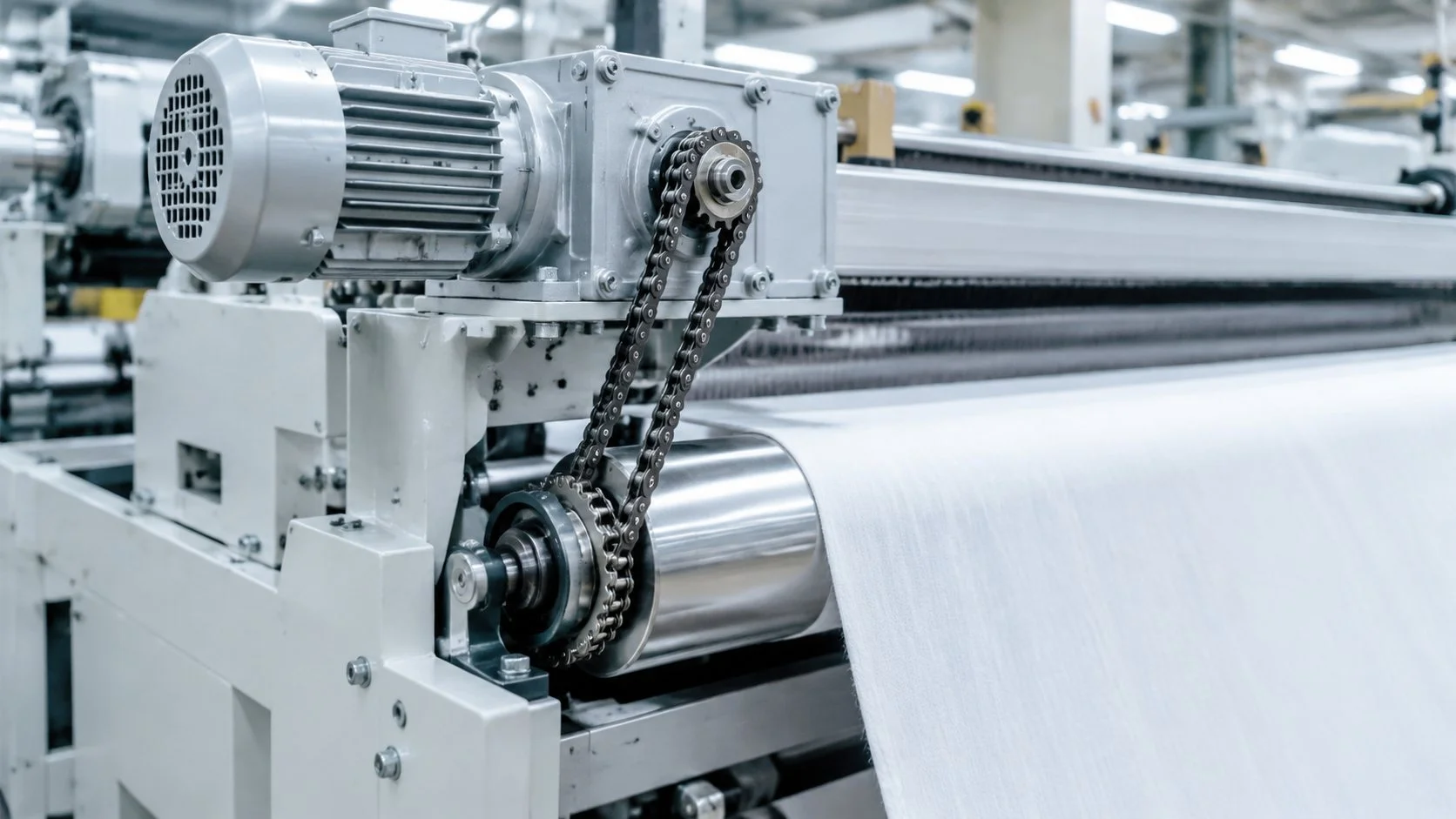
Textile and winding machinery has one property that most other gear motor applications do not: the load is usually turning at a constant speed while the thing it is winding keeps changing size. A spool starts empty and ends full. A fabric roll starts at the core and finishes at several hundred millimetres. Every one of those changes alters the relationship between motor speed, surface speed and tension, and that is where most drive selection mistakes in this industry begin.
This guide is for machine builders and maintenance engineers working in spinning, winding, rewinding, slitting and finishing equipment, with a focus on the compact AC gear motor range from 60W to 300W that most small and medium machines actually use. It covers which axes can safely run on a fixed-ratio AC gear motor, which cannot, and what the real limiting factors are in a mill environment: continuous duty, ambient heat, and lint.
The Core Problem: Constant Motor Speed Is Not Constant Surface Speed
A fixed-ratio gear motor gives a constant output shaft speed. What the process usually wants is constant surface speed, and the two only coincide when the roll diameter is constant.
Surface speed:      v = pi x D x n / 1000    (v in m/min, D in mm, n in rpm)

Core   D = 60 mm,  n = 100 rpm  ->  v = 18.8 m/min
Full   D = 200 mm, n = 100 rpm  ->  v = 62.8 m/min
The same drive that gives a sensible line speed at the core overspeeds the web by more than three times at full diameter. The reverse is also true and is often the bigger commercial problem: at full diameter the web is running far faster than the process intends, which shows up as web breaks, poor package density and inconsistent dye pickup.
Tension has its own diameter dependence. At constant motor torque, the pull available at the web falls as radius grows:
Tension F = T / (r x 1000)    (F in N, T in N.m, r in m)

T = 5 N.m, core radius 0.030 m  ->  F = 167 N
T = 5 N.m, full radius 0.100 m  ->  F = 50 N
So a fixed-ratio drive on a winding spindle produces a package that is tight at the core and loose at the outside. That is the classic telescoped or soft-shouldered roll, and no amount of motor power fixes it. Fixing it requires either a mechanism that slips, a control loop that varies speed, or a ratio chosen so that the diameter range is small.
Which Axes Can Run on a Fixed-Ratio AC Gear Motor
The useful question is not “which motor for a textile machine” but “which axis”. The table below sorts the common axes by whether a fixed-ratio AC gear motor is appropriate.
Axis
Diameter variation
Fixed-ratio AC gear motor?
Practical arrangement
Feed / draw roller
None, roller diameter is fixed
Yes, ideal
Direct or chain drive, ratio set for line speed
Traverse / guide rail
None
Yes, ideal
Motor plus cam or reversing gearbox, fixed stroke rate
Rewind spindle, small package range
Up to about 2:1
Yes, with a slip clutch
Fixed rpm, clutch takes up the tension difference
Rewind spindle, large package range
3:1 and above
Tidak
Dancer or load cell with VFD, or taper tension control
Unwind stand
3:1 and above
No, unless braked
Mechanical or pneumatic brake with tension feedback
Slitting / cutting roller
None
Yes
Fixed ratio, but check torque at the blade
Dyeing padder
None
Yes, with washdown protection
Fixed ratio, sealed gearbox, corrosion attention
The dividing line in most small machines sits near a 2:1 diameter range. Below it, a fixed ratio plus a mechanical slip element is cheaper and far more robust than a control loop. Above it, no gear ratio can serve both ends and a variable-speed drive or a tension-controlled unwind is the honest answer.
Sizing the Feed Roller: Speed First, Then Torque
Feed rollers are the easy part, and it is worth doing them properly because they set the reference for everything else.
Start from line speed and roller diameter. A machine running 25 m/min on a 120 mm roller needs 66 rpm at the shaft:
n = v x 1000 / (pi x D) = 25 x 1000 / (3.1416 x 120) = 66 rpm
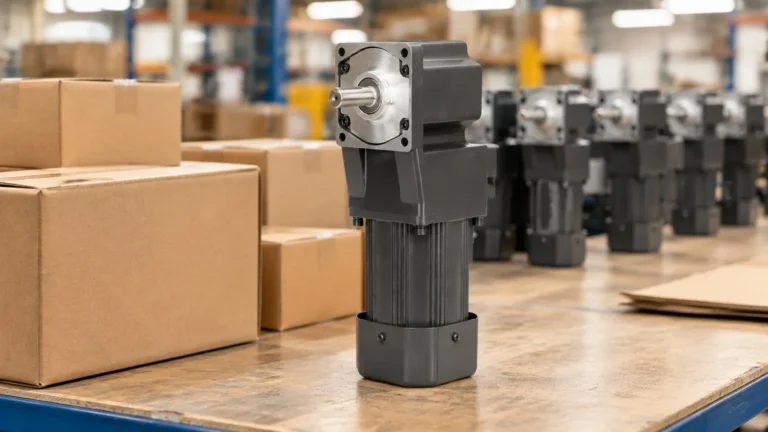
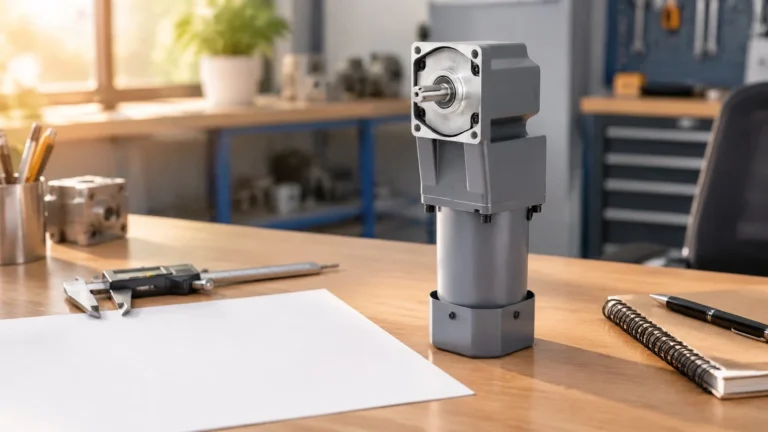
On a 4-pole motor at about 1350 rpm and 50 Hz, that is a ratio of roughly 20:1. The 90W 5RK 90 mm gear motor is available at 3:1 to 500:1, so 20:1 is an ordinary catalogue ratio and no compromise is needed.
Torque for a feed roller is dominated by web tension plus bearing and seal drag, not by the fabric weight. If the process runs at 150 N of web tension on a 60 mm radius, the shaft torque is 9 N·m before friction. Against the 90W allowable load table, 9 N·m sits at:
Ratio (50 Hz)
Kecepatan keluaran
90W allowable load
Comment
10:1
135 rpm
5.15 N·m
Below the 9 N·m requirement
15:1
90 rpm
6.96 N·m
Still short
20:1
67.5 rpm
9.28 N·m
Matches the requirement with no margin
30:1
45 rpm
13.9 N·m
1.5x margin, but the line now runs slower
50:1
27 rpm
19.6 N·m
Ceiling for this frame
Notice what happens above 50:1: the table stops at 19.6 N·m because that is the mechanical limit of the 90 mm gearbox. Going to 100:1 or 200:1 buys lower speed but no additional torque. If your process needs more than about 20 N·m at low speed, the answer is a larger frame, not a bigger ratio. That ceiling effect is explained in the 90W gear motor selection guide, and the arithmetic behind the conversion chain is set out in the torque calculation guide. Frame dimensions, shaft heights and mounting bolt spacing for the 70 mm, 80 mm and 90 mm frames are collected in the Tabel Ukuran Motor Roda Gigi.
Constant Duty Is the Norm, and It Changes the Motor Choice
Textile machinery runs for long shifts. A winder or a draw frame may operate 20 hours a day at near-constant load. That is the definition of continuous duty, and it rules out the reversible 30-minute variant that is standard on many small frames.
In the AC gear motor naming convention, the suffix tells you which duty you have. GU models are reversible with a 30-minute rating; A models are continuous-duty induction motors without the built-in braking arrangement. For a machine that runs all shift, the A model is the correct choice and the reversible variant is not, even though the reversible one costs about the same. The reversible versus continuous-duty article explains what the 30-minute rating physically limits. Where the axis is light, a 60W 5RK 90 mm frame in the same continuous-duty variant covers traverse and light feed duties at a lower cost than the 90W unit.
Two practical consequences of continuous duty in a mill:
Three-phase is usually the better supply. It removes the run capacitor, which is the most common electrical failure on small single-phase drives in hot, humid environments. The available winding options include 1-phase 110V, 1-phase 220V and 3-phase 380V on the same frame.
Ambient temperature has to be declared. Small AC gear motors are typically rated at 40°C ambient. A finishing or dyeing hall in Vietnam or Indonesia can sit at 40 to 45°C for hours, which erodes the thermal margin that the continuous rating assumed.
Lint, Dust and Heat: the Environment Decides the Service Life
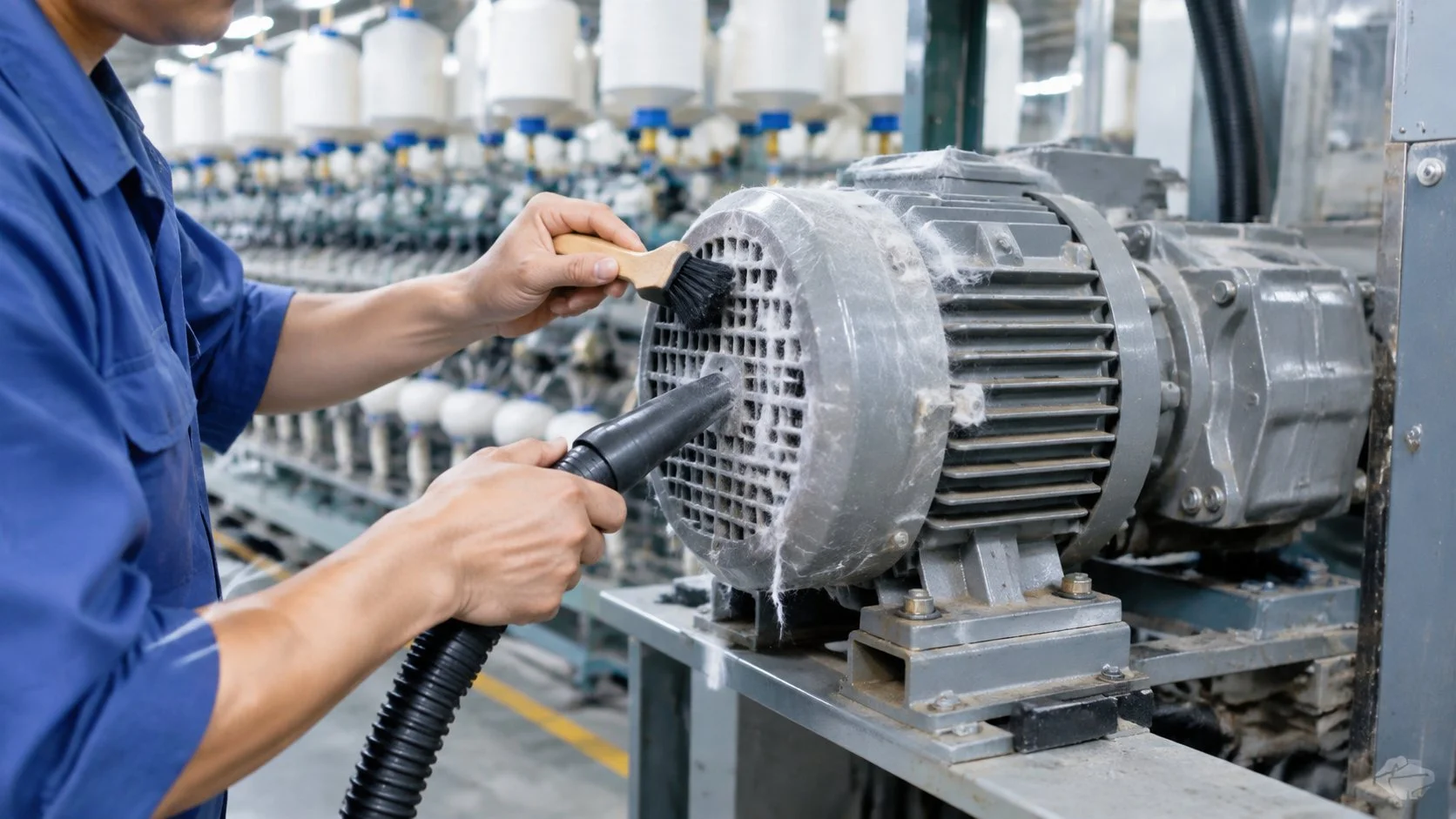
In a spinning or weaving hall, the most common cause of a failed drive is not electrical and not mechanical. It is a fan cowl packed with lint.
A totally enclosed fan-cooled motor depends on air moving across its finned surface. In a textile hall, airborne fibre collects on the cowl grille and inside the fins. A partially blocked cowl can halve the effective cooling, and the winding then runs well above its design temperature at the same load. The failure mode appears as a motor that “runs hot and dies young” while the load and the supply both test normal.
The practical responses, in order of cost:
Add a scheduled cleaning of the fan cowl and fins to the maintenance plan. Weekly is realistic in a spinning hall, monthly in a cleaner finishing area.
Position the motor outside the lint stream, or duct clean air to the intake, where the machine layout allows it.
Specify a larger frame running at part load, so that a 20 percent loss of cooling capacity is absorbed by thermal margin rather than by the insulation.
For very dusty areas, consider a motor with a separate forced ventilation inlet, which is outside the standard range but is the right engineering answer.
Humidity adds a second mechanism. In a humid climate, a machine that cools overnight can drop below the dew point, and moisture condenses inside the terminal box. Insulation resistance falls, and the next start trips the protection. Wrapping the terminal box, sealing cable entries properly, and running the motor briefly before the shift are the usual mitigations.
Where a Fixed Ratio Stops Working: the Winding Spindle
For a winding spindle with a large package range, the fixed-ratio gear motor is not the wrong product, it is the wrong part of the solution. Three arrangements are common, and each has a clear domain:
Pengaturan
How tension is controlled
Paling cocok untuk
Main cost of ownership
Fixed-ratio gear motor plus slip clutch
Clutch slips at a set torque; tension stays roughly constant as diameter grows
Package range up to about 2:1, modest line speeds
Clutch wear and heat; the slip power has to go somewhere
Gear motor plus VFD with dancer feedback
Speed trimmed to hold dancer position
Wide diameter range, tension-critical product
Drive cost, tuning, and low-speed cooling of the motor
Gear motor plus mechanical variator or change gears
Operator sets speed for the batch
Batch production where diameter is roughly uniform
Manual intervention between batches
The slip-clutch option deserves more respect than it usually gets. It is mechanically simple, needs no electronics, survives a dusty hall, and keeps the motor running at a fixed efficient speed. Its limitation is thermal: the power dissipated in the clutch equals the difference between input and output power, which grows with the diameter range. For a 2:1 range at moderate line speed that heat is manageable; for a 4:1 range the clutch can become the hottest component on the machine.
The VFD option has one trap specific to this range. A voltage-type speed controller, which is what most small single-phase AC gear motors are paired with, cannot hold constant surface speed. It reduces voltage to reduce speed, and torque falls with roughly the square of the speed change. The speed controller guide quantifies that loss: on a 60W speed-control motor, permissible torque at 90 rpm is about a third of the figure at 1200 rpm. A proper VFD on a three-phase motor behaves differently, but the motor then has to be inverter-rated and its low-speed cooling has to be considered.
Five Selection Mistakes in Textile and Winding Drives
Specifying by motor power from an old machine. Power alone says nothing about the ratio, and the ratio is what sets line speed and tension.
Using the reversible 30-minute variant on a continuous machine. It is designed for intermittent reversing duty, not for a 20-hour shift.
Choosing the largest available ratio for “more torque”. Above 50:1 on the 90 mm frame, additional ratio adds no torque because the gearbox is already at its mechanical ceiling.
Ignoring lint in the thermal calculation. A blocked fan cowl invalidates the published continuous rating without changing the load.
Setting a fixed ratio on a spindle with a 3:1 package range. The result is a soft or telescoped package, and it will be blamed on the motor.
Kesimpulan
In textile and winding machinery, the drive decision splits cleanly. Fixed-diameter axes such as feed rollers, traverse guides, cutting rollers and padders are ideal candidates for a compact fixed-ratio AC gear motor, and the engineering is straightforward: line speed to rpm, tension to torque, then check the ratio against the allowable load table. Diameter-varying axes such as rewind spindles and unwind stands need a slip element or a control loop, and the ratio only sets the operating point.
Get those two categories right, then treat the environment as a separate specification item rather than an afterthought: continuous duty instead of reversible, a declared ambient temperature, and a lint cleaning routine that is actually scheduled. If you send us the axis list, line speed, tension and ambient conditions for a machine, we can map each axis to a frame, ratio and duty variant, and flag the axes where a fixed ratio will not hold tension.
Pertanyaan yang Sering Diajukan
What gear motor is used in a winding machine?
Feed and traverse axes typically use a 60W to 120W compact AC gear motor at a fixed ratio. The winding spindle itself usually needs either a slip clutch or a variable-speed drive with tension feedback, because the package diameter changes and a fixed ratio cannot hold constant surface speed or tension across that range.
Why does my winding motor produce a loose roll at full diameter?
At constant motor torque, the tension available at the web falls as the roll radius grows. The package ends up tight at the core and loose outside. Either add a slip clutch, or control spindle speed from a dancer or load cell so that tension, not rpm, is held constant.
Can a speed controller hold constant surface speed on a winding axis?
Not by itself. A voltage-type controller reduces speed and torque together, and it has no knowledge of the roll diameter, so it cannot follow the surface speed requirement. Constant surface speed needs either a mechanical slip element that self-adjusts, or a control loop that measures diameter, dancer position or tension.
Should I use single-phase or three-phase for a textile machine?
Where a three-phase supply is available, use it. It removes the run capacitor, which is the most frequent electrical failure on small drives in hot and humid halls, and it makes inverter operation practical if speed control is needed later.
How often should a gear motor in a spinning hall be cleaned?
Check the fan cowl and cooling fins weekly in a spinning or weaving area, and monthly in a cleaner finishing area. Lint build-up reduces cooling without changing the electrical load, so it shows up as unexplained overheating and shortened winding life.
MOQ, lead time and sample policy follow from how gear motors are built. The three MOQ tiers, the lead time stages you can influence, and the levers that lower a first order.
Most quotations are slow because the enquiry was incomplete. The eight fields that actually change the answer, the three that force a re-quote, and a copy-paste RFQ template.
The dry side of a food factory fails drives with dust, not water. Station-by-station sizing, four dust failure mechanisms, and where a standard gear motor must not be used.