Động cơ bánh răng cho các hệ thống phân loại quy mô nhỏ và vừa: Tốc độ, tần suất chu kỳ và điểm dừng của dòng điện xoay chiều
Ngày đăng: Tác giả: Lisa
A Gear Motors for Small & Medium Sorters has to do two jobs that pull in opposite directions: move product fast enough to hit the throughput target, and stop or divert it accurately enough that it lands in the right lane. On small and medium sorting stations, a compact AC gear motor from the Dòng động cơ giảm tốc AC cỡ nhỏ is usually the most cost-effective drive for that job — but only if you size it against the right limits.
Those limits are not the ones most selection guides discuss. The real constraints are the speed-versus-allowable-load trade-off inside a single frame size, the cycle rate the motor can thermally survive, and the fact that an AC gear motor provides no positioning feedback of its own. This guide works through all three in order, using published 90W and 120W 5RK data as the worked example.
Pick the ratio from speed first, then check the allowable load at that ratio. At 3:1 a 90W unit delivers 450 r/min but is only rated for 1.54 N·m of output load; at 50:1 it drops to 27 r/min and the limit rises to 19.6 N·m.
Count starts and reversals per hour before you count torque. A reversible 30-minute rating is a thermal rating, not a licence for continuous reversing duty.
Do not expect the motor to position anything. Repeatability comes from sensors, mechanical stops, or a brake — not from the gearbox.
Add a thermal overload relay. These motors have no internal protection, and a jammed lane is a locked rotor.
What Sorter Speed and Precision Actually Require from the Drive
High speed in a sorting context is usually a throughput number — items per hour — not a shaft speed. What the drive needs is a specific output rpm that produces the correct linear speed at the belt, roller, or pusher so items are singulated and spaced consistently. A line running 2,000 items per hour at 200 mm pitch needs only about 0.11 m/s of belt speed, which converts to a low output rpm through the pulley diameter.
High precision means repeatable arrival at a known position, not tight servo-grade following error. Two mechanisms create the error you design around:
Coast. An AC induction motor has no holding torque, so cutting power lets the load keep moving until friction and inertia stop it. Stopping distance depends on load inertia — the same drive stops short with an empty lane and long with a full one.
Backlash. Every gear stage contributes lost motion. A 500:1 gearbox has more stages, and typically more backlash, than a 10:1 unit.
That is why sorters built around AC gear motors use external position sensing — photoelectric sensors, limit switches, or an encoder on the driven shaft — and often a mechanical stop the drive stalls gently against. The motor supplies repeatable motion; the machine supplies repeatable position.
Sorter Drive Types and What Each Motion Needs
Sorting systems are collections of small motions, not one big one. Group them by what happens when a drive stops unexpectedly, then size each group separately.
Motion function
Tốc độ đầu ra thông thường
Dominant requirement
Position accuracy source
Belt or roller transport section
Low, constant
Steady torque, speed matching with adjacent sections
Not critical; sensor confirms item presence
Diverter or pusher arm
Moderate, intermittent
Peak torque at actuation, high cycle count
Mechanical stop at end of stroke
Rotary or indexing table
Very low
Torque to overcome table inertia, smooth deceleration
Index pin, detent, or encoder
Chute or gate flap
Thấp
Holding torque against gravity or product pressure
End stops plus brake if it must hold
Cup chain or grading roller drive
Low to moderate
Constant speed stability for vision exposure
Speed consistency matters more than position
Step 1: Convert Throughput Into Required Output Speed
Start from the mechanism, not the catalogue.
Get the required linear speed. Multiply items per hour by the pitch between items, then divide by 3,600. A line handling 3,600 items per hour at 250 mm pitch needs 3,600 × 0.25 ÷ 3,600 = 0.25 m/s.
Convert linear speed to shaft rpm. Output rpm = (linear speed × 60) ÷ (π × roller diameter). At 0.25 m/s on a 100 mm roller that is (0.25 × 60) ÷ 0.314 ≈ 48 r/min.
Add an acceleration allowance if the section must reach speed within a set time from standstill. Rapid start-stop sections need more margin than constant-speed transport.
Divide motor speed by target output speed to get the ratio. With a 50 Hz four-pole motor at roughly 1,350 r/min, a 48 r/min output needs a ratio near 28:1. The nearest catalogue steps are 25:1 and 30:1.
At this point you have a candidate ratio, not a decision. The ratio may not be able to carry the load — which is where most compact-drive selections go wrong. The Hướng dẫn tính tỷ số truyền walks through the same conversion with further worked examples.
Step 2: Check Torque Against the Allowable Load at That Ratio
In a compact AC gear motor, the gearbox has a maximum allowable output load that varies with reduction ratio — and it falls sharply as the ratio drops. The published data for the 5RK 90 mm frame shows the shape of the curve:
Tỷ lệ
Tốc độ đầu ra ở tần số 50 Hz (vòng/phút)
90W max allowable load (N·m)
120W max allowable load (N·m)
3:1
450
1.54
2.11
5:1
270
2.60
3.52
10:1
135
5.15
6.88
15:1
90
6.96
9.60
25:1
54
11.6
14.5
30:1
45
13.9
18.5
50:1
27
19.6
19.6
Read that as a boundary, not a menu. At 450 r/min the load capability is very small. If your diverter needs 4 N·m at the shaft, you cannot run it at 3:1 or 5:1 — the gearbox will not take it, regardless of what the motor’s rated torque says.
Two distinctions matter when comparing your calculated torque to this table:
Rated motor torque is not allowable load. The 90W motor is rated at 670 mN·m at 50 Hz and 544 mN·m at 60 Hz. Those are motor-shaft figures with no load device attached, and they sit far below what the gearbox can pass at low ratios.
Peak torque during actuation is not continuous torque. A pusher arm sees a torque spike at the start of its stroke. The spike must stay under the allowable load, but it is the repeated spike — not the average — that governs thermal behaviour.
If the ratio you need cannot carry the load, you have three options: move to a larger frame, accept a lower output speed and rework the mechanism, or split the motion so the high-torque element becomes a separate drive. The 90W 5RK gear reducer motor sits mid-range in this family, using the same 90 mm frame as the 120W version, while the 60W unit covers lighter loads where frame space is the binding constraint. Frame dimensions and torque bands across the series are collected in the Bảng kích thước động cơ bánh răng.
Step 3: Check Cycle Rate Against the Duty Rating
Sorting drives are defined by how often they start, stop, and reverse. That is a thermal question before a mechanical one, because every start draws a current surge that heats the winding. Compact AC gear motors come in two duty variants, and the naming tells you which is which:
GU models — reversible, 30-minute rating. Built for forward and reverse operation, but the rating is a 30-minute duty, not a continuous one. Run them continuously and winding temperature keeps climbing.
A models — continuous rating. These tolerate sustained running but are not specified for repeated reversing.
A diverter firing hundreds of times per hour is therefore neither a continuous-duty application nor a simple 30-minute reversible one. Work out the on-time fraction: a diverter stroke taking 0.6 seconds on a line running 1,800 items per hour energises the drive about 1,080 seconds per hour — 30% duty. Add holding time if the drive stays energised between strokes, then compare the result against the rating and consider these measures:
Choose the three-phase version where the supply allows; it starts more smoothly with less current surge than single-phase capacitor-run types.
Reduce the inertial load accelerated on every cycle, which lowers starting current and heat per start.
Use a mechanical brake or over-centre mechanism to hold position instead of keeping the motor energised.
Fit a thermal overload relay set to actual running current, not the nameplate maximum.
The relay is not optional. A compact AC gear motor has no internal thermal cut-out, so a jammed item becomes a locked rotor drawing starting current indefinitely. The relay turns that into a trip instead of a replacement.
Step 4: Decide How Positioning Will Actually Be Achieved
Since the drive cannot report position, decide the reference before you order it. Three approaches cover most compact sorting stations:
Sensor plus coast. A photoelectric or proximity sensor cuts power at a set point and the load coasts to rest. Cheapest and simplest, but stopping distance varies with load — use it only where tolerance is generous.
Sensor plus mechanical stop. The drive runs into a positive stop at the end of each stroke, so repeatability comes from the stop and stays consistent regardless of load. Size the allowable load with margin, because the stop loads the gearbox every cycle.
Brake plus encoder. A spring-applied brake holds position and an encoder on the output shaft gives feedback — the only option giving genuine closed-loop positioning, and it moves you toward servo territory in cost.
Backlash belongs in this decision too. For a tight index position, prefer the lowest ratio that carries the load, because fewer gear stages generally means less lost motion. High ratios are for torque, not accuracy.
Step 5: Match the Supply, Capacitor, and Mounting Interface
Voltage and phase. The 90 mm 5RK frame comes in single-phase 110V and 220V, and three-phase 380V, at 50 Hz and 60 Hz. Confirm the site supply first: a 60 Hz machine runs about 15% faster than the 50 Hz rating, which changes both output speed and the ratio you need.
Run capacitor. Single-phase capacitor-run motors need the correct capacitor — 6 µF / 450 VAC at 220V and 24 µF / 250 VAC at 110V on this frame. A wrong or degraded capacitor costs starting torque and causes overheating.
Output shaft and mounting. Belt tension and chain pull act radially as overhung load, a separate limit from torque; long overhung spans are the usual cause of premature bearing failure on compact gearboxes. The accessories guide covers the standard mounting kits, couplings, and their limits.
Common Sorting Drive Selection Mistakes
Sai lầm
Hình ảnh khi đang vận hành
Sửa lỗi
Sizing from motor rated torque instead of allowable load
Gearbox failure or stripped teeth at low ratios
Read the allowable load at the chosen ratio, not the nameplate
Treating a reversible 30-minute rating as continuous duty
Winding overheating during peak throughput hours
Calculate the real on-time fraction and de-rate accordingly
Expecting the gearbox to hold position
Lane drift, items released early, inconsistent divert
Add a brake, stop, or over-centre mechanism
Ignoring coast when setting sensor positions
Position varies between empty and fully loaded lanes
Set the trigger point for worst-case load, or add a stop
No thermal overload protection
One jam destroys a motor that should have tripped
Fit an overload relay set to running current
Ignoring overhung load from belt or chain tension
Bearing noise and shaft play within months
Check the radial load limit and support the shaft if needed
Where a Compact AC Gear Motor Fits — and Where It Does Not
A compact AC gear motor suits sorting stations with moderate cycle rates, generous positioning tolerance, and a need for simple mains-powered reliability: small parcel and mail sorting tables, agricultural grading lines, cup and roller sorters, lane diverters on light conveyors, and indexing tables with mechanical stops.
It is the wrong choice when sorting depends on continuous closed-loop positioning, sub-millimetre repeatability at high cycle rates, or synchronised multi-axis motion. Those requirements point to servo or brushless systems with encoders and drives, and no amount of careful ratio selection substitutes for feedback the motor does not have. It is not a servo, and it should not be specified as one.
Kết luận
Sizing a gear motor for sorters comes down to four checks in order: convert throughput into required output speed, verify the allowable load at the ratio that speed implies, confirm the cycle rate fits the duty rating, and decide up front how position will be referenced.
If you are working through a specific sorter drive — a diverter, an indexing table, or a transport section — send the throughput, mechanism geometry, and supply details to our team and we will confirm frame size and ratio against the published allowable load data. The Hướng dẫn chọn động cơ giảm tốc từng bước covers the broader sizing method.
Câu hỏi thường gặp
Can an AC gear motor be used for a high-speed sorting system?
Yes, for transport and divert functions on small and medium sorting stations. A 90 mm 5RK frame reaches 450 r/min output at a 3:1 ratio, ample for most belt and pusher motions. The limit is not speed but allowable load — at 3:1 the same gearbox is rated for only 1.54 N·m, so high speed and high torque cannot both come from one compact frame.
How accurate is positioning with a gear motor on a sorter?
The motor itself provides no positioning feedback. Repeatability comes from an external sensor, a mechanical stop, or a brake and encoder. With a positive stop, position repeats to the stop’s own tolerance regardless of load. With sensor-only control, stopping distance varies with load because the motor coasts.
What cycle rate can a gear motor handle on a sorting diverter?
It depends on duty rating and on-time fraction, not a fixed number of cycles. Reversible GU models carry a 30-minute rating, and continuous A models are not specified for repeated reversing. Calculate the percentage of each hour the drive is energised, compare it against the rating, and fit a thermal overload relay so a jam trips the circuit.
Should I choose single-phase or three-phase for a sorting drive?
Three-phase is generally better for sorting duty: it starts more smoothly with lower current surge, reducing heating on high-cycle applications. Single-phase 110V and 220V versions suit lighter, less frequent motions, but need the correct run capacitor — 6 µF / 450 VAC at 220V, 24 µF / 250 VAC at 110V on the 90 mm frame — and produce less starting torque.
Why does my sorter drive overheat during peak throughput?
Peak hours raise starts per hour, and each start draws a current surge that heats the winding. If the drive was sized on average torque alone, the added starts push it past its duty rating. Fixes: move to the three-phase version, reduce the inertia accelerated each cycle, hold position with a brake instead of motor torque, and re-check the overload relay setting.
What happens if a sorter jams and the drive stalls?
A stalled compact AC gear motor becomes a locked rotor drawing starting current continuously. Because these motors have no internal thermal cut-out, the winding overheats and fails unless an external thermal overload relay trips. Fit a relay on every sorting drive and set it to actual running current rather than nameplate maximum.
Drive Ratings for Sorting and Conveying Lines
Sorting systems usually sit in the middle of the power range: fast belt speeds but moderate torque. That puts them in our động cơ giảm tốc bánh răng trung bình series, which covers 400W to 3700W with 22–50mm output shafts, rather than the động cơ giảm tốc AC cỡ nhỏ range used for individual feed or labelling stations.
So sánh động cơ bánh răng góc vuông và động cơ bánh răng thẳng dựa trên bảng tải trọng cho phép thực tế: hiệu suất, mô-men xoắn, “lầm tưởng về khả năng tự khóa” và cách đưa ra quyết định qua năm bước.
Hướng dẫn lắp đặt động cơ bánh răng 750W (khoảng 1 HP): những điểm khác biệt giữa lắp đặt theo phương thẳng đứng và phương ngang, mức dầu, bảo vệ phớt, tải trọng dọc trục và mô-men xoắn theo tỷ số truyền.
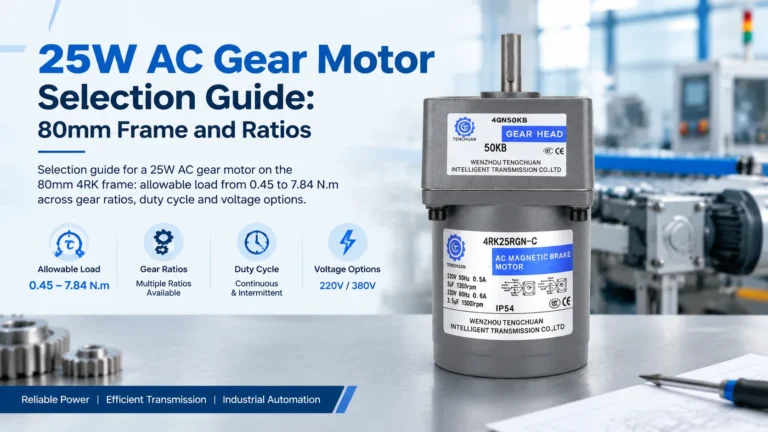
Cách lựa chọn công suất cho động cơ giảm tốc AC 25W trên khung 4RK 80 mm: tốc độ đầu ra, tải cho phép từ 0,45 đến 7,84 N·m, mô-men xoắn tối đa, chu kỳ làm việc và các lựa chọn điện áp.