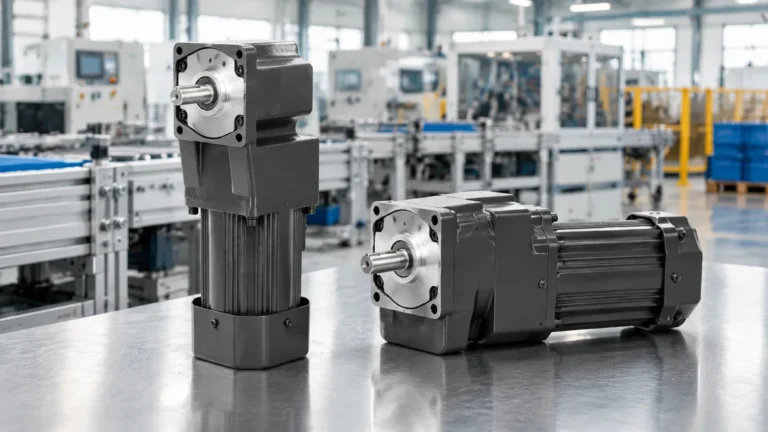
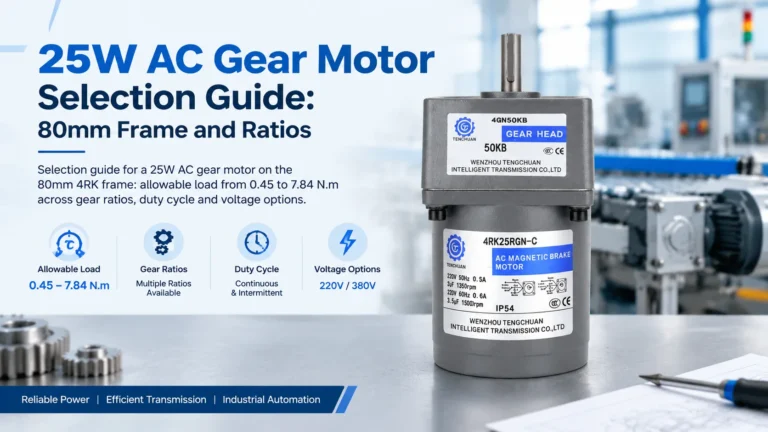
Parallel-Shaft vs Right-Angle Gear Motor: Which Fits Your Machine
Right-angle vs inline gear motor compared with real allowable load tables: efficiency, torque, the self-locking myth and how to decide in five steps.
Read More
Small AC Gear Reducer Motors combine an AC motor and a gearhead in one compact drive, reducing motor speed while increasing usable output torque. To choose the right model, begin with the machine’s required output speed and torque, then confirm motor power, gear ratio, duty cycle, voltage and frequency, shaft layout, mounting dimensions, and operating environment. The best choice is not simply the highest wattage or largest ratio; it is the smallest configuration that safely meets the complete application requirement.
This guide is written for OEM engineers, equipment buyers, and maintenance teams selecting compact drives for conveyors, labeling machines, feeders, packaging equipment, turntables, and other light industrial automation. For a broader view of Tenchuan’s drive range, start from the Tenchuan Home page.
A small AC geared motor integrates two functions. The motor converts alternating-current electrical power into rotation, while the gearhead lowers the shaft speed and multiplies torque. The integrated construction saves space, avoids a separate motor-to-gearbox coupling, and simplifies alignment in compact machinery.
These motors are commonly selected when a standard AC motor turns too quickly for the load or cannot deliver enough torque directly. Typical uses include small conveyors, packaging and labeling lines, food-processing auxiliaries, printing equipment, automatic doors, vending systems, and material-feeding mechanisms.
Available Small AC Gear Reducer Motors can be compared by power, frame size, ratio, output shaft, voltage, phase, and optional control features. Treat each value as part of one drive system rather than as an independent catalog filter.
Before choosing a motor, define what the driven machine must do. Record the required output rpm, the torque needed during normal operation, the extra torque needed during starting or acceleration, and any shock or jam load. A conveyor starting while fully loaded can require considerably more torque than the same conveyor running at steady speed.
For rotating loads, determine torque at the driven shaft. For a belt conveyor, convert the target linear speed into drive-roller rpm and include belt friction, conveyed mass, incline, roller radius, and transmission losses. If chains, pulleys, or external gears are used after the gearmotor, include their ratio and efficiency.
A useful preliminary ratio calculation is:
Gear ratio = rated motor speed / required output speed
If the rated motor speed is 1,500 rpm and the machine needs about 50 rpm, the preliminary ratio is 30:1. Select the closest standard ratio and then verify the supplier’s published output speed and allowable torque for the exact combination. Motor slip and gearbox losses mean real performance will not equal an ideal calculation.
Wattage helps narrow the product range only after output speed and load torque are known. The same motor power can produce very different output speeds and torques when combined with different gear ratios. A larger motor is not automatically safer: it adds cost, mass, current demand, and installation space, while the gearhead may still set the maximum allowable torque.
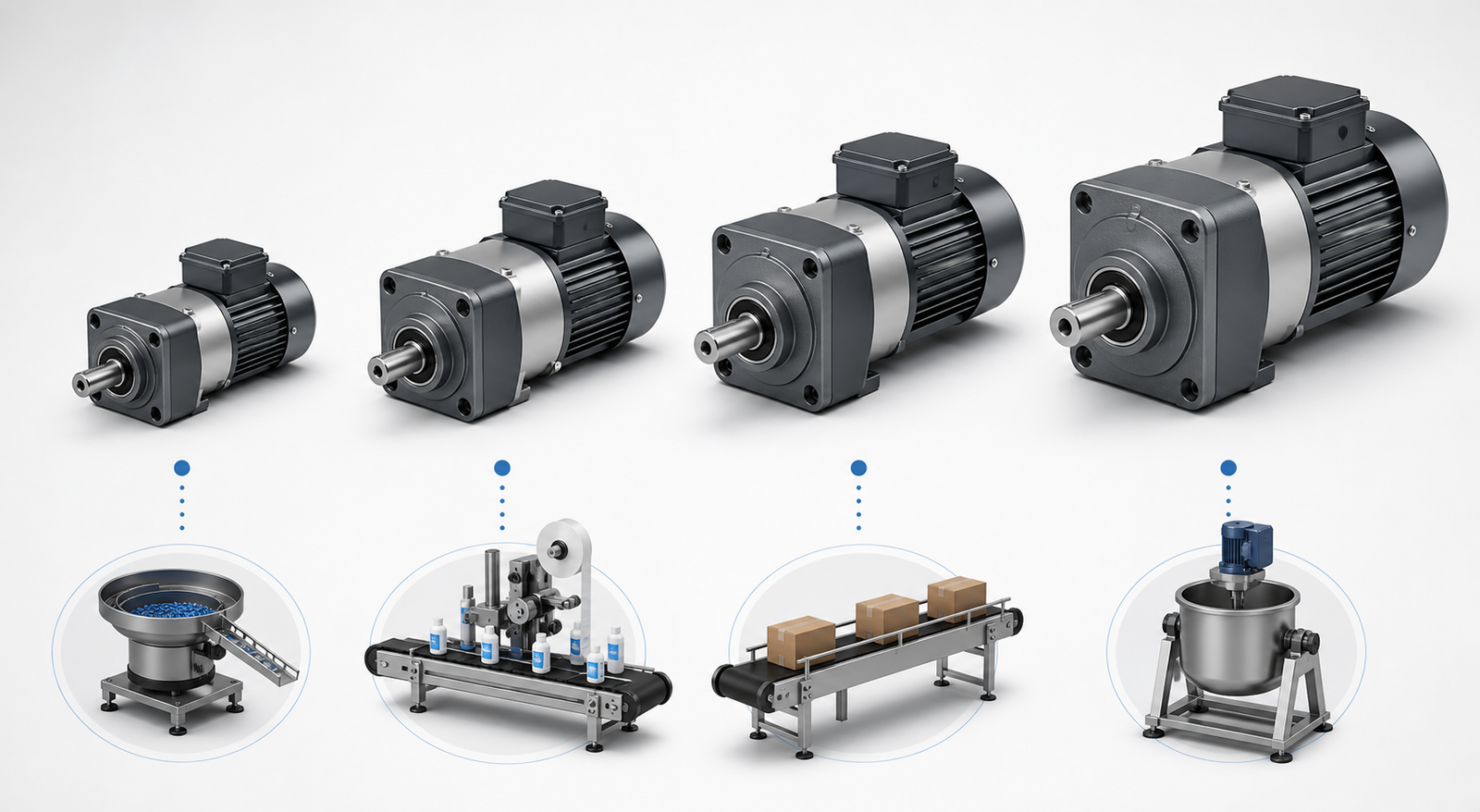
| Power range | Typical starting applications | What must be verified |
|---|---|---|
| 15W–25W | Small feeders, displays, light indexing devices | Starting torque, intermittent duty, compact frame |
| 40W–60W | Labelers, small rollers, light conveyors | Continuous torque, output rpm, overhung load |
| 90W–120W | Packaging conveyors, transfer mechanisms | Duty cycle, acceleration, thermal capacity |
| 140W–300W | Larger compact conveyors, mixers, handling equipment | Peak torque, mounting strength, supply and protection |
For a compact low-load mechanism, the 25W Small AC Gear Reducer Motor is one product class to evaluate. Light conveyor and labeling equipment may lead to the 60W model. Higher continuous loads can be compared with the 120W model or the 200W model. These are comparison points, not automatic recommendations; the final choice depends on ratio, torque, frame, voltage, duty, and mounting.
Electrical compatibility must be specified before ordering. State the available voltage, frequency, and phase. A voltage such as 220V is not a complete specification because the supply may be single-phase or three-phase and may operate at 50Hz or 60Hz. Frequency affects motor speed, so it can also change the geared output rpm.
If variable speed is required, define the usable speed range rather than merely requesting a controller. Running an AC motor far below its rated speed for long periods can reduce fan cooling and increase temperature. A more suitable mechanical ratio may allow the motor to operate closer to its intended speed.
The output shaft arrangement should follow the machine layout. A parallel-shaft gearmotor is convenient when motor and driven shaft axes can run in the same direction. A right-angle arrangement redirects the output by 90 degrees and can make better use of a narrow machine envelope.
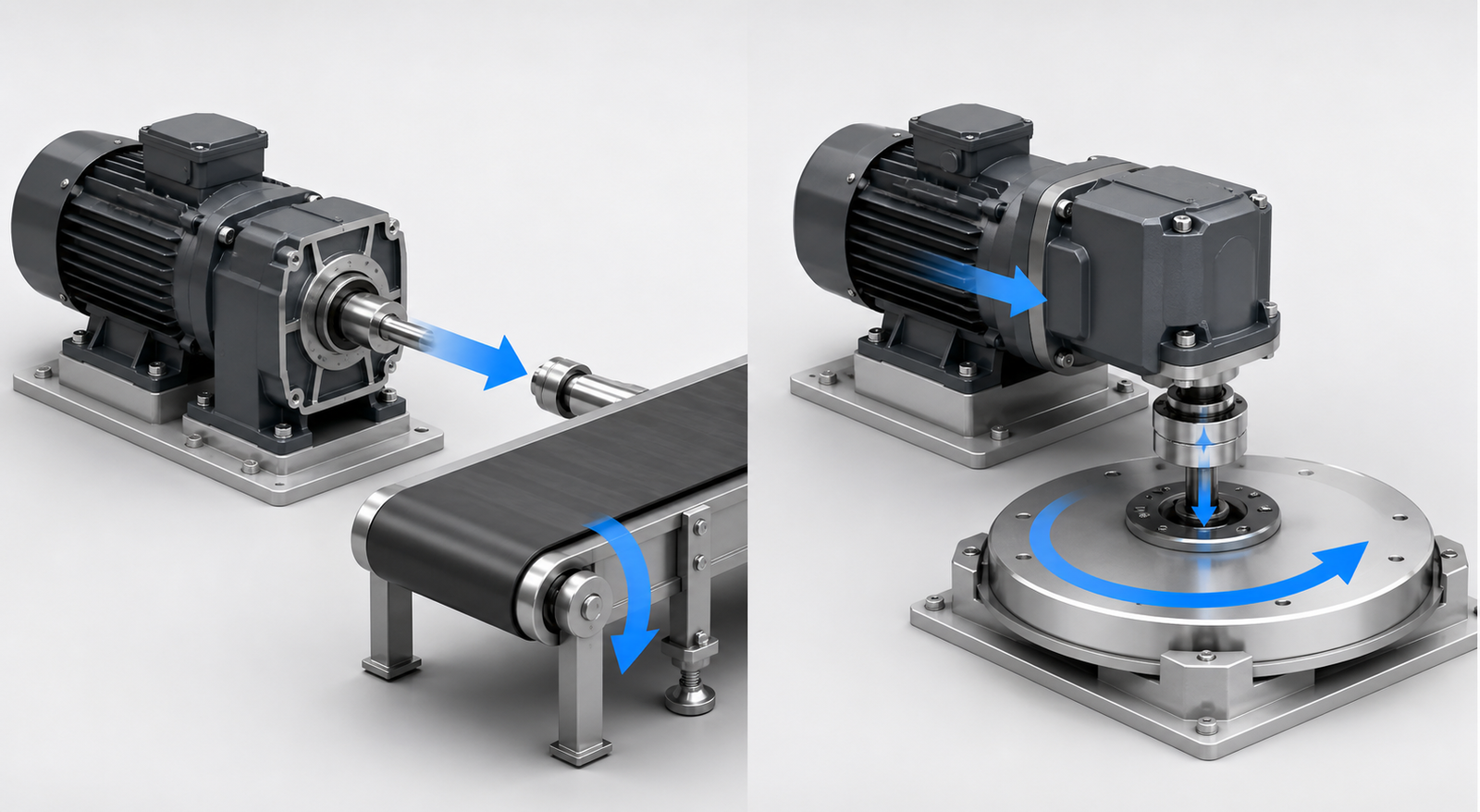
Check more than the direction. Confirm output shaft diameter and length, keyway, rotation direction, frame size, mounting-hole pattern, cable or terminal-box orientation, and access for installation. Pulley or sprocket loads can apply radial force to the output shaft; helical or other mechanisms may also create axial force. Compare these loads with the manufacturer’s allowable values.
Compact motors have less surface area for dissipating heat, so duty cycle matters. Record operating hours per day, percentage on-time, starts per hour, reversing frequency, ambient temperature, enclosure ventilation, and worst-case load. A motor that performs well during a short test may overheat in continuous production.
Apply a service margin using the manufacturer’s method. Frequent starts, shock loads, high inertia, reversing, uncertain friction, and long operating hours all increase demand. Do not use an emergency or peak torque rating as a continuous rating. The gearhead, bearings, output shaft, lubricant, motor winding, and control equipment must all remain within their allowable limits.
Speed control, stopping, and load holding are separate functions. A speed controller adjusts operating speed. A brake can stop or hold a load when correctly sized. Neither should be assumed to solve an incorrect motor or ratio selection.
Also define overload protection, grounding, emergency-stop behavior, direction control, and any required ingress protection. Dust, moisture, washdown, oil mist, chemicals, altitude, and high ambient temperature can change the suitable enclosure, materials, insulation, lubricant, and derating.
Tenchuan’s Solutions page can help relate these questions to real equipment layouts and industrial uses.
The correct Small AC Gear Reducer Motors are selected as complete drive systems. Begin at the load, calculate speed and torque, match a practical ratio and motor power, and then verify electrical supply, duty, heat, shaft loads, installation, and control requirements. This approach produces a compact drive that is easier to install and more reliable in service.
To evaluate the supplier and manufacturing background, visit About Us. For a project-specific recommendation, send the completed checklist through Contact Us and request confirmation of the model, ratio, torque, voltage, and mounting configuration.
Divide rated motor speed by required output speed, choose the nearest available ratio, and verify the resulting catalog rpm and allowable torque under the intended load and supply frequency.
No. Oversizing can increase cost, space, mass, and current without correcting the ratio or mounting. Select power from required speed, torque, duty, and service margin.
Only if the exact motor and gearhead combination is rated for continuous duty under the actual load, ambient temperature, ventilation, mounting position, and power supply.
Choose a right-angle layout when the output direction or available machine space requires a 90-degree turn, then verify efficiency, ratio, shaft loads, and mounting dimensions.
Send output rpm, load and peak torque, duty cycle, starts per hour, voltage, phase, frequency, mounting orientation, shaft dimensions, controls, brake needs, environment, available space, and order quantity.