750W AC Gear Motor: Vertical vs Horizontal Mounting Guide
750W (about 1 HP) gear motor mounting guide: what changes between vertical and horizontal, oil level, seal protection, thrust load and torque by ratio.
Read More
Choosing between a parallel-shaft drive and a right angle gear motor looks like a preference. It is actually a constraint. The shaft direction decides whether the drive can be mounted at all, and the gear type behind that 90-degree turn decides what it costs you in efficiency, torque and holding behaviour. Get the direction right and the rest follows; get it wrong and the machine needs a second reduction stage to compensate.
This comparison is written from published data for the two families in this range: the inline 4RK, 5RK and 6RK units, and the right-angle 4GN, 5GU and 6GU units that share the same motors with a bevel gearbox in front. It covers where the two really differ, where they do not, and the assumption that trips up most first-time buyers.
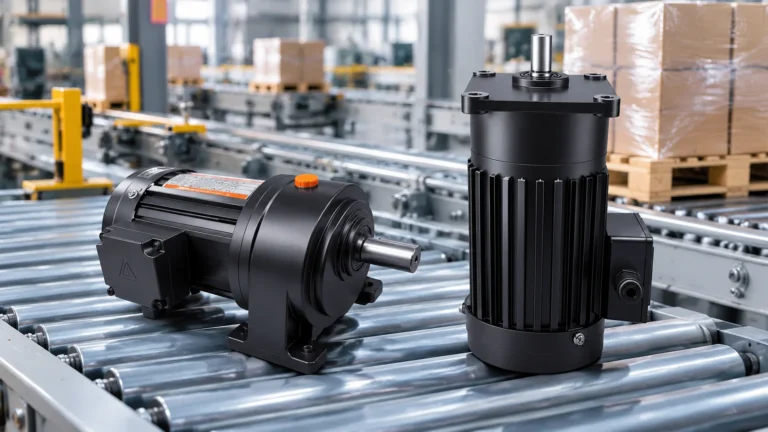
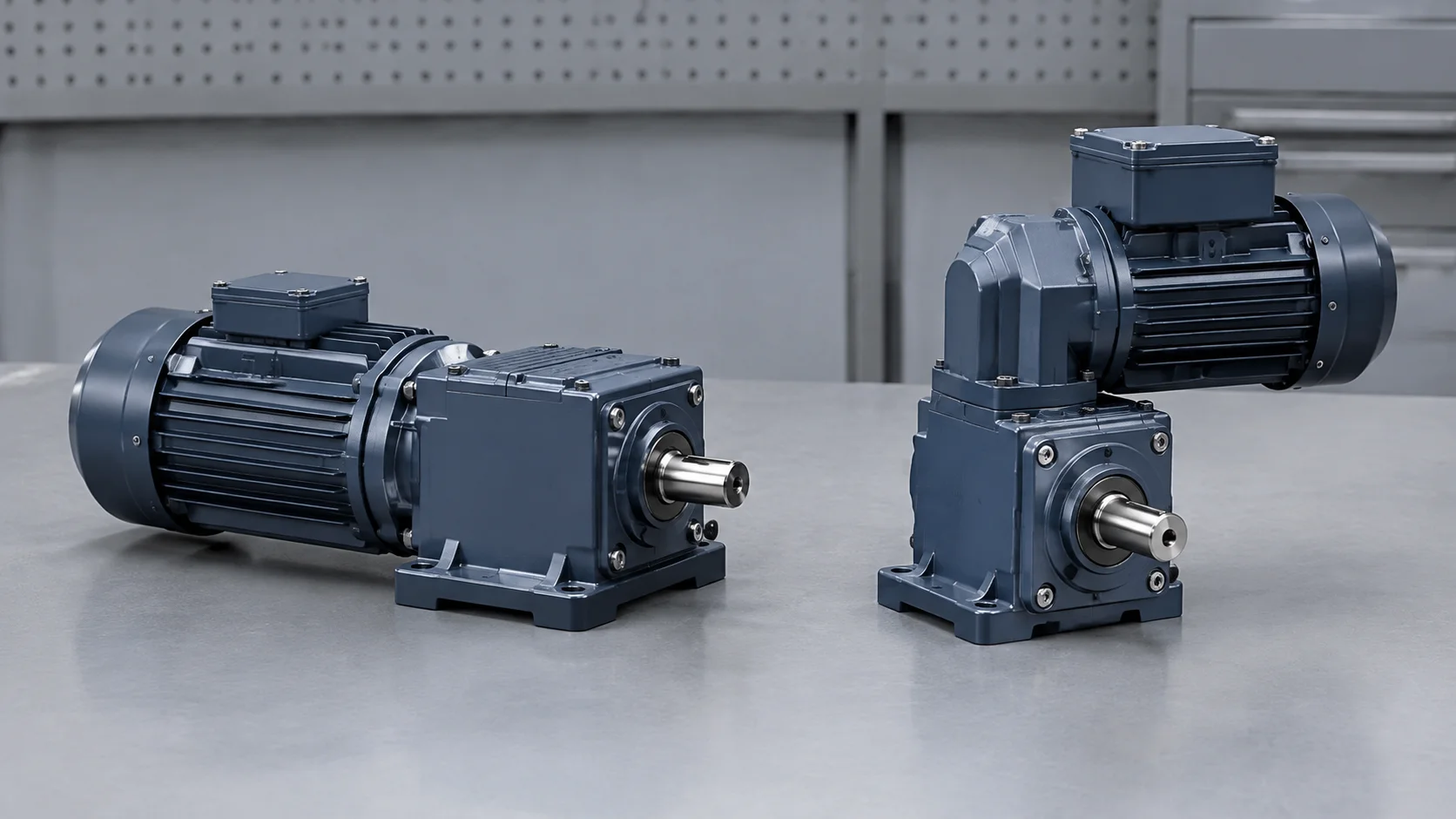
An inline, or parallel-shaft, gear motor keeps the motor shaft and the output shaft parallel. Power goes straight through a train of spur or helical gears, so the whole assembly is long and narrow. A right-angle gear motor turns the power through 90 degrees, so the motor body can sit beside the driven shaft instead of behind it.
That single change has three consequences that matter to a machine designer. The assembly length along the driven shaft drops dramatically, which is usually the reason the right-angle version exists. The motor can be tucked under, beside or behind a frame instead of projecting from it. And the housing becomes deeper in the direction perpendicular to the output shaft, so the drive is compact in one axis and larger in another.
| Item | Parallel-shaft (inline) | Right angle |
|---|---|---|
| Shaft arrangement | Input and output parallel | Input and output at 90 degrees |
| Gear type in this range | Spur / helical train | Bevel gear pair plus reduction stages |
| Length along output shaft | Long | Short — the reason to choose it |
| Depth perpendicular to shaft | Low | Higher |
| Efficiency (typical single stage) | ~95% and above | ~90–94% for bevel |
| Self-locking | No | No, on a bevel design |
| Relative cost at equal power | Lower | Higher |
| Maintenance focus | Bearings, seals, alignment | Bevel mesh wear, backlash, seals |
The efficiency row is where most online comparisons go wrong. They quote 60–85% for right-angle drives, because they are describing a worm gearbox. A worm drive is a right-angle gearbox, but not every right-angle gearbox is a worm. Our right-angle units use a bevel pair, which keeps efficiency in the low 90s — close enough to inline that efficiency alone is a poor reason to reject a right-angle layout.
This is the second assumption worth testing with real numbers. Because the 4GN, 5GU and 6GU units use the same motors as their inline counterparts, the allowable load tables can be compared directly at the shaft.
| Ratio | Inline 25W (4RK, 80 mm) | Right-angle 25W (4GN, 80 mm) | Inline 120W (5RK, 90 mm) | Right-angle 120W (6GU, 100 mm) |
|---|---|---|---|---|
| 3:1 | 0.45 N·m | 0.45 N·m | 2.11 N·m | 2.11 N·m |
| 5:1 | 0.79 N·m | 0.79 N·m | 3.52 N·m | 3.52 N·m |
| 10:1 | 1.55 N·m | 1.55 N·m | 6.88 N·m | 6.85 N·m |
| 15:1 | 2.25 N·m | 2.25 N·m | 9.60 N·m | 10.2 N·m |
| 20:1 | 3.10 N·m | 3.10 N·m | 12.4 N·m | 13.6 N·m |
| 30:1 | 4.12 N·m | 4.12 N·m | 18.5 N·m | 20.5 N·m |
| 50:1 | 6.18 N·m | 6.18 N·m | 19.6 N·m ceiling | 31.0 N·m |
| 75:1 | 7.84 N·m ceiling | 7.84 N·m ceiling | — | — |
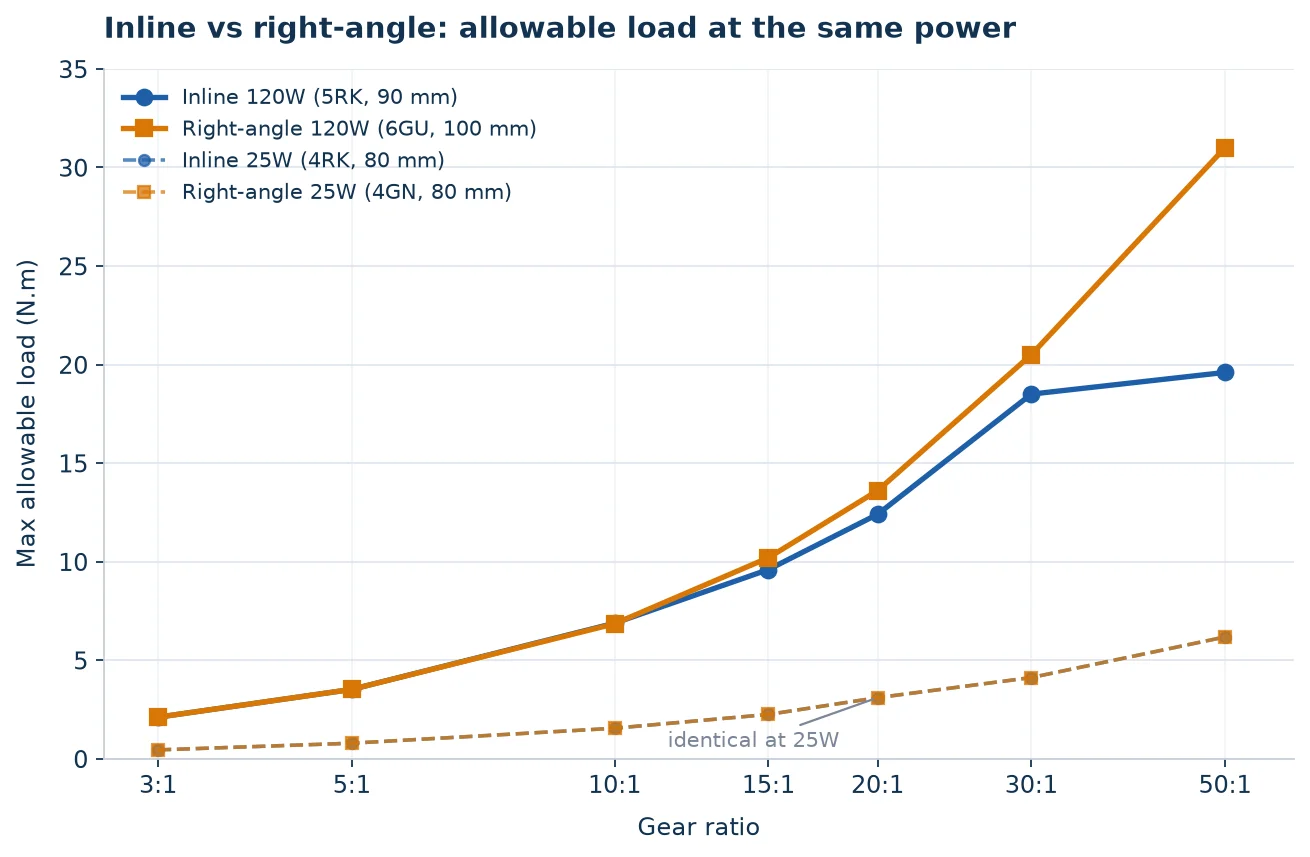
At 25W the two tables are identical line for line — the right-angle gearbox carries exactly the same load as the inline one on the same 80 mm frame. At 120W the right-angle unit actually carries more at high ratios, because its 100 mm frame housing is deeper and takes a wider gear set than the 90 mm inline gearbox, which tops out at 19.6 N·m. So the widespread belief that “right angle means less torque” is not supported by the data in this range. It costs length in a different axis, some efficiency, and money — not load capacity.
Right-angle units are widely assumed to hold their load when power is removed, because worm gearboxes have that property. A bevel gear train does not. It is a rolling contact between two cone-shaped gears with no sliding wedge to lock the mesh, so a right-angle bevel gear motor will back-drive under an unbalanced load exactly as an inline unit will.
On a horizontal conveyor this never matters. On a vertical lift, a hoist, an inclined gate or a barrier arm it matters completely: the load will run down when the motor stops unless something else holds it. The correct solutions are a mechanical brake motor, a service brake on the drive shaft, or a counterbalance that leaves the load in equilibrium. Not a bigger right-angle gearbox, and not a higher ratio — ratio changes speed, not the ability to hold.
If holding is a requirement, say so at the specification stage, because a brake is a factory option rather than a field addition on most of these frames.
Three situations genuinely require a 90-degree output, and they are all mechanical rather than electrical.
Swing and sliding door operators are the classic example: the motor sits inside the head frame and the output drives a vertical spindle through a 90-degree gearbox. The swing door gear motor guide covers that geometry, including the holding requirement that a bevel drive does not provide.
If the driven shaft is parallel to the mounting surface and there is room along it, the inline unit wins on three counts. It is cheaper at equal power because the gear train has fewer parts. It is more efficient, which matters on a drive that runs eight hours a day. And its housing is narrow, which suits conveyor frames and roller drives where the gear motor sits inside the frame profile.
Inline is also the simpler choice for high-ratio applications within the small frames. A 90 mm inline 5RK unit reaches 500:1 on the standard gearbox; the right-angle families in this range are typically specified to lower maximum ratios. Where an application needs very slow output, check the published ratio range for the exact model rather than assuming both families match.
The right-angle range is organised by motor frame, which makes the selection straightforward once the power class is fixed.
If the inline arrangement is possible, the equivalent power exists on the small AC gear reducer motor range, where the same motors are offered with spur and helical gearboxes. Frame dimensions for both families are compared in the gear motor size chart.
The ratio arithmetic is the same for both families and is set out in how to calculate gear ratio, with the wider family taxonomy in types of gear motors.
Send the direction of the driven shaft and the three available clearances, the mounting face and bolt pattern, required output speed in r/min, load torque or mass and radius, duty cycle including reversing, and whether the load must be held with power off. With those, the configuration question answers itself before the ratio is even discussed.
The 4GN 25W right-angle unit is the smallest frame in the range and the quickest way to confirm dimensions against a tight layout.
Not in this range. At 25W the 4GN and 4RK allowable load tables are identical line for line. At 120W the right-angle 6GU on a 100 mm frame carries up to 31 N·m at 50:1 against a 19.6 N·m ceiling on the 90 mm inline gearbox.
Not if it uses a bevel gear pair, which is what the 4GN, 5GU and 6GU units use. Bevel drives back-drive under an unbalanced load. If the load must hold with power off, specify a brake motor.
Inline is slightly more efficient, typically 95% or more per stage against roughly 90–94% for a bevel right-angle stage. The large 60–85% figures often quoted for right-angle drives refer to worm gearboxes, not bevel ones.
Only if the driven shaft is vertical. If the driven shaft is horizontal and you simply need the motor out of the way, an inline unit cannot deliver a horizontal output from a vertical motor axis — that geometry requires a right-angle gearbox.
The bevel gear set needs a second precision mesh, a deeper housing and more machining than a parallel gear train, so cost is higher at equal power. The premium buys layout flexibility, not extra output torque.
Yes. The 4GN uses the same 4RK 80 mm motors as the inline 25W units, the 5GU uses the 5RK 90 mm motors, and the 6GU uses the 6RK 100 mm motors. Only the gearbox and output arrangement change.
Choose the configuration from the direction of the driven shaft and the tightest of your three clearances, then read the allowable load from the correct table for that family. Expect to pay a little more and lose a few points of efficiency for a right angle, but not to lose torque. And never assume a 90-degree gearbox holds its load — bevel units back-drive, so anything that must stay put with the power off needs a brake.