Geared DC Motor vs Geared AC Motor: Key Differences
Published: Author: JellyDai
Choosing between a geared DC motor and a geared AC motor is one of the first decisions you make when sizing a drive for a machine. Both use the same basic idea: an electric motor plus a reduction gearbox that lowers output speed and raises output torque. But the two types differ in power supply, speed control, maintenance, cost, and the applications they suit best. In this guide you will see the key differences side by side, learn which one fits a given requirement, and get a practical framework for choosing the right geared motor for your application.
What Is the Difference Between a Geared DC Motor and a Geared AC Motor?
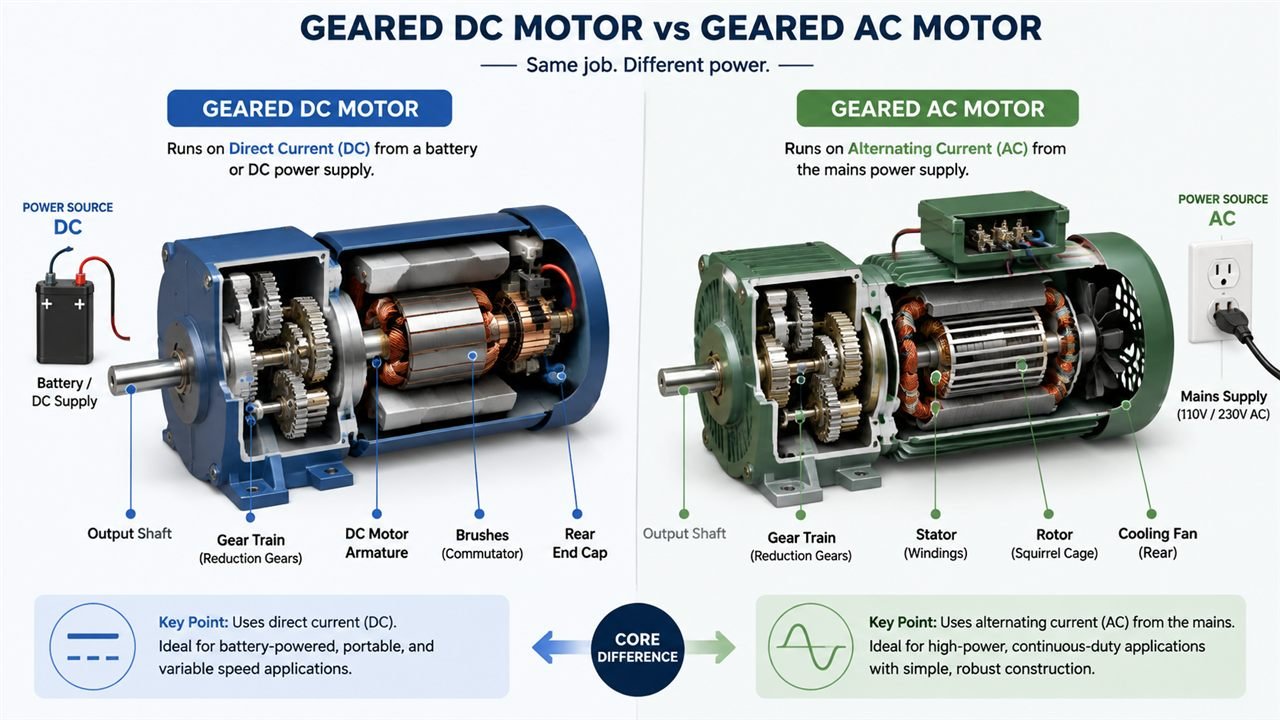
The core difference is the power they run on and how that affects speed control. A geared DC motor runs on direct current, so its speed can be changed simply by adjusting the voltage, and it is easy to make compact, battery-powered or portable. A geared AC motor runs on alternating current from the mains, is fixed-speed by design (unless a frequency drive is added), and is usually more rugged and maintenance-free for continuous industrial duty.
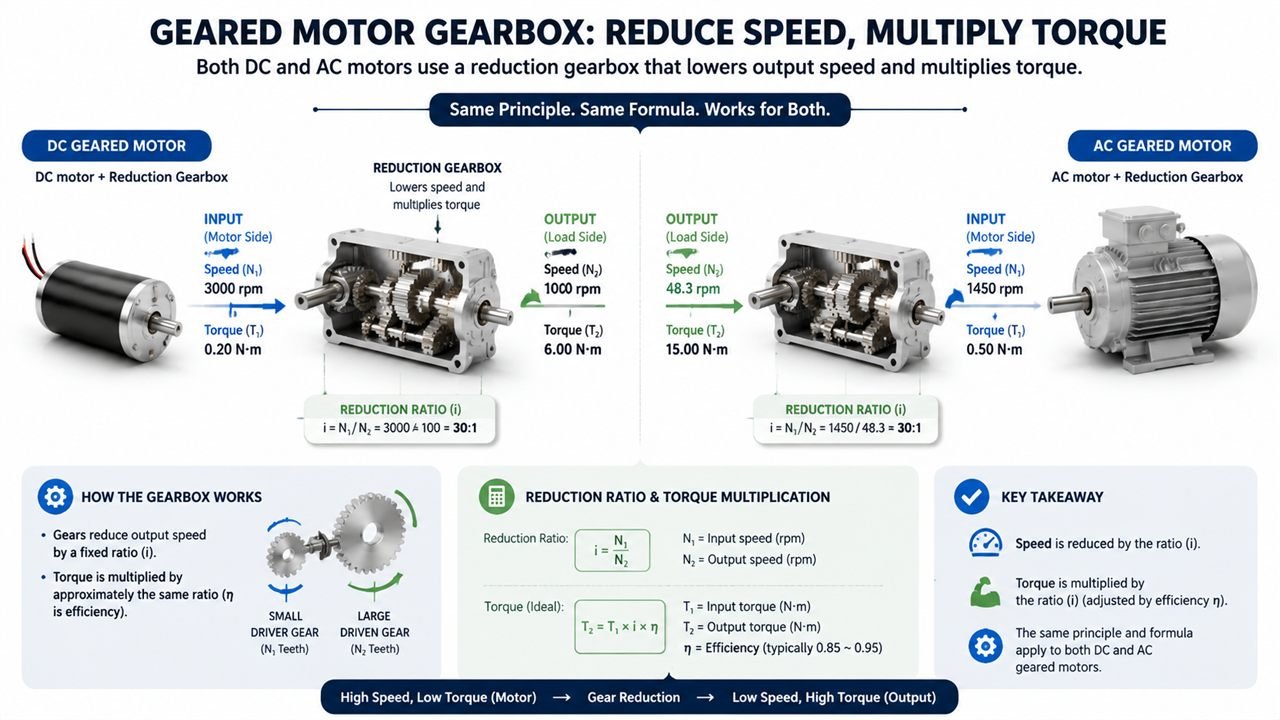
Both are “geared” in the same sense: a gearhead is mounted on the motor shaft to multiply torque and reduce speed. The gear reduction part is nearly identical; it is the motor itself that creates the practical differences. If you need the basics of how a motor and gearbox work together, our guide on how a gear reducer motor works explains the principle in more depth.
Geared DC Motors: How They Work and Where They Shine
A geared DC motor attaches a reduction gearbox to a DC motor. Brushed DC motors use brushes and a commutator to switch the current in the rotor windings, while brushless DC motors use electronic commutation instead. In both cases, torque is roughly proportional to current, and speed rises with voltage, which makes speed control straightforward.
Geared DC motors shine when you need variable speed, high starting torque, or a battery-powered and compact drive:
Easy speed control. Lowering the voltage slows the motor down, so a simple controller gives smooth speed adjustment without complex electronics.
High starting torque. DC motors deliver strong torque from standstill, useful for loads that need to break away under load.
Portable and battery-driven. Because they run on direct current, they are natural fits for cordless tools, automotive, robotics, and medical devices.
Precise motion. Brushless DC gear motors respond quickly and are common in automation, servos, and positioning systems.
The trade-off is maintenance: brushed DC motors wear out their brushes and commutator over time, and the brushes need periodic inspection or replacement.
Geared AC Motors: How They Work and Where They Shine
A geared AC motor is most often an induction motor with a reduction gearbox. It uses alternating current in the stator to create a rotating magnetic field; the rotor follows that field, and the output speed is set by the number of poles and the line frequency. For example, a 4-pole motor on a 50 Hz supply runs at a nominal 1,500 rpm, and the gearbox then reduces that to the required output speed.
Geared AC motors are the workhorses of continuous industrial operation:
Constant speed. Under normal load, an AC induction gear motor holds a near-fixed speed with little fluctuation, which suits conveyors, packaging lines, and other steady processes.
Low maintenance. There are no brushes or commutator to wear, so AC gear motors run for very long periods with little attention.
Durable and compact. AC gear motors are rugged, handle continuous duty well, and are generally smaller, lighter, and less expensive than equivalent brushless DC gear motors.
Mains powered. They plug straight into the standard AC supply found in most factories.
The main limitation is speed: the motor is essentially fixed-speed. If you need to vary the speed, you must add a variable frequency drive (VFD), which increases cost and complexity. Small AC gear reducer motors of this kind are exactly what Tenchuan produces, from 15W to 300W in parallel and right-angle configurations.
Geared DC vs Geared AC Motor: Side-by-Side Comparison
Feature
Geared DC motor
Geared AC motor
Power supply
Direct current (battery or rectified)
Alternating current (mains)
Speed control
Simple, via voltage or controller
Fixed speed; VFD needed for variation
Starting torque
High from standstill
Good, but lower than brushed DC
Maintenance
Brushes need periodic replacement
Very low, brushless design
Continuous duty
Good, but heat limits apply
Excellent, built for it
Size and cost
Compact; brushless units cost more
Compact, light, generally lower cost
Best fit
Variable speed, portable, battery
Fixed-speed industrial automation
The gearhead behavior is the same for both: the reduction ratio sets the output speed and multiplies the torque, so the ratio calculation applies equally. You can use the gear ratio calculation guide to size either type.
Speed Control: The Biggest Practical Difference
Speed control is where the two types diverge most. A geared DC motor responds to a change in voltage almost immediately, which makes it ideal for adjustable-speed applications such as adjustable conveyors, door operators, and equipment that must run at different speeds in one cycle. A geared AC induction motor, by contrast, spins at a speed locked to the line frequency, so the only practical ways to change its speed are changing the gear ratio, changing the pole count, or adding a variable frequency drive.
If your machine runs at one fixed speed all day, an AC gear motor is the simpler and cheaper choice. If your application needs frequent speed changes, precise positioning, or a low-speed range, a geared DC or brushless DC motor is usually the better fit.
Torque and Starting Behavior
Both types use the gearbox to multiply torque, but the motor part behaves differently at startup. Brushed DC gear motors provide high torque from standstill, which helps when a load must be pulled from rest or when the drive reverses often. AC induction motors also produce solid starting torque, though generally lower than a comparably sized brushed DC motor, and they pull a higher current during startup.
For steady, continuous loads such as a conveyor or a packaging line, the AC gear motor holds torque steadily and is very reliable. For demanding starts, short motion bursts, or frequent reversals, a DC gear motor often feels more responsive. As with any gear motor, the actual torque at the output depends on the motor’s rated torque and the gearbox ratio and efficiency, so verify both before selecting.
Maintenance, Lifespan, and Cost
Brushed DC gear motors need the most attention because their brushes wear with use; in dirty or high-duty environments this can mean regular servicing. Brushless DC gear motors remove that problem but cost more because they need an electronic driver. Geared AC motors sit at the low-maintenance end: with no brushes and a simple, rugged construction, they run for years on continuous duty with little more than basic checks.
In cost terms, AC gear motors tend to be the budget-friendly option for fixed-speed industrial work, both in purchase price and in total ownership because they rarely need parts. If you need speed control, the DC route may look cheaper at first, but a brushless DC motor plus its controller can push the total cost higher than an AC motor with a VFD for some applications. The right choice is not “cheaper motor” but “cheapest reliable system for the job.”
Which Gear Motor Should You Choose?
Match the motor type to the way your machine actually runs:
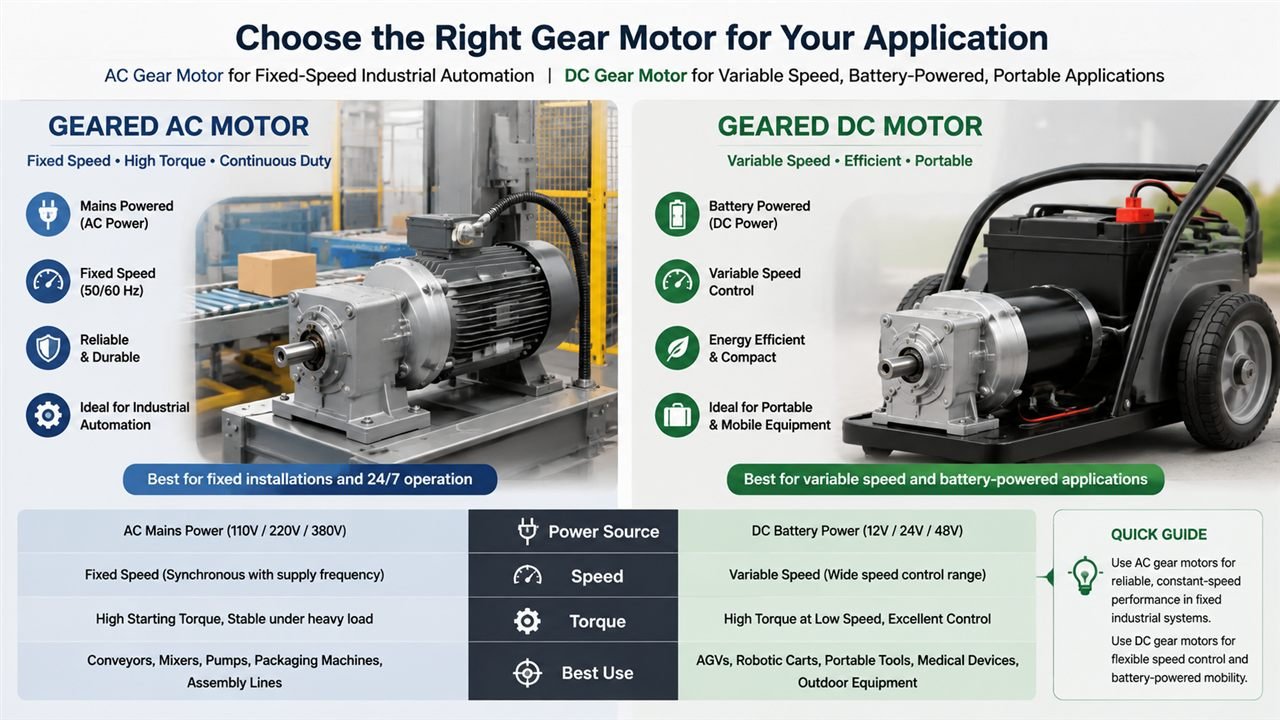
Choose a geared AC motor when the application runs at one speed for long periods, is powered from the mains, and values low maintenance and ruggedness: conveyors, packaging machines, mixers, fans, and most continuous automation.
Choose a geared DC motor when you need variable speed, high starting torque, battery power, compact size, or precise motion: cordless tools, robotics, actuators, medical equipment, and adjustable-speed drives.
Choose brushless DC when you need DC advantages but want a long, low-maintenance life and can accept the higher component cost and driver requirement.
Once the motor type is decided, the rest of the selection is the same for both: output speed, torque, ratio, duty cycle, mounting, and power supply. Our guide to how to choose a small gear reducer motor walks through those steps, and the article on types of small reducer electric motor compares the functional variants you can choose from.
Frequently Asked Questions
Can a geared AC motor be used for variable speed?
Yes, but it needs a variable frequency drive (VFD) to change the supply frequency and voltage. Without a VFD, a standard AC induction gear motor runs at a fixed speed set by its poles and the line frequency.
Which gear motor has higher starting torque, DC or AC?
Brushed DC gear motors generally provide higher torque from standstill. AC induction motors also start under load, but their starting torque is usually lower than a comparably sized brushed DC motor.
Do geared DC motors need more maintenance than geared AC motors?
Usually yes. Brushed DC motors have brushes that wear and need periodic replacement. Brushless DC motors avoid that but cost more. AC gear motors have no brushes, so maintenance is very low.
Are AC gear motors cheaper than DC gear motors?
For fixed-speed industrial use, AC gear motors are generally less expensive and lighter than equivalent brushless DC units. When speed control is required, compare the full system cost including controllers or VFDs.
Which is better for a battery-powered application?
A geared DC motor is the natural fit because it runs on direct current. AC motors need a mains or inverter supply and are rarely used for battery-powered, portable devices.
What is the difference between a gear motor and a geared motor?
None in practice. Both mean an electric motor combined with a reduction gearhead. “Geared motor” and “gear motor” are used interchangeably, and both describe the motor-plus-gearbox unit discussed here.
Choose the Motor Type That Fits the Job
The contrast between a geared DC motor and a geared AC motor comes down to power supply, speed control, and duty. Choose a geared AC motor for fixed-speed, continuous, low-maintenance industrial operation. Choose a geared DC motor when you need variable speed, high starting torque, or battery power. The gearbox does the same job in both, so once you know the type and the required speed and torque, the rest of the selection is straightforward.
Practical guide to selecting a gear motor for door openers: calculate required torque and output speed, understand self-locking worm gear drives, and match the right AC gear motor to your door type.
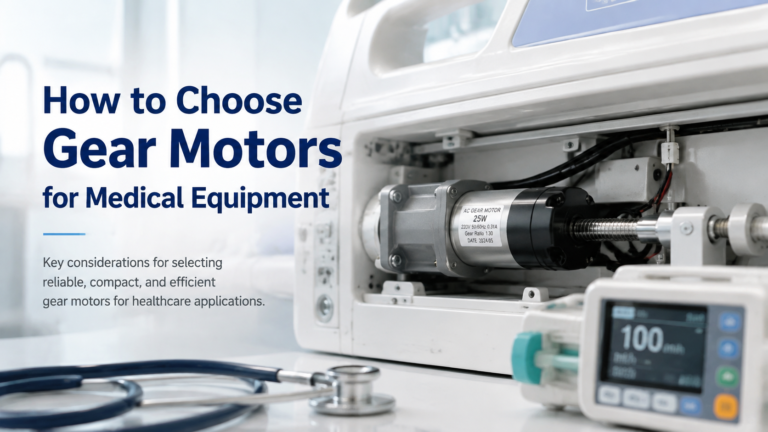
Selection guide for gear motors used in hospital beds, infusion pumps, ventilators, lab equipment and other medical devices. Covers noise, precision, IEC 60601-1 safety, IP rating and self-locking requirements, plus a step-by-step selection workflow and application table.
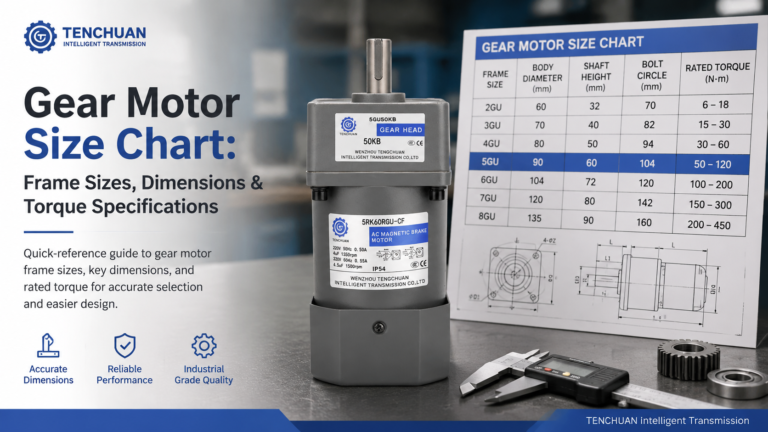
Read a practical gear motor size chart for small AC gear motors. Frame sizes 60-104 mm, dimensions, rated torque and RPM at common ratios, mounting styles.