Reversible vs Continuous Duty AC Gear Motor: What the 30-Minute Rating Limits
Published: Author: Lisa
A reversible gear motor and a continuous-duty gear motor can look identical, mount identically and cost almost the same. The difference is a single character on the nameplate — and it decides whether your machine can run for eight hours or has to stop every half hour.
Almost every application article on this site mentions that a motor is “reversible, 30-minute rated”. This one explains what that rating is actually protecting, how to work out whether your duty cycle fits inside it, and what to do when it does not. It is the least glamorous specification on a gear motor and the one most often ignored until a winding fails in the third month.
The suffix on the model number is the whole story
In the compact AC gear motor naming convention, the letters after the frame and power tell you the duty and the shaft type. The ones that matter here are the duty letters.
Suffix
Motor character
Duty rating
Typical use
GN
Reversible, with damping brake; pinion (gearhead-mating) shaft
30 minutes
Doors, gates, indexing moves, anything that must reverse
GU
Reversible, with damping brake; round output shaft (right-angle families)
30 minutes
Right-angle drives that must reverse
A (or induction equivalent)
Standard induction motor, no damping brake
Continuous
Conveyors, pumps, fans, mixers running one direction
S
Speed-control motor with tachogenerator
Continuous within the safe-operation line
Machines needing adjustable speed
So a model ending GN or GU is a reversible motor, and a reversible motor in this family is rated 30 minutes. A model without the reversible lettering is an ordinary induction motor and is continuously rated. That is the entire distinction, and it is decided at order — you cannot convert one into the other afterwards.
What the 30-minute rating is actually measuring
It is not a timer and it is not an electronic limit. It is a thermal statement: at rated load, in a 40 °C ambient, the winding reaches its permitted temperature rise in about 30 minutes of continuous running. After that, the insulation starts to age faster than its design life allows.
Three consequences follow, and all three are useful in the field.
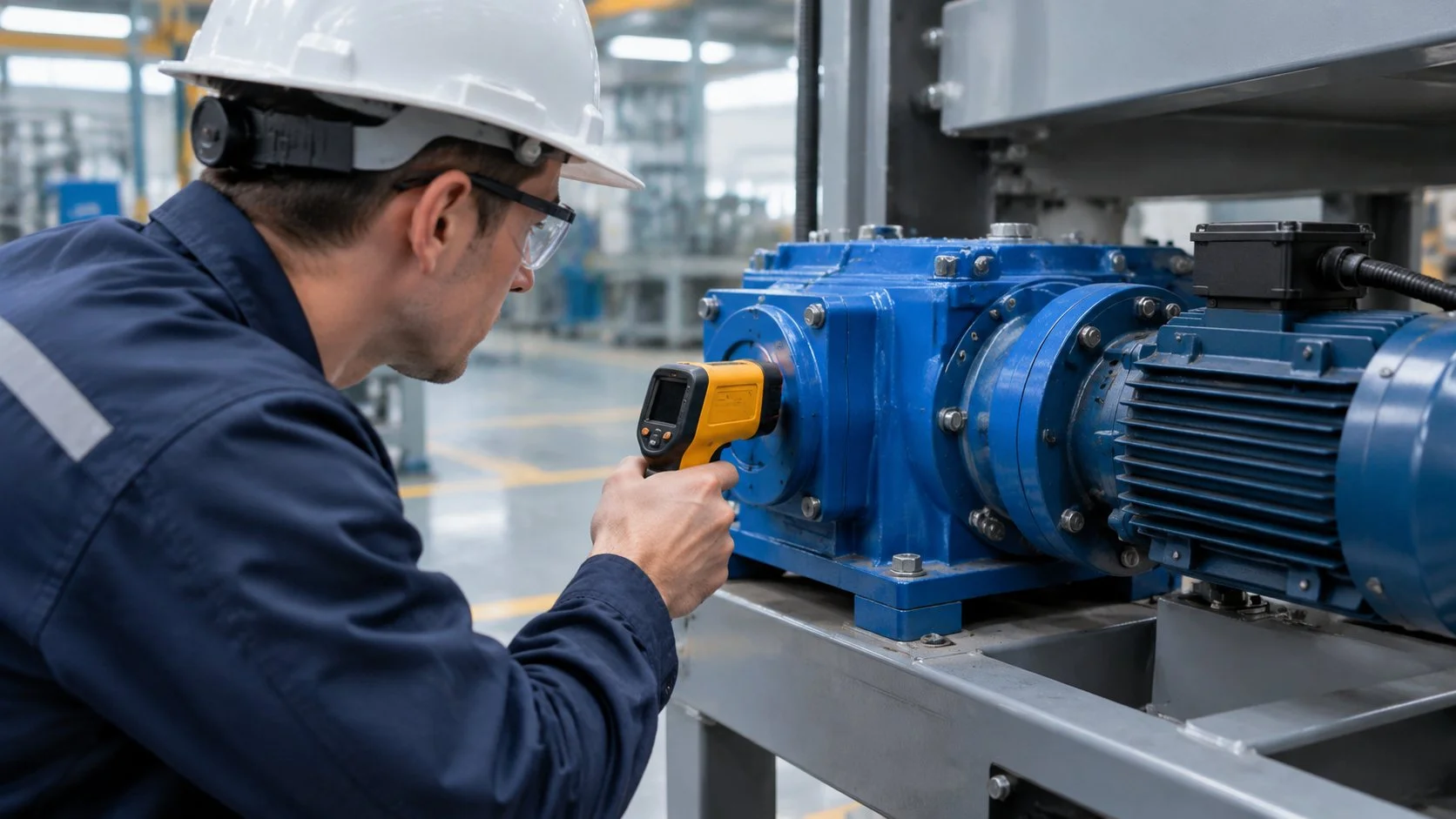
It is about temperature, not minutes. If the motor’s case surface stays below roughly 90 °C, it can run considerably longer than 30 minutes. A motor that is hot to the touch but not painful, mounted in moving air, at part load, will outlast the nominal rating comfortably. The rating assumes full load, still air and 40 °C ambient — conditions that are frequently not the real ones.
Interruption resets it partially, not fully. Because the winding cools between runs, a motor that runs 20 minutes and rests 10 can accumulate far more than 30 minutes of running per hour. The relationship is not linear: the shorter the pause, the less cooling, and there is a curve for every frame where a short run with a very short pause is no better than continuous operation.
The gearhead helps. A reversible motor bolted to a substantial gearbox has extra thermal mass and surface area attached to it. Manufacturers’ data for these families show that a reversible motor running with its gearhead reaches thermal equilibrium later than the same motor alone — in some published cases three to four times later. The metal around the motor is, in effect, a heat sink. This is one reason the assembled gear motor is rated as a unit rather than as a bare motor.
Why a reversible motor heats faster than an induction motor
Two mechanisms, and both are the price of being able to reverse on command.
The first is the damping brake. A reversible motor carries a light friction brake that stops the shaft quickly when power is removed, so that the load does not coast and the next direction command starts from a known position. That brake does work on every stop, and the energy it absorbs becomes heat inside the motor housing.
The second is starting. A reversible motor has a higher starting current than an equivalent induction motor, because it is designed to accelerate a load and change direction rather than to run steadily. Every reversal is a start, so a machine that cycles twenty times an hour asks its motor to absorb twenty starts per hour — each one a burst of current, each one a slug of heat in the winding.
Put together: a reversible motor in a machine that reverses frequently is doing more thermal work per operating hour than its continuous-duty cousin doing the same job in one direction. The 30-minute rating is not conservative bookkeeping; it is a fair description of what the design can dissipate.
Reading your duty cycle off the machine
Before deciding whether 30 minutes is enough, write down the real cycle. Three numbers do it.
Duty pattern
Run / rest per hour
Duty %
Verdict on a 30-minute reversible motor
Door or gate, occasional use
3 × 10 s with long pauses
Under 5%
Comfortable; thermal margin is large
Indexing table, 10 moves/min
Short moves, short dwell
20–40%
Acceptable if the case stays below about 90 °C; monitor it
Reversing conveyor in a wash station
5 min run, 2 min rest
70%
Marginal at full load; derate the load or step to a continuous motor
Continuous forward running
Uninterrupted
100%
Wrong motor — use the induction (continuous) version
The last row is the one to act on. Plenty of machines are built around a reversible gear motor because it was already in the design’s parts list, and then run it one direction for eight hours. That is buying a brake you never use and a duty limit you will eventually exceed. The continuous-duty version of the same frame is usually cheaper and has no 30-minute constraint.
Three honest ways to run longer
If the duty cycle genuinely does not fit, there are three real options and one that is not.
Change to the continuous-duty motor on the same frame. Same mounting, same gearbox interface, same ratio options. If the machine does not need the damping brake to stop the load, this is the correct answer and it is almost always the cheapest.
Derate the load. The 30-minute rating is at rated torque. Running at 60% of rated torque produces roughly a third of the temperature rise, and the motor will sit far below its thermal limit. If the application has margin in the torque specification, using it is free.
Improve cooling and increase rest time. Mount the motor where air moves, keep the fins and the fan cover clear, and lengthen the pause between cycles rather than shortening it for throughput. If the case surface stays under about 90 °C in service, the thermal basis of the 30-minute figure is not being approached.
What does not work is fitting an external fan to a totally enclosed motor and calling it continuous, or simply ignoring the rating because “it has been fine so far”. Winding insulation fails by cumulative thermal ageing, so a motor run past its rating does not fail on day one — it fails in the second or third year, usually out of warranty and usually during a busy period.
Reversible does not mean instant reversal
This is the second misunderstanding attached to the same suffix. “Reversible” describes a capability, not a speed.
When you reverse a running motor, the rotating field reverses and the motor acts as a brake until the shaft stops and accelerates the other way. That interval is called plugging, and it produces several times rated current plus a torque shock transmitted straight through the gearbox. The motor will survive a certain amount of this; the gear teeth and the coupling will not survive very much.
Two rules keep reversing machines reliable. Allow the shaft to reach standstill before the next direction command — a dwell of a few tenths of a second is usually enough at small inertia, longer for a high-inertia load. And check that the mechanism itself can tolerate the deceleration, because a reversing drive stops the load faster than friction would, and anything loose on the load side becomes a shock load.
Where the load must be held after stopping, a reversible motor is not enough. The damping brake slows the shaft; it does not guarantee holding torque. That requires an electromagnetic brake motor, and the difference is worth stating plainly: a gear motor is not a safety device.
The relationship to torque and allowable load
Duty rating and torque rating are separate constraints, and a selection has to satisfy both. The 40 W 5RK unit on the 90 mm frame illustrates how the two interact: it is a reversible 30-minute model, offers ratios from 3:1 to 500:1, and has a maximum allowable load of 9.81 N·m regardless of how far the ratio goes.
Constraint
What sets the limit
How it fails
Duty rating (30 minutes)
Winding temperature rise
Insulation ages; motor dies in months, not minutes
Allowable load (9.81 N·m)
Gear tooth and bearing strength
Gear damage, usually sudden and under shock
Service factor margin
Load character and starts per hour
Premature failure on shock or frequent starting
Running a reversible motor at half its allowable load does not extend its duty rating automatically, and improving cooling does not raise the allowable load. The two limits move independently. The service-factor logic that sits on top of both is set out in the service factor and gearbox duty guide.
Mistakes that repeat
Mistake
Result
Correction
Using a reversible motor for continuous one-way duty
Winding fails after months of unnoticed overheating
Order the continuous-duty (induction) version of the same frame
Treating 30 minutes as a hard timer
Unnecessary motor changes on machines that were fine
Measure case temperature; the limit is thermal
Reversing without dwell
Plugging current and gear tooth shock
Add a standstill delay in the control logic
Assuming the brake holds the load
Load drifts or drops when power is removed
Specify an electromagnetic brake motor where holding is required
Ignoring starts per hour
Thermal failure at what looks like light load
Count reversals as starts when estimating duty
For machines where the reversing duty is the whole point — door operators, gates, indexing stations, sorting diverters — the practical selection order is duty first, then torque, then ratio. Applications where that sequence has already been worked through include material handling drives and sorting system drives, both of which depend on knowing exactly how many cycles an hour the motor will see. Frame dimensions, shaft sizes and load ceilings for the models under discussion are in the gear motor size chart, and the mounting hardware that goes with a reversing installation — torque arms, flanges and couplings — is covered in the accessories guide.
The frame choice usually comes down to two neighbours in the same family. If the cycle is intermittent and light, a 40 W reversible unit with a 9.81 N·m allowable load covers a surprising amount of machinery. When the load grows past that, the 90 W unit on the same 90 mm frame takes the allowable load to 19.6 N·m — and the 120 W version shares that same 19.6 N·m ceiling, so the step up is worth taking for efficiency and thermal margin rather than for more load.
Conclusion
The 30-minute rating on a reversible gear motor is a thermal rating, and it is honest. It says that at rated load, in still air at 40 °C, the winding reaches its temperature limit in about half an hour. Run lighter, run cooler, run with longer pauses, and you can run longer — but run continuously at full load in one direction and you have simply bought the wrong motor.
Decide the duty before the model. If the machine needs to reverse and the cycle is intermittent, a reversible 30-minute unit is the right tool. If it needs to run all day, order the continuous-duty version on the same frame and use the money you save on a better brake. Tell us the cycle — run time, rest time, reversals per hour — and the load torque, and we will confirm which rating fits.
FAQ
Does a 30-minute rated motor stop working after 30 minutes?
No. The rating describes where the winding reaches its permitted temperature rise at rated load in a 40 °C ambient. Run below rated load, in cooler air, or with pauses, and the motor can operate well beyond 30 minutes without exceeding that limit.
Can I run a reversible gear motor continuously if it never reverses?
Mechanically yes, but you are paying for a damping brake you do not use and accepting a duty limit you do not need. The continuous-duty induction version of the same frame is the better and usually cheaper choice.
How do I tell whether a motor is reversible or continuous duty?
From the model suffix. GN and GU indicate reversible motors in this family, which are 30-minute rated. A model without the reversible lettering is an induction motor with continuous duty.
How hot should a gear motor get in normal operation?
Warm to the touch is normal; case surface around 60–70 °C is expected under load. Above roughly 90 °C at the centre of the housing is the point to investigate load, ambient or duty.
Can I add a brake to a continuous-duty gear motor?
Not by bolting one on. Order an electromagnetic brake motor, which combines the continuous induction motor with a proper holding brake rated for the load.
Does reversing count as a start for thermal purposes?
Yes, and it is a harder start than a cold start because the winding is already warm. When estimating duty, count every reversal as a start.
Agitator drives fail on starting torque and thrust load, not on kilowatts. How to calculate impeller power, convert it to shaft torque, and where a gear motor stops being the right drive.
How a speed controller actually slows an AC gear motor, why torque falls to about a third at the bottom of the range, how to wire it, and when a VFD or a different gear ratio is the better answer.
Five steps from a machine to a torque number: converting load to force, force to shaft torque, correcting for gearbox efficiency, applying a service factor, and checking the result against the allowable load table.