Parallel-Shaft vs Right-Angle Gear Motor: Which Fits Your Machine
Right-angle vs inline gear motor compared with real allowable load tables: efficiency, torque, the self-locking myth and how to decide in five steps.
Read More
A small gear motor combines an electric motor with a reduction gearbox, while a “normal motor” usually means a standalone motor without an integrated gearbox. The geared unit produces lower output speed and higher usable torque; the standalone motor typically runs faster and leaves speed reduction or load transmission to the machine designer. Neither is automatically better—the right choice depends on speed, torque, space, duty cycle, control, and cost.
A compact geared drive contains two functional sections. The motor converts electrical energy into high-speed rotation. The gear train reduces that speed and raises torque at the output shaft. Depending on the product, the gearbox may use spur, helical, worm, bevel, hypoid, or planetary gears.
The terms gear reducer motor, gear reduction motor, electric gear motor, and gearbox motor are often used for closely related motor-and-reducer assemblies. However, naming varies by manufacturer. Always inspect the construction and rated data rather than assuming that every seller uses each term identically.
Manufacturers may offer AC, brushed DC, or brushless motor technology with different ratios, shaft orientations, and mounting arrangements. Tenchuan’s Small AC Gear Reducer Motors illustrate one industrial category designed for compact low-speed drive applications.
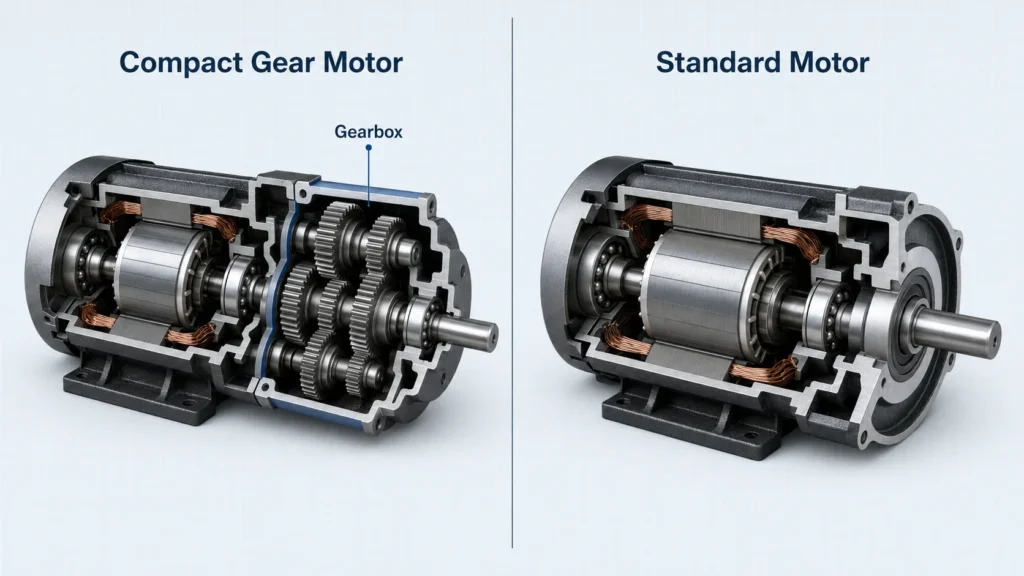
“Normal motor” is not a formal engineering classification. In this comparison, it means a standalone AC or DC electric motor whose shaft is not supplied with an integrated reduction gearbox. It may drive a fan or pump directly, or connect to the load through a belt, chain, coupling, pulley, or separately selected reducer.
A standard motor can be the better choice when the machine needs high speed, when a direct-drive load matches the motor’s torque-speed range, or when the designer wants to service the motor and transmission independently. The absence of internal reduction also avoids gearbox backlash and mechanical losses.
| Feature | Small gear motor | Standard motor without reduction |
|---|---|---|
| Construction | Motor and reduction gearbox form one drive assembly | Motor supplies rotation directly or through separate transmission parts |
| Output speed | Lower, determined largely by gear ratio | Usually close to the motor’s rated shaft speed |
| Output torque | Multiplied by the gearbox, minus efficiency losses | Limited to the motor’s direct shaft torque |
| Package | Compact integrated drive, but longer or wider than the motor alone | Smaller component by itself; external transmission may add space |
| Mechanical complexity | Factory-matched reduction can simplify installation | May need pulleys, belts, chains, couplings, or a separate reducer |
| Potential limitations | Gear friction, backlash, wear, and rated gearbox load limits | High direct speed and insufficient low-speed torque for many loads |
| Typical applications | Conveyors, feeders, doors, packaging equipment, compact automation | Fans, pumps, spindles, and machines with a separate transmission |
The gear motor gearbox creates the most important performance difference. If a motor turns at 1,500 rpm and the reducer has a 30:1 ratio, the theoretical output speed is approximately 50 rpm:
Output speed = motor speed ÷ reduction ratio
Torque rises as speed falls:
Estimated output torque = motor torque × ratio × gearbox efficiency
A gearbox does not create power. Friction, lubricant churning, bearings, seals, and gear contact consume some energy, so mechanical output power is lower than input power. Use the manufacturer’s rated output torque and allowable load instead of assuming ideal multiplication.
Higher ratios are also not automatically better. Excessive reduction can make the output too slow, add stages and losses, increase reflected inertia, or reach the reducer’s torque limit. The correct ratio produces the required speed while leaving adequate torque and service margin.
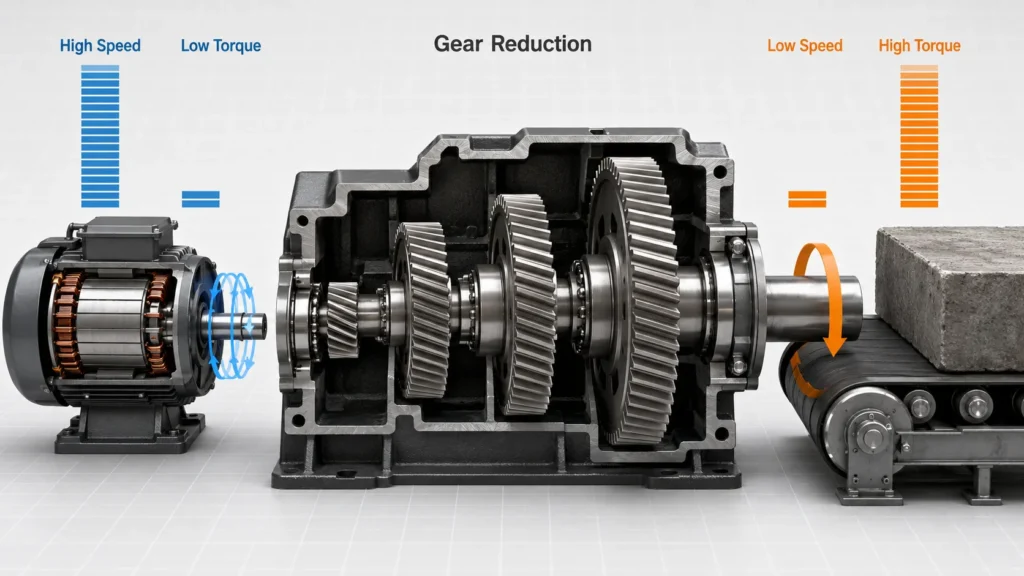
The word “small” can be misleading. A geared assembly is normally larger than its motor section alone because the reducer adds gears, bearings, lubricant, an output shaft, and a housing. Yet it can make the complete machine smaller by eliminating a separate transmission or a much larger direct-drive motor.
Integrated construction can simplify alignment and reduce the number of separately sourced components. The tradeoff is that the complete unit may need replacement if either section is not independently serviceable. A standalone motor with a separate reducer is usually more flexible to reconfigure, but it requires careful matching, coupling, guarding, and alignment.
A normal motor avoids gearbox losses, but system efficiency depends on how it transfers power to the load. Belts, chains, and external reducers also have losses. Compare the complete drive system at the intended operating point, not just the motor efficiency shown on a nameplate.
Gear tooth geometry affects sound and efficiency. Spur gears can be simple and economical; helical gears tend to engage more smoothly; worm gearing can provide compact right-angle reduction but may generate more heat because of sliding contact. Manufacturing accuracy, lubrication, load, housing stiffness, and installation all affect operating noise.
Backlash is the small amount of lost motion between mating gear teeth when direction reverses. It may be unimportant in a conveyor but critical in positioning equipment. Precision gearing can reduce backlash, usually at additional cost. Direct-drive motors avoid gear backlash, although the rest of the machine can still introduce compliance or play.
Compact AC geared units are common in fixed-speed industrial machines connected to mains power. Single-phase and three-phase options can suit different installations, while reversible or speed-control versions may be available. Voltage, frequency, phase, duty, and controller compatibility must be confirmed together.
A brushed DC design can provide straightforward voltage or PWM speed control and simple direction reversal. Brushes and the commutator wear with use, so service life and maintenance depend on load, speed, current, and operating conditions.
A brushless gear motor uses electronic commutation instead of mechanical brushes. This removes brush wear and can support efficient, precise control, but a compatible controller is part of the required drive system. The gearbox still has its own efficiency, lubrication, bearing, and wear limits; “brushless” describes the motor technology, not the gears.
A geared unit is usually the better starting point when the load needs relatively slow, strong, controlled motion and a direct motor would run too fast. Common examples include:
Within one AC series, power rating offers an initial comparison. A light mechanism may start with a 15W small AC gear reducer motor, while a modest conveyor may call for a 40W model. Heavier requirements can be compared with a 90W model or a 160W model. Final selection must use output torque and speed, not wattage alone.
A motor without integrated reduction may be preferable when the load naturally operates near motor speed, as with many fans, pumps, blowers, and spindles. It can also suit equipment that already has a belt, chain, or gearbox designed into the machine.
Direct drive can reduce mechanical complexity, noise, and backlash. A separately mounted motor may also be easier to replace from local stock. However, using an oversized motor merely to obtain more low-speed torque can increase size, current demand, and cost. Compare complete systems before deciding.
Tenchuan’s broader Products page can help identify available layouts, while About Tenchuan provides company and manufacturing context for supplier evaluation.
Choose a compact geared drive when your machine needs low speed and useful torque in an integrated package. Choose a standalone motor when the load operates near motor speed or the machine already includes a suitable transmission. Start with the required output—not the motor label—and verify the complete system under real load. Visit the Tenchuan home page for an overview or contact Tenchuan with your operating requirements for model and ratio guidance.
Not necessarily. Reduction trades speed for torque but does not create power. Compare rated mechanical output power, torque, speed, and efficiency.
Yes, if the motor and reducer are correctly matched for speed, torque, shaft interface, mounting, duty, and load. Coupling alignment and adapter design are also important.
A reduction gearbox makes its output slower than the motor input. Available ratios vary, so actual output speed must be checked in the product data.
A gearbox is the mechanical transmission. A Small Gear Motor combines an electric motor and gearbox into a drive assembly.
Only if its rating permits continuous duty under the actual torque, speed, temperature, mounting, and ventilation conditions. Some reversible models have limited duty ratings.
Provide output rpm, continuous and peak torque, voltage, frequency, phase, duty cycle, mounting, shaft loads, environment, control needs, available space, and quantity.