Why Electric Motor Should Use Speed Reducer (Gearbox)?
Published: Author: Tenchuan
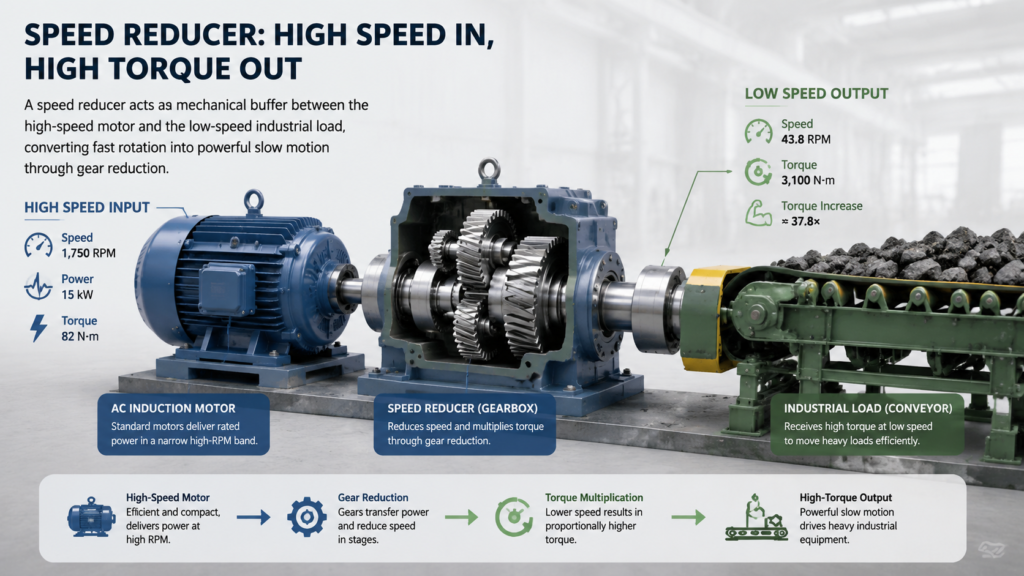
Electric motors are designed to run efficiently at high speeds — typically 1,200 to 3,600 RPM for AC induction motors. Industrial equipment, however, rarely needs that speed. Conveyors run at 30 to 80 RPM. Mixers operate at 20 to 200 RPM. Gate drives and lifts move even slower. The result is a fundamental mismatch: a motor that spins too fast with too little torque for the job at hand. A speed reducer (gearbox) bridges this gap. It converts high-speed, low-force rotation into low-speed, high-force output — making the motor usable for real industrial work.
The Core Problem: Speed-Torque Mismatch in Electric Motors
Standard AC induction motors produce their rated power within a narrow, high-RPM band. At 1,750 RPM, a typical 200W motor delivers around 1.1 Nm of torque. That is enough to spin a fan blade but nowhere near enough to move a loaded conveyor or drive a mixing paddle through viscous material.
The issue is physical. Motor torque output depends on magnetic field strength and rotor construction — both of which are fixed by design. You cannot simply tell a motor to “slow down and push harder” without external help. Running a motor well below its rated speed causes:
Torque drop-off — the motor cannot sustain peak torque at low RPM
Overheating — reduced cooling fan speed leads to thermal buildup and winding damage
Current spikes — the motor draws excessive current trying to overcome the load from a standstill
Stalling risk — without enough low-speed torque, the motor simply stops under load
This is why a speed reducer is not an optional accessory — it is the component that makes the motor work in real-world conditions.
Why Direct-Drive Is Rarely the Right Choice
Connecting a motor shaft directly to equipment — known as direct-drive — seems simpler at first glance. Fewer parts, no gearbox to maintain. In practice, it creates more problems than it solves for most industrial applications.
When Direct-Drive Works
Direct-drive is suitable for a narrow set of conditions: high-speed fans, centrifugal pumps, blowers, and certain compressors where the load naturally runs at 1,000 RPM or above. In these cases, a gearbox adds unnecessary cost and complexity.
When Direct-Drive Fails
For the vast majority of industrial equipment — conveyors, hoists, mixers, screw feeders, rotary tables, packaging machines — direct-drive is impractical. The motor would need to be massively oversized to deliver adequate torque at low speed. A motor sized for direct-drive at 50 RPM might need to be 25 times larger than one paired with a 25:1 gearbox. That means:
Higher upfront motor cost
Larger physical footprint that may not fit the machine enclosure
Higher energy consumption running a large motor at partial load
Poor speed regulation under varying load conditions
Scenario
Direct-Drive Motor
Motor + Speed Reducer
Conveyor at 70 RPM under 50 Nm load
Requires large, expensive motor rated for low-speed torque
Compact 200W motor + 25:1 gearbox delivers the same torque in a fraction of the space
Mixer starting under heavy material load
High startup current, risk of stalling or overheating
Gearbox handles startup inertia; motor stays within safe current range
Packaging machine with frequent starts and stops
Poor acceleration control, mechanical shock transferred to motor
Reducer provides smooth speed ramp and protects motor from reflected load shock
High-speed centrifugal pump at 1,750 RPM
Ideal — no reduction needed
Unnecessary — adds cost without benefit
How a Speed Reducer Multiplies Torque
Inside a gearbox, a small input gear meshes with a larger output gear. When the motor turns the input shaft, the difference in gear sizes determines how much the speed drops and how much the torque rises. This is known as the reduction ratio.
Reduction Ratio = Motor Input RPM ÷ Desired Output RPM
Output Torque ≈ Motor Torque × Reduction Ratio (minus minor efficiency losses)
For example, a 1,750 RPM motor paired with a 25:1 reducer produces approximately 70 RPM at the output shaft — and roughly 25 times the original torque. That 200W motor that delivered 1.1 Nm at its shaft now delivers around 27 Nm at the equipment. This is the single most important reason electric motors use gearboxes: torque multiplication through mechanical advantage.
Different gear reducer types achieve this with different efficiency levels. Helical gear stages typically deliver 95%+ efficiency per stage, while worm gear units operate between 50% and 80%. Planetary reducers offer the highest torque density in the smallest package. The right choice depends on your application’s speed, load, and space requirements.
Motor Protection Through Inertia Matching
Beyond torque multiplication, a speed reducer protects the motor itself. Heavy industrial loads carry significant rotational inertia — they resist starting and, once moving, resist stopping. When a motor couples directly to a high-inertia load, that inertia reflects back through the shaft.
The result is a series of destructive conditions:
Startup current surges that can trip circuit breakers and overheat windings
Prolonged acceleration during which the motor operates outside its efficient range
Mechanical shock from sudden load changes transmitted directly to the motor shaft and bearings
Premature winding failure from repeated high-stress starts and stops
A speed reducer acts as a mechanical buffer. The gearbox sits between the motor and the load, absorbing inertia fluctuations so the motor can accelerate quickly to its efficient operating speed — no matter how massive the driven equipment is. This technique, called inertia matching, extends motor life substantially in applications with frequent cycling, such as indexing conveyors, automated gates, and pick-and-place systems.
Space and Cost Efficiency: Smaller Motor, Bigger Output
One of the most overlooked benefits of adding a speed reducer is the space and cost savings at the system level. Consider a machine that needs 50 Nm of torque at 60 RPM:
A direct-drive motor sized for that output would be physically large, heavy, and expensive — potentially several horsepower and weighing over 50 kg.
A 120W small AC gear reducer motor with a 30:1 ratio delivers comparable torque in a unit weighing under 10 kg, fitting into tightly packed machine enclosures.
This size and cost advantage compounds across multi-axis machinery. In automated packaging lines, robotic systems, and OEM equipment where every kilogram and cubic centimeter matters, the motor-plus-gearbox configuration is the standard solution for good reason.
Precise Speed Control for Process Quality
Modern manufacturing depends on precise, repeatable motion. In food processing, an inconsistent conveyor speed causes uneven cooking times, filling errors, and packaging misalignment. In printing, speed variation distorts registration. In automated assembly, it disrupts cycle timing.
A speed reducer provides a stable, predictable output speed that matches the equipment’s design point. When paired with a variable frequency drive (VFD), the combination offers adjustable speed control across a useful range while maintaining high torque — something a direct-drive motor cannot achieve at low RPM.
A balanced understanding helps you avoid over-engineering. A speed reducer is not needed when:
The equipment naturally operates at or near the motor’s rated RPM — such as centrifugal pumps, high-speed fans, and blowers.
The load is light enough that a small direct-drive motor with a VFD can cover the required speed range without stalling.
The application demands ultra-high precision positioning better served by a direct-drive torque motor or linear motor — common in semiconductor manufacturing and precision metrology.
Budget constraints favor a simpler, lower-efficiency direct-drive system for a non-critical, intermittent-duty task.
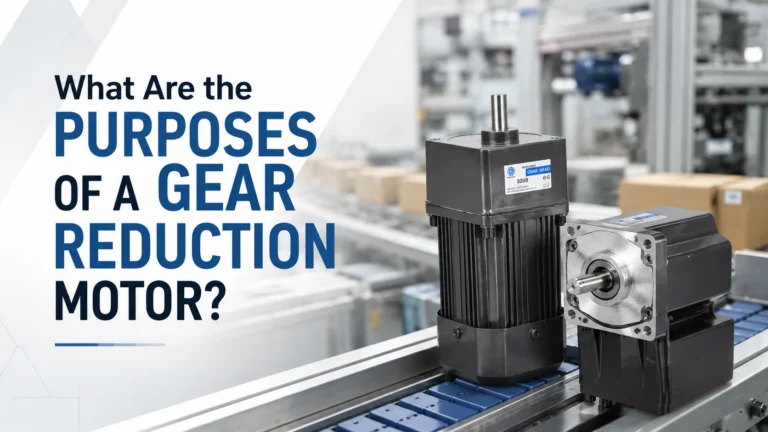
For all other cases — and that covers the vast majority of industrial drive applications — pairing a motor with a properly sized speed reducer is the practical, cost-effective, and reliable solution. For an overview of the complete benefits a combined unit delivers, read our article on the purposes of a gear reduction motor.
Frequently Asked Questions
Why can’t I just use a bigger motor instead of a speed reducer?
A larger motor does produce more torque at its rated speed, but the torque still drops off sharply as RPM decreases. To deliver adequate torque at 50 RPM without a gearbox, the motor would need to be massively oversized and would run inefficiently at partial load for most of its life. A smaller motor with a gearbox is almost always more cost-effective, energy-efficient, and space-friendly.
What is the difference between a speed reducer and a gearbox?
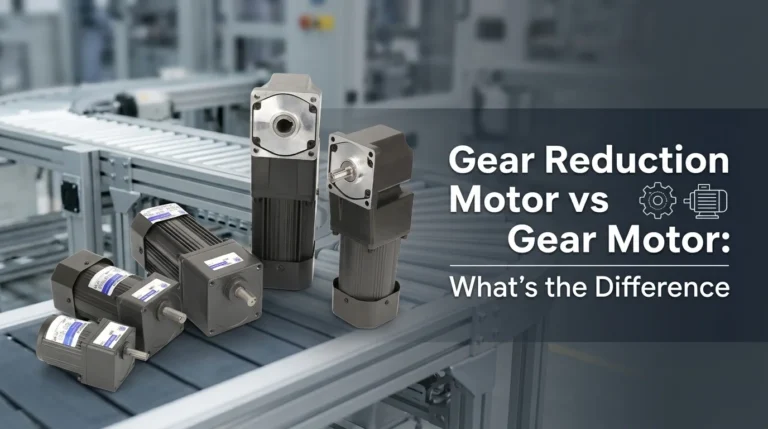
These terms are often used interchangeably in industrial contexts. Technically, a speed reducer is a type of gearbox specifically designed to reduce speed while increasing torque. All speed reducers are gearboxes, but not all gearboxes are speed reducers — some gearboxes are designed for speed increase or direction change without reduction. For a detailed comparison of related terms, see our guide on gear reduction motor vs gear motor differences.
Does a speed reducer waste energy?
Every gear stage introduces a small efficiency loss — typically 2% to 5% per stage for helical gears. However, the overall system efficiency often improves because the motor runs at its optimal high-efficiency RPM rather than struggling at low speed. The energy saved by right-sizing the motor typically outweighs the small gearbox losses.
How do I choose the right reduction ratio?
Divide your motor’s rated RPM by your equipment’s target output RPM. For example, 1,750 RPM ÷ 70 RPM = 25:1 ratio. Then verify that the motor’s torque multiplied by the ratio (minus efficiency losses) meets your load requirement with an appropriate service factor. For heavy-duty or continuous applications, apply an AGMA service factor of 1.25 or higher.
Can I use a VFD instead of a speed reducer?
A VFD can adjust motor speed, but it cannot multiply torque. Running a motor at very low frequency (below 20-30 Hz) causes significant torque loss and overheating risk. For applications requiring low-speed, high-torque output, a VFD works best when paired with a speed reducer — the reducer handles the bulk of the speed reduction and torque multiplication, while the VFD provides fine adjustment around that operating point.
What types of gear reducers are available?
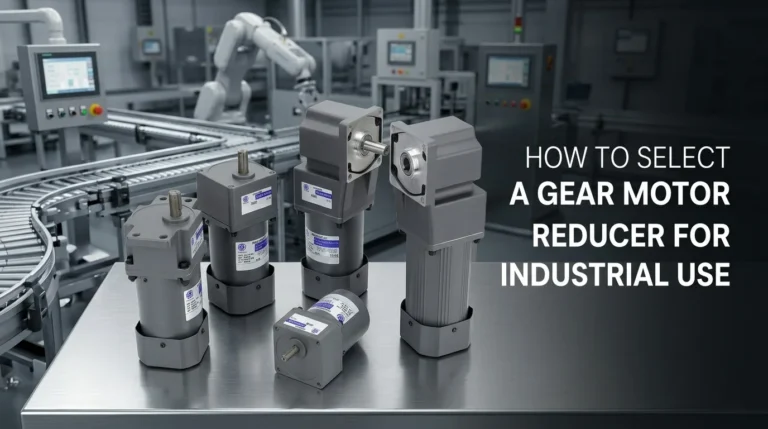
The main types include helical (parallel shaft, high efficiency), worm (right-angle, self-locking), planetary (coaxial, highest torque density), and bevel (right-angle, high efficiency). Each type suits different space, load, and cost requirements. For a complete breakdown of types, working principles, and selection factors, see our gear reducer types guide.
What Is a Gear Reduction Motor? A gear reduction motor combines an electric motor with a gearbox that reduces output speed while multiplying torque. Rather than sending high-speed, low-force rotation directly to a load, the integrated gear train converts that energy into slower, stronger motion. This fundamental principle makes gear reduction motors indispensable across manufacturing, […]