Parallel-Shaft vs Right-Angle Gear Motor: Which Fits Your Machine
Right-angle vs inline gear motor compared with real allowable load tables: efficiency, torque, the self-locking myth and how to decide in five steps.
Read More
If you are selecting or replacing a gear reduction motor, the gear ratio is usually the first specification you need to pin down. It decides how fast the output shaft turns, how much torque the machine gets, and whether the drive matches your application at all. The good news is that the calculation is simple: count the teeth on two gears, or compare the motor speed with the output speed you need. In this guide, you will learn the gear ratio formula for a gear reduction motor, how to work through the math, how multi-stage gearboxes multiply ratios, and how to avoid the mistakes that commonly lead to the wrong motor.
A gear reduction motor is an electric motor combined with a gearbox that lowers the output speed and increases the output torque. The gear ratio is the number that describes how many revolutions the motor (the input) makes for every single revolution of the output shaft. A 10:1 ratio means the motor turns ten times while the output shaft turns once.
In short, the gear ratio of a gear reduction motor is calculated by dividing the number of teeth on the driven gear by the number of teeth on the driving gear. When tooth counts are not available, you can use the same result by dividing the motor input speed by the required output speed.
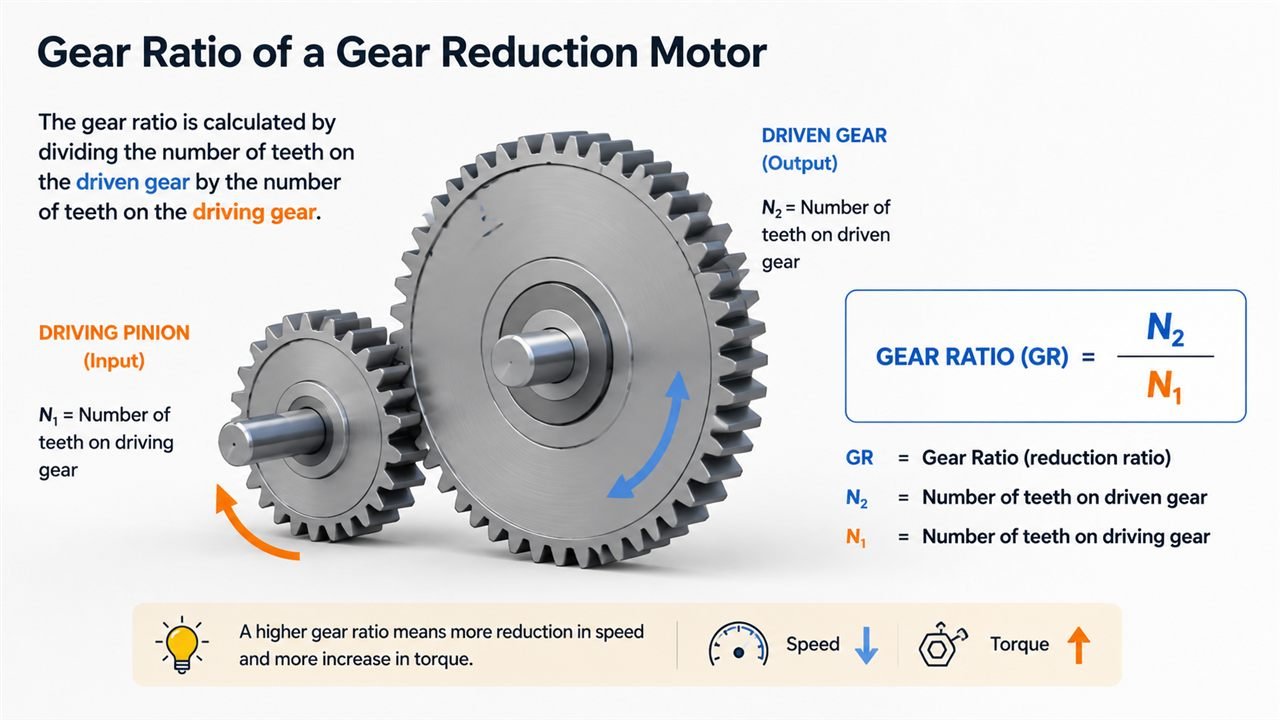
The most direct way to calculate the gear ratio is to count the teeth on the two gears that mesh together. The formula is:
Gear ratio = Number of teeth on the driven gear ÷ Number of teeth on the driving gearBefore you divide, be clear about which gear is which:
Because a reduction motor is meant to slow the speed, the driven gear normally has more teeth than the driving gear, so the ratio comes out greater than 1:1. Ratios greater than 1:1 describe reduction; ratios below 1:1 would describe overdrive, which is rare in gear motors.
Worked example. Suppose a 13-tooth pinion on the motor shaft drives a 65-tooth gear on the output shaft. The gear ratio is:
65 ÷ 13 = 5The reduction is 5:1. The motor turns five times for every single turn of the output shaft, so a 1,500 rpm motor produces about 300 rpm at the output.
You can also use pitch diameters instead of tooth counts when the gears use the same module or pitch. Since tooth count is proportional to pitch diameter in standard gears, the ratio is the same either way. Counting teeth is still the most reliable method in practice.
Sometimes you cannot open the gearbox to count teeth, or you already know the speeds you are working with. In that case, calculate the ratio from the input and output speeds:
Gear ratio = Motor input speed (rpm) ÷ Required output speed (rpm)Worked example. Your motor runs at 1,500 rpm and the conveyor needs to move at 300 rpm. The required ratio is:
1,500 ÷ 300 = 5The application needs a 5:1 reduction. You can then check whether a standard gear reduction motor offers a close ratio, keeping in mind that output speed under load is slightly lower than the theoretical value.
This speed method is useful because it starts from the two numbers you actually know: the rated motor speed and the machine speed you want. Most gear motor datasheets list the rated motor speed and the output speed for each ratio, so you can quickly confirm that the speed ratio matches the nameplate ratio.
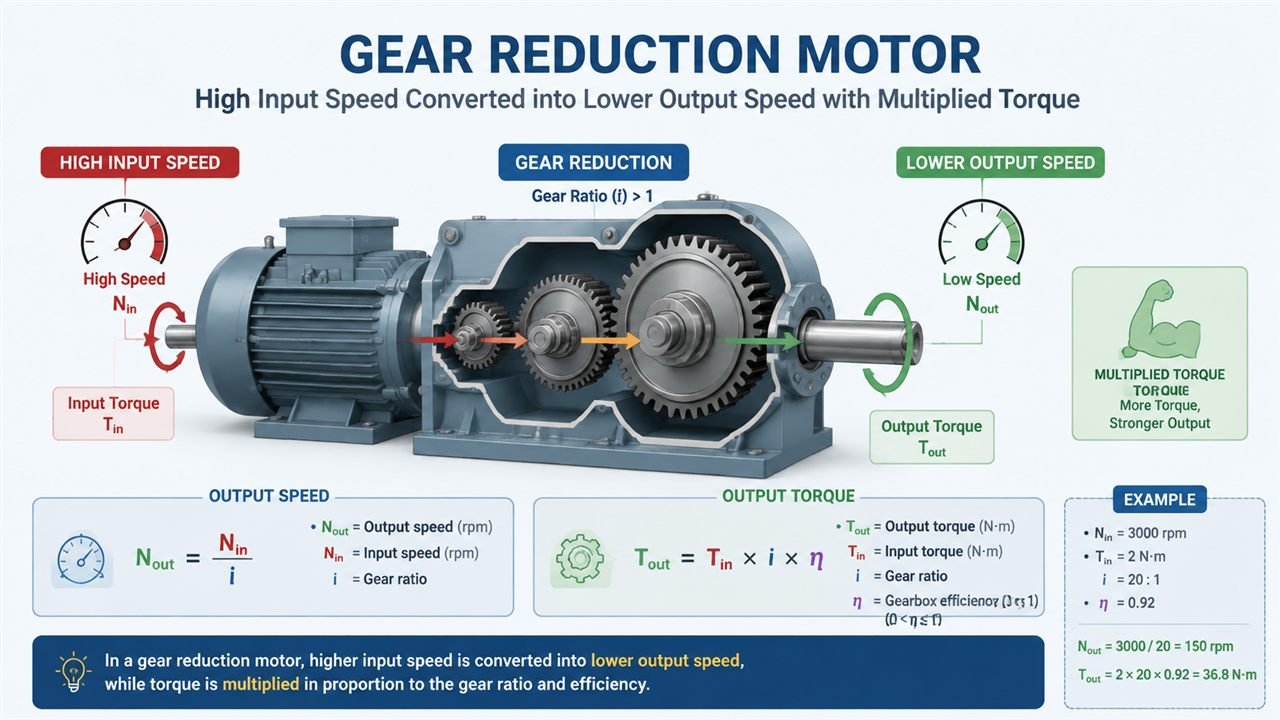
The gear ratio is not only about speed. It also multiplies torque in the opposite direction. Two simple rules describe the effect:
So a higher ratio gives a slower, stronger output, while a lower ratio gives a faster, weaker output for the same motor. This is why you should not choose a ratio only to hit a speed target; you also need to confirm that the resulting torque clears the load requirement.
Efficiency matters in the torque calculation. A real gearbox is never 100% efficient because of friction, backlash, and heat. Most small spur and helical gearboxes run between 90% and 98%, while worm and right-angle stages are lower, often 50% to 85% depending on ratio and lubrication. When in doubt, apply a conservative efficiency value and then verify with the motor supplier. To see how the motor and gearbox convert electrical input into lower-speed, higher-torque output, read how a gear reducer motor works.
| Gear ratio | Output speed at 1,500 rpm input | Torque multiplier (at 95% efficiency) |
|---|---|---|
| 5:1 | 300 rpm | × 4.75 |
| 10:1 | 150 rpm | × 9.5 |
| 20:1 | 75 rpm | × 19 |
| 50:1 | 30 rpm | × 47.5 |
The torque figures above are simplified multipliers, not guaranteed values for every motor. Always confirm the rated output torque of the specific gear reduction motor against your load, including startup and peak loads.
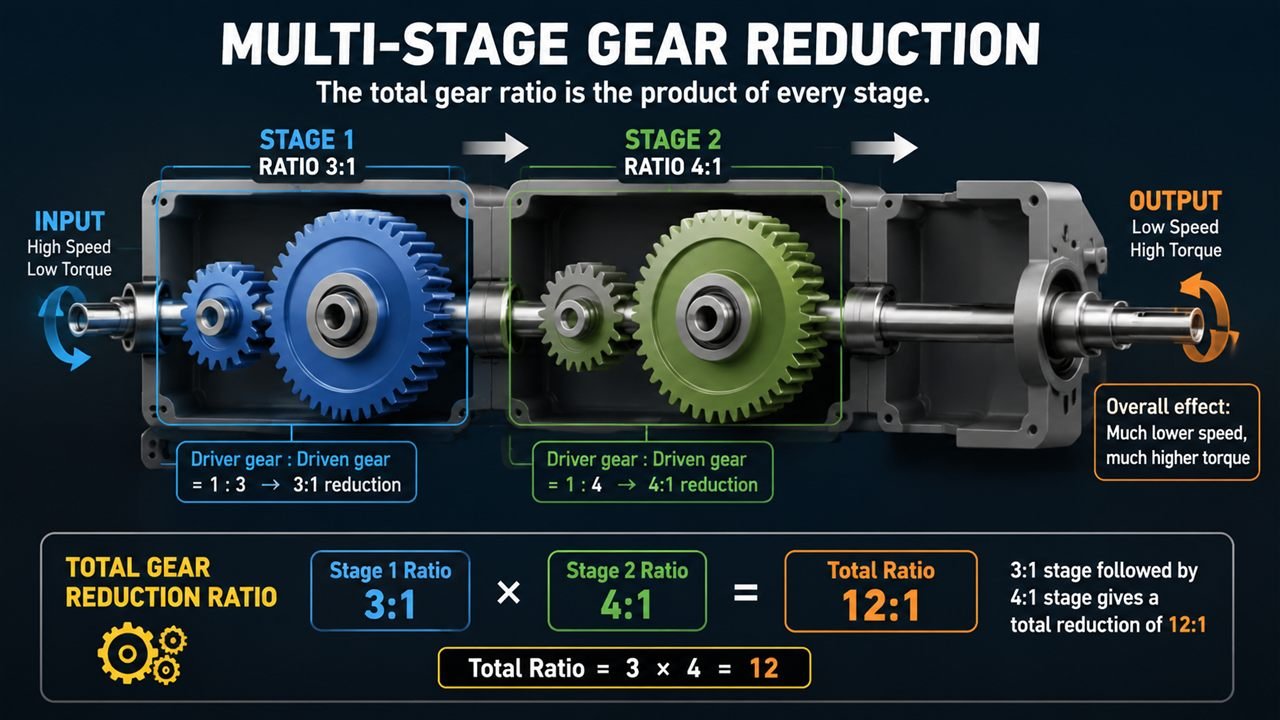
Many gear reduction motors use more than one set of gears to reach a high ratio in a compact housing. In a multi-stage gearbox, each meshed pair is one stage, and the total gear ratio is the product of every stage:
Total ratio = ratio of stage 1 × ratio of stage 2 × ratio of stage 3 ...Worked example. A two-stage gearbox has a first stage of 3:1 and a second stage of 4:1. The total ratio is:
3 × 4 = 12The overall reduction is 12:1, so a 1,440 rpm motor delivers roughly 120 rpm at the output. Multi-stage design is how compact gearboxes reach ratios of 50:1, 100:1, or higher without an impractically large gear. Right-angle gear reduction motors often combine a spur or helical stage with a worm or bevel stage, and the same multiplication rule applies.
To bring the calculation together, here is a complete selection example.
This four-step routine is the same one used when sizing most small gear reduction motors: decide the ratio from speed, then verify torque, then match a standard product. For a deeper walkthrough of the other selection factors, read how to choose a small gear reducer motor.
Gear ratio math is straightforward, but a few errors come up again and again:
If you are not sure how the gearbox is arranged or how many stages it has, it is safer to confirm the reduction with the manufacturer than to guess from a photo or model number.
A 5:1 gear ratio means the motor or input gear turns five times for every single turn of the output. It reduces speed to one-fifth and, in ideal conditions, multiplies torque by five before efficiency losses.
Yes, up to the limit of the gearbox and motor. A higher ratio gives a slower output with a higher theoretical torque multiplier. The usable torque still depends on gearbox efficiency and the motor’s rated torque.
They describe the same relationship. In a reduction drive the gear ratio is greater than 1:1, so it is often called the reduction ratio. In a gear reduction motor, the two terms are used interchangeably.
Multiply the ratio of each stage together. For example, a 3:1 stage followed by a 4:1 stage gives a total ratio of 12:1.
Small AC gear reducer motors are commonly offered in standard ratios such as 3:1, 5:1, 10:1, 15:1, 20:1, 30:1, 50:1, 100:1, and higher, depending on the motor family and the number of gear stages. Confirm the exact ratio list with the product datasheet.
The ratio calculation uses the rated motor speed. Under load, the motor speed drops slightly, so the measured output speed is a little below the theoretical value. This is expected and is usually accounted for in the application.
The gear ratio of a gear reduction motor comes down to one division: driven gear teeth divided by driving gear teeth, or input speed divided by output speed. For multi-stage gearboxes, multiply the stage ratios, and always remember that the real output torque is the ideal torque reduced by the gearbox efficiency.
Once you know the ratio you need, the next step is matching it to a motor with enough torque for your load. Browse the small AC gear reducer motors or the full product range to see the available ratios and output speeds, or contact the Tenchuan team with your speed and torque figures to get a recommendation for your application.