SEW Gear Motor Alternatives for 0.2-3.7 kW Compact Drives
Which SEW families the 0.2-3.7 kW band maps onto, the four dimensions that decide drop-in, and the efficiency rule that sinks otherwise sound substitutions.
Read More
A hot gear motor is a symptom, not a diagnosis. The same 70 °C housing can mean a correctly loaded motor in a warm room, a motor being asked to deliver 40% more torque than it was rated for, or a fan cowl packed solid with cardboard dust. Replacing the motor before you know which one it is means you buy the same failure twice.
This guide covers compact AC gear reducer motors from 15 W to 300 W: the six causes that account for almost every overheating complaint we see, the temperature numbers that actually define “too hot”, a ten-minute diagnostic sequence you can run without instruments beyond a clamp meter, and the fixes in order of cost.
This single step eliminates half the guesswork. An AC gearmotor has two heat sources that fail for completely different reasons, and they are separated by a few centimetres of casting.
| Where it is hot | What it points to | First check |
|---|---|---|
| Motor body and end shields, hottest near the centre of the barrel | Winding heat — electrical or overload | Current per phase against the nameplate |
| Gearbox housing, motor body comparatively cool | Gear friction, lubricant, over-tight preload, or a bearing | No-load current and coast-down feel |
| Bearing housing, localised hot spot at one end | Bearing damage, misalignment, or excessive belt or chain tension | Listen, and check belt tension and alignment |
| Evenly warm across the whole assembly | Normal for the duty — check against ambient and the rating | Ambient temperature and duty cycle |
If the gearbox is hot and the motor is not, the problem is downstream of the motor. Everything in the electrical section below is irrelevant to that fault, and this is the most common wasted afternoon in gear motor troubleshooting.
“Too hot to touch” is not a specification. These are the numbers that are:
| Number | Value | What it means |
|---|---|---|
| Insulation class B, maximum winding temperature | 130 °C | Hot-spot limit for the winding. Sustained operation above it degrades insulation |
| Insulation class F, maximum winding temperature | 155 °C | A higher class, common on larger frames |
| Permissible temperature rise, resistance method | 80 K | Winding rise above ambient at rated load — the figure quoted on a typical small gearmotor datasheet |
| Rated ambient temperature | 40 °C | Standard rating basis for a totally enclosed fan-cooled motor |
| Typical thermal protector trip | ~130 °C open, ~85 °C close | Automatic-reset protectors on reversible motors; not fitted to every model |
Read those together. A motor at 40 °C ambient with an 80 K rise reaches a 120 °C winding at rated load, which leaves 10 K of margin to the class B limit. That is the entire margin. Now put that motor in a sealed cabinet at 55 °C ambient, and the same load puts the winding past 130 °C. Nothing about the motor changed. The installation did.
There is no reliable conversion from “how hot the case feels” to winding temperature, because the thermal path varies with frame, mounting and airflow. What you can say is this: if the housing is uncomfortable to hold for more than a second or two — roughly above 60 °C — the winding is close enough to its limit that the current and duty should be checked rather than assumed. The customer support size chart gives the frame-by-frame ratings you need to compare against.
This is the most common cause we see, and it is almost always a specification misunderstanding rather than a fault.
Reversible (RK) motors in this class carry a 30-minute rated duty. That rating is not a suggestion about how you should use the motor; it is a thermal limit. The motor can deliver its rated torque for 30 minutes, after which the winding reaches its permissible temperature and the motor must cool. The 30-minute figure exists because these motors are designed for applications that reverse frequently — doors, gates, dispensers, indexing mechanisms — where the actual running time is short.
Put that motor on a conveyor that runs eight hours without stopping and you have a motor designed for 30 minutes of thermal load, asked for 480 minutes of it. It will reach its temperature limit in the first half hour and keep climbing. Nothing is broken. The rating was simply not read.
How to tell: the motor runs hot within 30–40 minutes of a cold start and then holds at an uncomfortably high temperature, current is at or below nameplate, ambient is normal, the fan is clean, and the load feels normal. That combination is a duty problem, not an overload.
Fix: for continuous duty, specify the continuous-rated version of the same frame. The reversible vs continuous duty guide explains exactly what the 30-minute rating limits physically, including why the case temperature rule exists and why reversing needs a dwell time.
Genuine overload looks different from a duty problem: current is above nameplate, the motor heats progressively, and output speed sags under load.
The trap is that overload is often introduced by a well-intentioned change in ratio. Someone increases the reduction to slow the machine down, expecting lower speed at higher torque, and the machine now stalls or trips under the same product load. Two things combine:
The allowable load figure is a ceiling, and on most of these frames it plateaus. On the 25 W 80 mm frame it reaches 7.84 N·m (80 kg·cm) at high ratios and stays there. On the 90 mm frame it plateaus at 19.6 N·m (200 kg·cm). Adding ratio past the plateau gives you a slower shaft and a hotter gearbox, not more usable torque.
Fix: measure current at the actual production load and compare with the nameplate. If it is above the rating, the motor is undersized for the duty — go up a frame. The torque calculation guide shows the conversion from load to required output torque, including the starting factor.
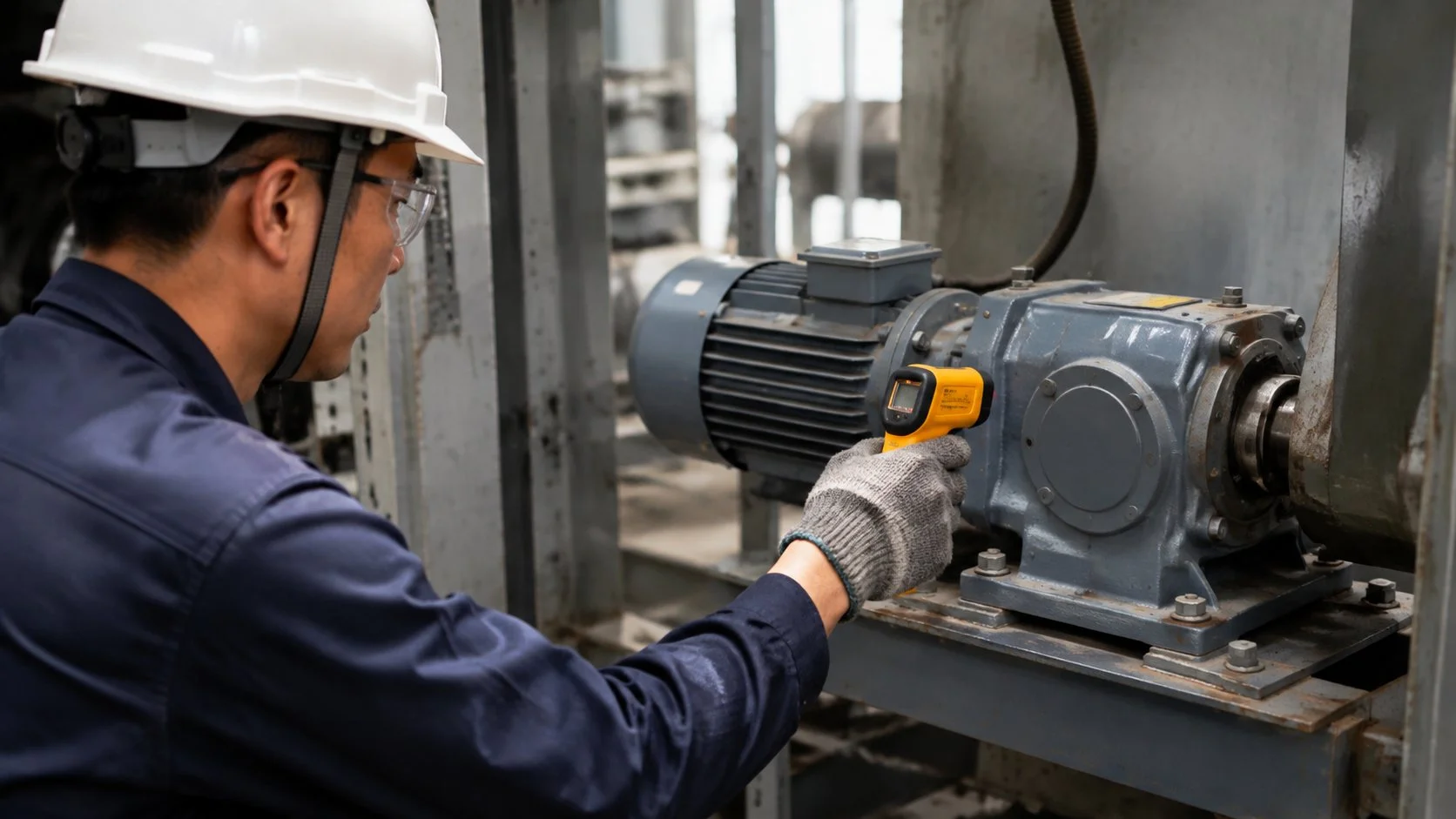
Every rating on the datasheet assumes 40 °C ambient and installation below 1,000 m altitude. Both assumptions are frequently wrong in practice.
Ambient. The motor is cooled by air at ambient temperature. If the air around it is hotter than 40 °C, the motor cannot reject the same amount of heat at the same load. Three common ways this happens without anyone noticing:
Above 40 °C, the continuous capability reduces. The size of the reduction is published as an ambient derating curve — ask the supplier for it rather than extrapolating from a rule of thumb, because the curve depends on the frame and the insulation class.
Altitude. Above roughly 1,000 m, lower air density reduces cooling. The effect is small at 1,200 m and significant at 3,000 m. If the machine ships to a highland site, state the altitude at enquiry stage.
Fix: measure the actual air temperature at the motor, not in the room. If it exceeds 40 °C, either reduce the load, improve the airflow, or specify a larger frame with thermal headroom.
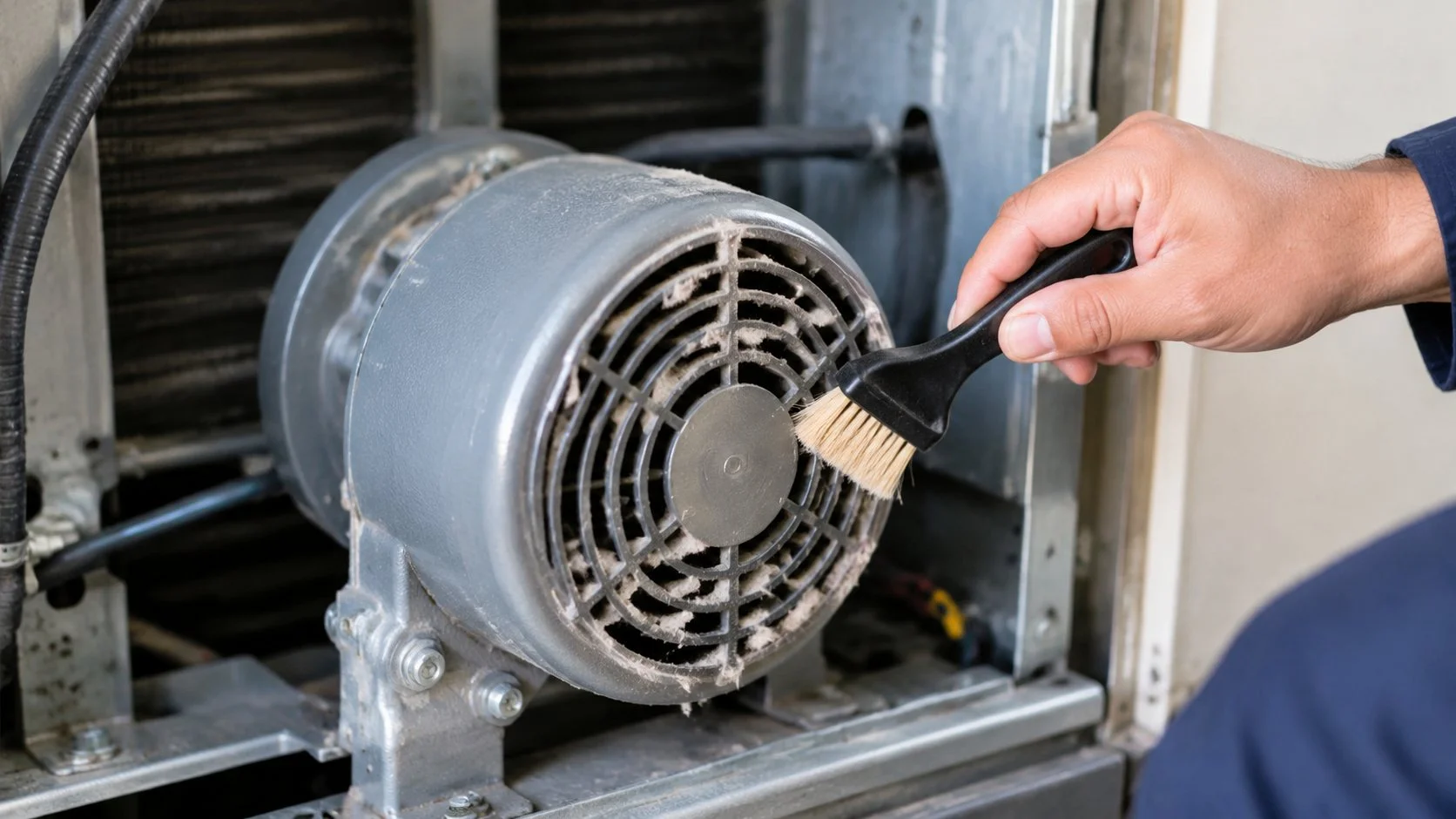
A totally enclosed fan-cooled motor relies on a shaft-mounted fan blowing air along fins under a cowl. Four things block that path, and all four are common:
Fix: clean the cowl and fins on a schedule matched to the dust load, not to a generic interval. In a textile plant that can mean monthly. The parts identification guide shows the cowl and fan arrangement so a maintenance technician knows what they are looking at.
Five supply conditions produce excess heat with no mechanical fault at all.
| Condition | What happens | How to confirm |
|---|---|---|
| Low supply voltage | For the same load, current rises to deliver the same power — more I²R loss in the winding | Measure voltage at the motor terminals under load, not at the panel |
| High supply voltage | Core saturation, rising magnetising current, excess heat even at no load | Measure at the terminals; compare with the nameplate band |
| Phase loss or severe imbalance on three-phase | Remaining phases carry much higher current and the winding can fail within minutes | Measure all three phases; check for a blown fuse or a loose terminal |
| Wrong or failing capacitor on single-phase | Poor starting torque, high running current, hot winding. A bulging or leaking capacitor is a direct cause | Compare the capacitor value and voltage rating with the specification; substitute a known-good one |
| 60 Hz motor on a 50 Hz supply | Speed drops about 17% and the shaft-mounted fan cools less, while the load torque demand is unchanged | Check the nameplate frequency against the supply |
The capacitor point deserves emphasis because it is the one that gets missed. A single-phase motor’s run capacitor is matched to its winding and voltage: a 220 V unit and a 110 V unit take very different capacitance values. A wrong-value capacitor, or one that has drifted with age, causes exactly the symptoms people describe as “the motor is overheating” — hot winding, poor starting, normal mechanical load. Check it before condemning the motor.
The frequency point connects back to the sizing question. A motor specified from a 60 Hz datasheet and installed on a 50 Hz supply runs slower and cooler at the fan, while the machine still asks for the same torque. That combination is a slow thermal overload. The single-phase vs three-phase and 50/60 Hz guide covers the selection implications, and the three-phase wiring guide covers connection and protection.
If the electrical side checks out and the motor still overheats, the load is heavier than it should be. Five sources:
Fix: uncouple the motor from the driven machine and run it free. If it runs cool unloaded and heats up when coupled, the fault is downstream. That single test decides whether you are buying a motor or fixing a machine.
One more case that belongs here: a motor run from a variable frequency drive at low speed for long periods. The shaft-mounted fan moves much less air at low rpm, so cooling falls while the torque demand does not. If the application needs sustained low-speed operation at high torque, that is a cooling design problem, and a standard TEFC motor is the wrong starting point. The speed control guide covers the torque loss and thermal implications.
Steps 3, 4 and 8 catch the overwhelming majority of real faults. Everything before them is preparation, and everything after is confirmation.
| Symptom | Most likely cause | Fix | Cost |
|---|---|---|---|
| Hot after 30–40 min, normal current, clean fan | Reversible 30-minute rating in continuous duty | Change to the continuous-rated version | New motor |
| Current above nameplate, speed sags under load | Genuine overload | Go up a frame; recheck the allowable load | New motor |
| Hot only in summer, or only in the afternoon | Ambient above 40 °C | Improve airflow or derate | Low |
| Hot in a sealed cabinet | Cabinet temperature is the ambient | Ventilate the cabinet or relocate the drive | Low |
| Cowl packed with dust or lint | Blocked cooling | Clean, then set a maintenance interval | Low |
| Hot, poor starting, normal mechanical load | Wrong or failing capacitor | Replace with the specified value | Very low |
| One phase current much higher | Phase loss or imbalance | Check supply, fuses, terminals | Low |
| Gearbox hot, motor cool | Gear friction, lubricant, or bearing | Inspect gearbox; do not change the motor | Variable |
| Hot only when coupled | Mechanical drag downstream | Fix belt tension, alignment, bearing or brake | Variable |
Replace rather than investigate further when the winding has already discoloured or smells — insulation damage is not reversible. Replace when the bearing housing is worn or the shaft is scored, because at this frame size the repair cost approaches the replacement cost. Replace when current is correct, ambient is correct, the fan is clean and the motor still overheats: that points to an internal winding fault.
Do not bypass a thermal protector to stop nuisance tripping. Automatic-reset protectors mask the problem by cycling. A motor that trips regularly has a fault that needs finding, and the protector is reporting it correctly.
At 40 °C ambient and rated load, a typical small gearmotor with class B insulation runs a winding temperature rise of up to 80 K, which puts the winding near 120 °C. The housing will feel very hot to the touch at that point and that is normal. What is not normal is a motor that keeps getting hotter after the first hour, or one that is noticeably hotter than identical units on the same line.
Because it is almost certainly a reversible motor with a 30-minute rated duty being run continuously. The thermal limit is reached in the first half hour and then exceeded. Check the model code — an RK designation indicates the reversible 30-minute rating, while a continuous-duty version is a different specification.
Sometimes, but not reliably. A shaft-mounted fan cools less at lower speed, so running slower reduces the cooling as well as the load. If the overheating is caused by overload, reducing speed without reducing load torque does not help. Establish the cause first.
No, and this is the most common misdiagnosis. Gearbox heat comes from gear friction, lubricant condition and bearing preload. A gearbox can be hot while the motor winding is well within its limit. Check where the heat actually is before replacing anything.
The run capacitor is the first suspect. A wrong-value or degraded capacitor produces poor starting torque and elevated running current with a perfectly normal mechanical load. Compare the fitted value and voltage rating with the specification before looking further.
In dusty environments, frequently yes. On textile and woodworking machinery a blocked cowl is the single most common cause of overheating, and cleaning it restores the original thermal margin at no parts cost. The lesson is the maintenance interval, not the cleaning.
If you have a motor that runs hot and the electrical and cooling checks are clean, send the nameplate details, the measured current per phase, the ambient temperature and the duty cycle. We will tell you whether it is a rating problem, a sizing problem, or a machine problem — and if the honest answer is that the frame is wrong for the duty, we will say so.